In Switzerland, legal CBD oils do exist — but under very strict conditions: they must never be ingested. According to cannabidiol legislation in Switzerland, such oils are only permitted when classified as CBD cosmetics for topical use or CBD chemical products for technical use, and only if their THC content remains below the THC limit of 1% set by Swiss law.
This CBD oil regulation is particularly strict when it comes to ingestion. Unlike the United States, where certain CBD products may be sold as food supplements, in Europe — and especially in Switzerland — CBD is subject to the European “Novel Food” regulation. This status, established by the European Food Safety Authority (EFSA), requires a full safety evaluation and pre-market authorization, which no CBD oil has received to date in the European area.
So, if you’re planning to buy CBD oil in Switzerland legally, it’s essential to understand its legal classification, check the labeling carefully, and ensure that all product compliance conditions are met. This guide will help you navigate the complex legal CBD oil Switzerland framework so you can make informed, safe choices.
⚠️ Disclaimer: CBD-based products are not medicines and are not intended to diagnose, treat, or cure any disease. Always consult your doctor before using CBD, especially if you’re taking other medications. The information in this article is for educational purposes only and does not constitute medical advice. The CBD oils sold on uWeed in Switzerland are not intended for ingestion. Make sure to read the packaging instructions and follow all provided warnings.
Table of contents on the ban on CBD oils in Switzerland
- Is CBD legal as a substance, and under which conditions in Switzerland?
- Why is ingesting CBD oils forbidden in Switzerland?
- How are CBD oils classified under Swiss law?
- How has Swiss legislation on CBD oil evolved?
- What is the difference between Swiss and EU CBD oils?
- How can you verify that a CBD oil complies with Swiss laws?
- Where to buy 100% legal CBD oil in Switzerland?
- FAQ • Your questions about the legality of CBD oil in Switzerland
- Conclusion: What you must know before buying CBD oil
Is CBD legal as a substance, and under which conditions in Switzerland?
You might be wondering whether CBD is legal in Switzerland — and the answer is yes, though the legal framework includes specific nuances that clearly distinguish the Swiss system from its European neighbors.
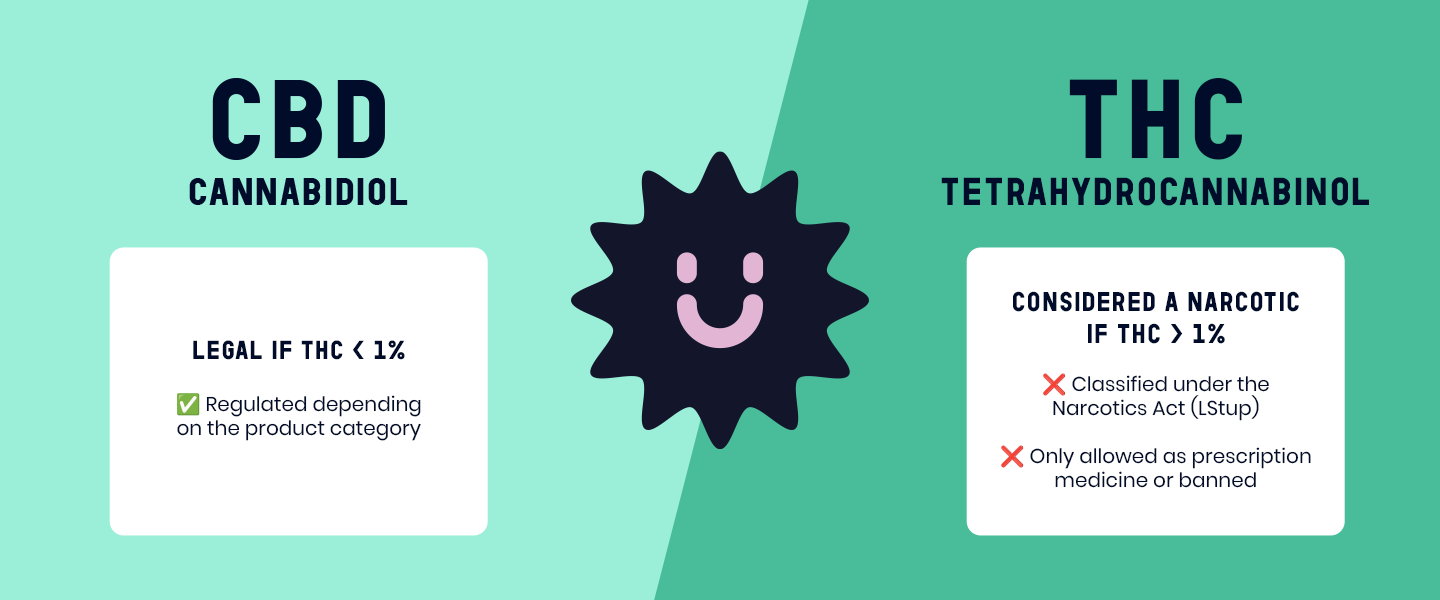
In fact, cannabidiol is fully legal in Switzerland, as it is not psychoactive like THC. Since the 2023 revision of the Swiss Narcotics Ordinance (OTStup-DFI), CBD has been officially removed from the list of controlled substances.
For a product containing CBD to be sold legally on the Swiss market, it must meet three essential conditions:
- The THC content must not exceed 1%. This threshold, which is up to five times higher than in the EU (0.2–0.3%), is defined by the Federal Office of Public Health (FOPH) in its May 2023 “Information sheet on products containing cannabidiol (CBD)”. This tolerance allows the sale of full-spectrum legal oils, but only when supported by rigorous laboratory analysis and a certificate of analysis available to consumers.
- The CBD must be extracted from industrial hemp varieties that are authorized for hemp cultivation in Switzerland.
- Finally, no CBD oil can be marketed as a food supplement in Switzerland — even if it contains 0% THC. It must be classified as either a cosmetic or chemical product, each with strict requirements concerning labelling and usage.
This last rule reflects the Swiss interpretation of the EU’s Novel Food regulation, which the FOPH enforces with particular strictness when it comes to ingestion, as outlined in the February 2024 “Application Guide for Products Containing Cannabinoids”.
Why is ingesting CBD oils forbidden in Switzerland?
Although CBD as a molecule is permitted in Switzerland, its legal use depends heavily on how the product is consumed. CBD can legally appear in various forms such as smokable flowers, external-use extracts, and CBD cosmetics — but ingestible CBD oils like sublingual drops or food supplements are treated very differently under Swiss law.
The country’s food legislation is among the strictest in Europe when it comes to cannabinoids. This is particularly true when it comes to buy compliant CBD oils, as products containing even small traces of THC are rarely compatible with Swiss food standards.
For example, the maximum THC levels permitted in hemp-containing foods vary by product type, as set by the DFI Ordinance on Foreign Substances and Ingredients in Food (OSuV):
- 0.007% THC in hemp oils intended for consumption
- 0.001% THC in other food products
Legal THC limits in hemp-based food products in Switzerland
| Hemp-based product | Maximum authorized THC content | Notes |
|---|---|---|
| Bakery products | 2 mg/kg | Based on dry weight |
| Non-alcoholic beverages | 200 µg/kg | As consumed |
| Hemp seeds | 10 mg/kg | Based on dry weight |
| Hemp seed oil | 20 mg/kg | Based on dry weight |
| Herbal infusions | 200 µg/kg | 15 g/L, infusion at >85 °C for 30 minutes |
These thresholds are so low that no CBD oil with even trace amounts of THC, such as 0.2%, can meet Swiss food standards. Moreover, because CBD is classified as a “novel food”, it cannot be included in ingestible products without prior authorization — a requirement that no CBD oil has fulfilled to date in Switzerland.
👉 As a result, any ingestible CBD oil is automatically considered non-compliant with Swiss legislation, regardless of its CBD or THC content.
This is why legally sold CBD oils must carry clear warnings like “do not ingest” or “for external use only.” They must also be officially classified as chemical or cosmetic products, never as food supplements, even if the formulation might appear similar to those sold abroad.
How are CBD oils classified under Swiss law?
In Switzerland, CBD oil classification is limited to just two legal options: they must be registered either as chemical products or as cosmetics.
Legal classification of CBD products in Switzerland
| Classification | Key characteristics | Applicable regulation |
|---|---|---|
| Chemical product | For technical use, denaturation required | Chemicals Act (ChemA) |
| Cosmetic product | Topical use only, ingredients must be controlled | Ordinance on Cosmetics (OCos) |
Each of these classifications comes with its own strict set of legal obligations.
What is a CBD oil classified as a chemical product?
When a CBD oil is classified as a chemical product, it is not intended for any contact with the body. These oils are typically used for:
- Fragrance diffusion
- Laboratory testing
- Technical industrial processes
To be sold legally, such oils must:
- Be listed in the Swiss Chemicals Register (RPC)
- Display hazard pictograms and safety warnings
- Clearly indicate non-consumable status
- Be rendered unfit for consumption
Why must CBD oils be denatured in Switzerland?
Under Swiss chemical legislation, any liquid product that could be mistaken for food must be made unfit for consumption. This rule also applies to CBD oils categorized as chemical products, especially if their smell or appearance resembles edible oils.
The aim is to prevent accidental ingestion, particularly among children or vulnerable individuals. This denaturation requirement is part of the Swiss Chemicals Ordinance (OChim), and applies across all similar products — not just CBD.
For CBD oils, denaturation usually involves adding a natural substance that imparts a bitter or aromatic taste, making ingestion unpleasant but harmless. A common additive is rosemary extract, used in very low concentrations (0.2% to 0.3%), which is well tolerated for topical use.
The “do not ingest” label is mandatory and must be clearly visible on the packaging, alongside chemical safety pictograms and legally required warnings.
What is a CBD oil classified as a cosmetic product?
In Switzerland, many CBD oils are formulated for topical use and classified as cosmetics. These products are applied to the skin, nails, or hair, and must comply with the Ordinance on Cosmetics (OCos). The classification is strictly regulated to ensure user safety, especially for CBD cosmetics and skincare products that are increasingly popular on the wellness market.
To be legally sold as a cosmetic, a CBD oil must meet the following requirements:
- Include a complete list of ingredients (INCI format)
- Carry clear labeling that specifies “for external use only”
- Be supported by a Product Information File (PIF) prepared by a qualified safety assessor
- Demonstrate validated skin safety testing
- Make no therapeutic or medical claims under any circumstance
A common example is a CBD oil marketed as a massage oil or a beard care product, which fits this category when formulated exclusively for external application.
What legal requirements must be met to sell CBD oil?
The conditions for legally selling CBD oil in Switzerland depend entirely on its official classification, either as a cosmetic or a chemical product. Each status comes with a precise legal framework.
| For cosmetic products, the seller must ensure | For chemical products, the requirements include |
|---|---|
| Complete INCI labeling (International Nomenclature of Cosmetic Ingredients) | Mandatory denaturation to render the oil unfit for ingestion |
| Validated skin safety tests | Registration in the Chemicals Register (RPC) |
| A detailed Product Information File (PIF) | Display of hazard warnings and pictograms |
| THC content strictly below 1% | THC content also under 1% |
Across all classifications, one principle is non-negotiable: the oil must never be marketed for ingestion, regardless of its composition or appearance.Dans tous les cas, aucune mention d’ingestion n’est tolérée.
How has Swiss legislation on CBD oil evolved?
The regulatory landscape surrounding CBD oils in Switzerland has developed gradually over the years. Here’s a look at the key milestones that have shaped today’s legal framework:
- 2011–2016: Emergence of the CBD market without clear regulation. Many oils were sold without any legal classification, creating widespread confusion among consumers and authorities.
- 2017: First wave of official regulation. CBD was removed from the list of narcotics, and products containing less than 1% THC were authorized under certain conditions.
➕ The FOPH released the first edition of its Application Guide for products containing cannabinoids. - 2019: The EFSA and the FSVO confirmed the “Novel Food” status of cannabidiol, banning its use in food products without prior approval (Novel Food Catalogue, January 2019).
- 2021: A sharp increase in product recalls by cantonal authorities, especially for CBD oils sold as food. Many brands began removing ingestion instructions to comply with food safety rules.
- 2022: Clear legal requirements were set for chemical classification: all CBD oils must now be denatured to prevent misuse. This became a formal obligation under the revised Chemicals Ordinance (OChim).
- 2024: The FOPH published version 7.0 of its Application Guide (February 2024), strengthening the legal conditions for selling CBD oils depending on their classification — cosmetic, chemical, or food (with the latter still not permitted).
What is the difference between Swiss and EU CBD oils?
In Switzerland, the legal framework for CBD oils is particularly strict and precise: CBD oils cannot be sold for ingestion. Instead, they must be classified either as cosmetic products (for external use) or chemical products (for technical use), and must always carry the label “do not ingest”.
In contrast, the legal approach within the European Union differs — and is often less consistent. On paper, any ingestible CBD oil must:
- Contain 0% THC, or a negligible amount depending on national limits
- Be authorized as a Novel Food by the European Commission
But in practice, enforcement varies widely across EU member states. Controls can be lax in some countries, allowing brands to market full-spectrum CBD oils (which may contain traces of THC) as food supplements — even without formal authorization. This creates a regulatory grey zone in much of the EU, with inconsistent consumer protections and labeling practices.
By contrast, the Swiss approach is far more rigorous. Ingestible use is strictly prohibited, and classification requirements are strictly enforced. This ensures greater clarity for retailers — and safer, more transparent information for consumers.
How can you verify that a CBD oil complies with Swiss laws?
Before purchasing a CBD oil in Switzerland, there are several key indicators to look for to ensure the product is fully legal and safe:
- The legal classification (cosmetic or chemical) must be clearly stated on the label
- A visible and explicit “do not ingest” warning must be present
- An independent certificate of analysis must be provided, confirming THC is below 1% and the product is free from contaminants
The label should include a RPC number (for chemical products) or documentation confirming cosmetic compliance (PIF) - The origin of the hemp must be traceable, including details about the country of cultivation and extraction methods
💡 The good news: as a consumer, you are not legally liable for mislabelled or non-compliant CBD oils. It is the seller’s responsibility to ensure the product meets Swiss law. If there’s an issue, the product can be withdrawn from the market — not your hands.
To avoid any risk, always choose trusted retailers who publish their certificates and provide complete compliance documentation, like uWeed.
Which elements ensure CBD oil quality and traceability?
When evaluating a CBD oil, a few key details can help confirm both quality and product traceability:
- Use of Swiss or European hemp, preferably organic
- CO₂ supercritical extraction, which is clean and efficient
- Full lab tests confirming THC levels, and checking for solvents, heavy metals, or pesticides
- Packaging that protects the oil (e.g., dark glass bottles, childproof caps)
- Presence of a Product Information File (PIF) or Chemical Registry number (RPC) depending on classification
These factors not only ensure product compliance CBD but also provide additional peace of mind when it comes to Swiss quality CBD and safety standards.
Where to buy 100% legal CBD oil in Switzerland?
Thanks to clear legal guidelines, it is now easy to buy from the best Swiss CBD online shops that guarantee product compliance, transparency, and convenient home delivery. Trusted platforms like uWeed thoroughly check every CBD oil listed, ensuring legal classification, up-to-date certificates, and proper labeling.
Brick-and-mortar CBD shops are also an option, offering personalised advice and on-the-spot product inspection. Pharmacies, however, rarely carry CBD oils due to the regulatory complexities and absence of therapeutic status.
Wherever you buy, always check that the seller displays the product’s classification and lab test results. Prioritise verified platforms to ensure you get safe, legal, and traceable CBD oils.
FAQ • Your questions about the legality of CBD oil in Switzerland
Do I need a prescription to buy CBD oil in Switzerland?
No, CBD oils classified as cosmetics or chemicals are sold over the counter.
Even though very few pharmacies stock them, you can legally purchase compliant oils without a medical prescription, either online or in specialized stores.
Is a CBD oil rendered unfit for ingestion dangerous to use?
No, denatured oils are safe for external use in 99% of cases.
Despite common misconceptions about CBD safety risks, the additives used, like rosemary extract, are harmless when applied to the skin and simply discourage accidental ingestion.
CBD oil vs THC oil: what are the legal differences?
CBD oils are legal and non-psychoactive; THC oils are narcotics and require a prescription.
The key difference between CBD and THC oils lies in their legal status: THC oils are strictly controlled and require Swissmedic approval, while compliant CBD oils can be sold freely if non-ingestible.
What happens if the police check your CBD oil?
If the product is compliant, 95% of police checks result in no issue.
Swiss authorities are well-informed about CBD police control procedures. Still, it’s wise to keep the product’s lab report with you, especially if traveling.
Can you travel abroad with Swiss CBD oil?
Yes within Switzerland, but abroad it depends on local THC thresholds.
While travelling with CBD in Switzerland poses no issue, EU countries often limit THC to 0.2–0.3%. Swiss oils may exceed these levels and thus be considered illegal at the border.
Can minors buy CBD oils in Switzerland?
No, CBD oil sales are strictly limited to adults over 18.
Regardless of interest in CBD for children, the law prohibits sales to minors due to the classification of oils as chemical or cosmetic products, which must be used under adult supervision.
Conclusion: What you must know before buying CBD oil
In Switzerland, CBD oils are legal, but only under very specific conditions: they must not be intended for ingestion. To be sold legally, a CBD oil must be clearly classified as either a cosmetic product (for topical use) or a chemical product (for technical use), with a THC level below 1%, proper labeling, and full compliance documentation.
At uWeed, you’ll only find oils that meet these strict standards: lab-tested, traceable, and 100% compliant with Swiss regulations. So you can shop with peace of mind, knowing your product is both legal and safe.