A fatal overdose from CBD is considered practically impossible, according to the World Health Organization (2018), which states that cannabidiol has an “excellent safety profile.” This scientific reassurance does not, however, eliminate the risk of temporary side effects when taking excessively high doses. CBD overdose typically causes extreme fatigue, digestive issues, and marked drowsiness – uncomfortable but reversible symptoms within 6 to 24 hours.
Maximum daily doses vary depending on body weight (1-6 mg per kg), age, and metabolism, with clinical thresholds reaching up to 1,500 mg. Certain groups are more sensitive, including older adults, patients taking anticoagulants, and people with liver disorders. Product quality also plays a direct role in these risks: a study by Bonn-Miller et al. (2017) found that 69% of CBD products have incorrect labeling.
In cases of excessive intake, hydration and rest are usually sufficient. The best prevention strategy is to start with 5-10 mg daily, increase slowly (“start low, go slow”), and choose Swiss lab-tested products. Swissmedic standards ensure THC levels below 1% and superior quality, significantly reducing unpredictable overdose risks.
⚠️ Disclaimer: CBD products are not medicines and do not replace any medical treatment. The information in this article does not constitute medical advice and cannot be used to diagnose, treat, or cure any disease. Always consult your doctor or a health professional before using CBD, especially if you take other medications. Additionally, CBD products (including oils) sold by uWeed in Switzerland are not intended for ingestion: always read the packaging instructions carefully and respect all provided warnings.
Can CBD kill you?
The scientific answer is clear: a fatal CBD overdose is practically impossible based on current data. Toxicological studies indicate that the theoretical lethal dose would be around 20,000 mg, equivalent to consuming more than 70 bottles of 30 ml CBD oil at 10% concentration all at once.
The World Health Organization (2018) has established that CBD has an “excellent safety profile” and is “generally well tolerated” even at high doses. Clinical studies have tested dosages up to 1,500 mg per day for several weeks without observing lethal effects or major toxicity.
A study by Bergamaschi et al. (2011), published in Current Drug Safety and titled “Safety and Side Effects of Cannabidiol, a Cannabis sativa Constituent,” confirms this position. This practical impossibility of a fatal overdose reinforces the fundamental safety of cannabidiol.
What is a CBD overdose? Definition and limits
A CBD overdose refers to consuming an amount of cannabidiol that exceeds your individual tolerance threshold, leading to temporary side effects without any life-threatening risk. This definition clearly distinguishes between temporary discomfort and dangerous toxicity.
Practical thresholds vary significantly between individuals:
- Therapeutic dose: 5–100 mg per day depending on the goals
- Excessive dose: 200–500 mg per day (probable side effects)
- Significant overdose: over 1,000 mg per day (marked discomfort)
The UK Food Standards Agency recommends a daily limit of 70 mg for healthy adults, while clinical studies have used doses up to 1,500 mg without serious effects. This wide safety margin demonstrates CBD’s remarkable tolerance.
Age, body weight, liver metabolism, and individual sensitivity strongly influence these thresholds. For example, a 60 kg user might experience side effects at 200 mg, while someone weighing 90 kg might tolerate this dose easily.
How does your liver process CBD and affect maximum dose?
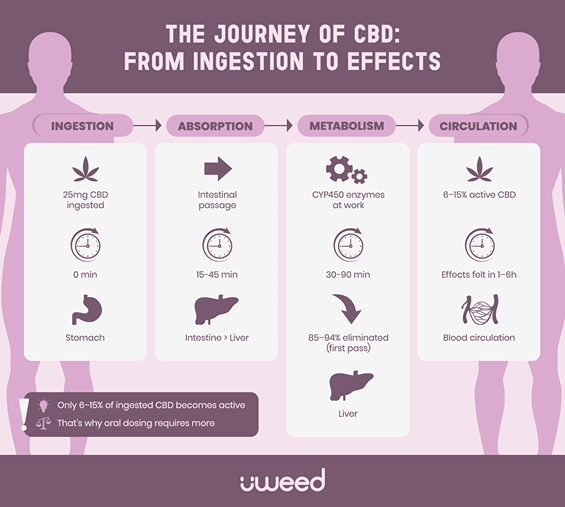
The liver metabolises CBD through cytochrome P450 enzymes (CYP3A4 and CYP2C19), which directly determine individual tolerance and the risk of drug interactions. This “first-pass hepatic metabolism” reduces cannabidiol’s bioavailability, explaining why oral doses need to be relatively high.
Genetic variants in CYP450 enzymes create two distinct profiles:
- Slow metabolisers accumulate more CBD and may experience side effects at moderate doses.
- Fast metabolisers eliminate cannabidiol more efficiently.
A study by Millar et al. (2018), published in Clinical Pharmacokinetics and titled “A Systematic Review on the Pharmacokinetics of Cannabidiol in Humans,” found plasma concentration variations of 1 to 10 times between individuals taking identical doses.
Additionally, CBD can inhibit some CYP450 enzymes, slowing the metabolism of other medications and increasing their effects – a crucial factor for determining each person’s maximum safe dose.
What is the lethal dose of CBD according to research?
Toxicological studies by Rosenkrantz et al. (1981), published in Toxicology and Applied Pharmacology and titled “Toxicity of short-term administration of cannabinoids to rhesus monkeys” established the theoretical lethal dose of CBD at 200–300 mg per kg in primates, which equates to roughly 20,000 mg for a 70 kg adult – a physically impossible quantity to consume accidentally.
This amount is equivalent to 67 full bottles of 10% CBD oil. No study has ever documented any human death directly attributable to CBD alone. This exceptional safety margin confirms the practical impossibility of a fatal CBD overdose.
CBD vs THC overdose: What’s the difference?
CBD overdose and THC intoxication are two distinct phenomena with different mechanisms and effects. THC acts as a direct agonist of CB1 receptors in the brain, causing intense psychoactive effects, while CBD modulates these receptors indirectly without activating them.
- CBD overdose: fatigue, nausea, drowsiness (non-psychoactive)
- THC intoxication: euphoria, paranoia, hallucinations (psychoactive)
In Switzerland, the legal limit of 1% THC guarantees no significant psychoactive effects in certified Swiss products.
THC intoxication sometimes requires medical attention, while CBD overdose is generally manageable at home with rest and hydration.
CBD Overdose vs THC Intoxication: Comparison of Risks and Effects
| Aspect | CBD Overdose | THC Intoxication |
|---|---|---|
| Psychoactivity | None | Marked alteration of consciousness |
| Mechanism | Indirect modulation of receptors | Direct activation of CB1 receptors |
| Main effects | Fatigue, nausea, drowsiness | Anxiety, paranoia, hallucinations |
| Duration | 4–8 hours | 2–12 hours depending on dose |
| Reversibility | Completely reversible | Reversible but may last longer |
| Medical emergency | Very rare | Possible (panic attacks) |
What are CBD overdose symptoms?
CBD overdose symptoms mainly involve an amplification of cannabidiol’s usual side effects, without presenting any life-threatening risk. These temporary and reversible manifestations affect different body systems with a dose-dependent intensity.
Extreme fatigue is the most common symptom (70% of cases), accompanied by digestive issues such as nausea and abdominal cramps (60% of cases). Cardiovascular manifestations include mild hypotension (30% of cases), while psychological effects are generally limited to temporary mental confusion and moderate anxiety in predisposed individuals.
How long before CBD overdose symptoms appear?
The onset time of CBD overdose symptoms depends directly on the route of administration used, as each method has a distinct bioavailability and absorption profile.
Inhalation produces the fastest but shortest effects, while oral administration causes later but longer-lasting symptoms. Eating food delays oral absorption by 30–60 minutes, and individual metabolism can speed up or slow down these processes depending on personal sensitivity.
Onset times of CBD overdose symptoms by administration route
| Route of administration | Onset of effects | Peak intensity | Total duration |
|---|---|---|---|
| Inhalation/Vaporisation | 2–15 minutes | 30–60 minutes | 2–4 hours |
| Topical application | 15–45 minutes | 1–3 hours | 4–6 hours |
| Oral route | 30–120 minutes | 2–4 hours | 6–8 hours |
Normal CBD side effects vs overdose: How to tell?
The distinction between normal CBD side effects and an overdose is based on three criteria: intensity, duration, and functional impact. This differentiation guides appropriate management.
While common CBD side effects to watch for usually remain mild and tolerable, an overdose causes symptoms that are marked and uncomfortable.
Normal CBD Side Effects vs Overdose: Distinction Criteria
| Criterion | Normal side effects | Concerning overdose |
|---|---|---|
| Intensity | Mild, tolerable | Marked, uncomfortable |
| Duration | Maximum 2–4 hours | Persisting over 6 hours |
| Functionality | Activities possible with effort | Temporary inability |
| Progression | Gradual improvement | Stagnation or worsening |
| Frequency | Occasional, predictable | Systematic at usual doses |
Physical symptoms of CBD overdose
Physical manifestations affect three main systems in a dose-dependent progression:
- Gastrointestinal (60–70% of cases): Moderate to severe nausea, diarrhoea within 4–6 hours, abdominal cramps, temporary loss of appetite.
- Cardiovascular (30–40% of cases): Mild hypotension with weakness, slight compensatory increase in heart rate, dizziness when standing up.
- Neurological (80–90% of cases): Extreme fatigue, coordination difficulties, slowed reflexes, pronounced dry mouth.
Severity follows a progression: mild effects (100–300 mg), moderate (300–800 mg), marked (>1,000 mg) in an average adult.
Mental symptoms of too much CBD
Psychological effects can sometimes be surprising due to their paradoxical nature:
- Mild to moderate anxiety (25% of cases): Especially in predisposed individuals, often linked to the surprise of experiencing intense physical effects.
- Mental confusion (40% of cases): “Foggy” thinking, concentration difficulties, short-term memory problems – completely reversible.
Irritability (10–15% of cases): Rare mood changes, disappearing within 12–24 hours.
A particular phenomenon called a “paradoxical effect” can occur at very high doses: unlike its usual relaxing properties, CBD can paradoxically cause agitation and insomnia instead of promoting sleep, due to its interaction with different receptors at elevated concentrations.
How long do CBD overdose symptoms last?
The duration of CBD overdose symptoms mainly depends on the dose consumed, administration route, and individual metabolic capacity. Most symptoms naturally resolve within 24 hours without any specific intervention.
Typical resolution timeline:
- 0–2 hours: Gradual onset of symptoms
- 2–6 hours: Peak intensity
- 6–12 hours: Gradual decline of main effects
- 12–24 hours: Complete resolution in 85% of people
- 24–48 hours: Normalisation in slow metabolisers
Several factors influence this timeline: age (slower metabolism in seniors), liver disorders (potential prolongation up to 72 hours), drug interactions (enzyme inhibition slowing elimination), and chronic use (accumulation in fat tissues).
Can too much CBD cause serious effects?
Serious effects from a CBD overdose remain exceptionally rare. Fewer than 0.1% of users report symptoms requiring medical consultation, generally due to drug interactions rather than CBD’s direct toxicity.
Potential complications remain mild:
- Symptomatic hypotension requiring lying down
- Dehydration secondary to vomiting (very rare)
- Extreme drowsiness increasing fall risk in older adults
Drug interactions are the main risk factor for serious effects, as CBD can potentiate anticoagulants, antiepileptics, or sedatives, requiring medical monitoring in patients taking multiple medications. Overall, the risk of CBD overdose remains remarkably low compared to common substances.
Who’s at higher risk for CBD side effects?
Certain populations have increased sensitivity to CBD due to specific physiological, pathological, or pharmacological factors. Understanding who’s at higher risk for CBD side effects helps adapt cannabidiol product use to each individual profile.
Populations at higher risk include:
- Older adults: slowed liver metabolism (–1% per year after age 40)
- Patients with liver disorders: reduced metabolic capacity
- Pregnant/breastfeeding women: maximum caution recommended
- Patients on multiple medications: risk of multiple interactions
- People with CYP450 genetic variants: altered cannabinoid metabolism
This extreme individual variability explains why some people feel effects from 10 mg, while others only from 200 mg. Such variability reflects the complexity of cannabinoid metabolism and the importance of a personalised approach for sensitive populations.
Can medications increase CBD overdose risk?
There are known drug interactions with cannabidiol, mainly linked to CYP450 enzyme inhibition. This enzyme competition increases the effects of other substances by slowing their elimination and raising their concentrations.
Known CBD drug interactions to avoid include:
- Anticoagulants: warfarin, apixaban
- Antiepileptics: valproate, carbamazepine
- Sedatives: benzodiazepines, barbiturates
- Immunosuppressants and antidepressants
⚠️ Mandatory precautions: these interactions require medical consultation before any CBD use. Self-medication in polymedicated patients represents a significant risk needing professional evaluation
Are older adults more sensitive to CBD?
Older adults develop increased sensitivity to CBD due to slowed metabolism. Liver capacity decreases by around 1% annually after age 40, leading to stronger and longer-lasting effects.
Polypharmacy is common in seniors, multiplying risks. It is recommended to start with lower doses (2.5–5 mg), increase gradually every 5–7 days, and apply reinforced precautions in case of multiple medications. This personalised approach optimises benefits while minimising risks in this vulnerable population.
Can pregnant women overdose on CBD?
It is formally advised not to use CBD during pregnancy or breastfeeding, a position supported by Swissmedic and international health authorities. Due to the lack of robust data on potential risks to fetal development, it is recommended that woman should avoid CBD during pregnancy.
Cannabidiol crosses the placenta and passes into breast milk, potentially exposing the baby to effects on neurological development.
Medical conditions that increase CBD sensitivity
Certain medical conditions significantly modify sensitivity to CBD and require specific medical monitoring. Medical conditions that increase CBD sensitivity include:
- Liver diseases (cirrhosis, hepatitis): 50–70% reduced metabolism
- Cardiovascular disorders: possible interactions with antihypertensive treatments
- Epilepsy: neurological monitoring required despite recognised therapeutic use
- Severe anxiety disorders: paradoxically, high doses may worsen anxiety
These comorbidities affect either cannabidiol metabolism or the body’s response to its effects. Personalised dose adjustments and prior medical evaluation help avoid complications while optimising potential benefits.
How much CBD is too much?
The maximum daily dose varies considerably. The UK Food Standards Agency recommends 70 mg for healthy adults, while clinical studies have tested up to 1,500 mg with no serious effects.
This disparity reflects the difference between wellness use and specialised therapeutic applications. For this reason, it is important to calculate your CBD dose by body weight to account for such huge individual variability.
Some people tolerate 300–500 mg daily, while others experience side effects from as little as 50–100 mg.
How to calculate CBD dose by body weight?
Calculating your CBD dose based on body weight follows a simple pharmacological rule: 1–6 mg of cannabidiol per kilogram. This personalised method avoids common dosing errors and optimises effects while minimising side effects.
Basic formula: Weight (kg) × Factor (1–6 mg) = Daily dose (mg)
The table below presents the recommended doses according to your body weight and symptom intensity.

Important adjustment factors:
- Beginners: minimum coefficient (1 mg/kg) for safe CBD initiation
- Seniors: reduce by 25% after age 65 (slower metabolism)
- Liver disorders: reduce by 50% (reduced metabolic capacity)
- Drug interactions: reduce by 30–40% depending on substances
This systematic approach helps identify your optimal individual dose, avoiding overdose risks while respecting personal sensitivity. Gradual progression from the minimal threshold remains the safest strategy for long-term use.
Maximum daily CBD dose in mg?
The maximum daily dose varies considerably. The UK Food Standards Agency recommends 70 mg for healthy adults, while clinical studies have tested up to 1,500 mg with no serious effects.
This large disparity reflects the difference between wellness use and specialised therapeutic applications. Some people tolerate 300–500 mg daily, while others experience side effects at 50–100 mg.
CBD dosage differences by product type
CBD’s bioavailability varies considerably depending on the format used, directly influencing the equivalent dose needed to achieve similar effects. This pharmacokinetic variability requires specific dosage adjustments to avoid overdose.
Bioavailability and CBD Dosage by Administration Format
| Format | Bioavailability | Equivalent dose | Duration of action |
|---|---|---|---|
| Inhalation | 30–60% | Reference dose | 2–4 hours |
| Topical application | 15–35% | 2–3× inhaled dose | 4–6 hours |
| Oral route | 6–15% | 4–6× inhaled dose | 6–8 hours |
| Tinctures/drops | 13–19% | 3–4× inhaled dose | 4–6 hours |
For example, a user accustomed to 50 mg topically should reduce to 15–25 mg if switching to inhalation to avoid overdose. Inhalation bypasses first-pass liver metabolism, maximising bioavailability.
CBD oil maximum dose: How much is safe?
CBD oils, generally applied topically in Switzerland, have a bioavailability of 15–35%, depending on formulation and application area. This characteristic directly influences maximum recommended doses and dosing progression.
For example, calculations by concentration:
- 5% oil: maximum ~140 drops/day (≈280 mg CBD)
- 10% oil: maximum ~70 drops/day (≈280 mg CBD)
- 20% oil: maximum ~35 drops/day (≈280 mg CBD)
These calculations assume around 2 mg of CBD per drop depending on concentration, with a practical cutaneous absorption limit of ~280 mg per day. Beyond this amount, absorption becomes negligible and may cause local saturation.For more details on choosing quality oils, choosing quality CBD oils with accurate labeling is essential to ensure safe and effective use.
Can you overdose on CBD flower?
CBD flowers present unique challenges for precise dosing due to their variable concentration (5–25% CBD) and the difficulty of measuring exact doses during use. This natural imprecision increases the risk of accidental overdose.
Specific challenges with flowers:
- Fluctuating concentration depending on plant part
- Difficult to measure exact dose
- Variable bioavailability depending on consumption method
Associated methods and risks:
- Vaporisation: rapid absorption, moderate control, effects in 2–10 minutes
- Combustion: unpredictable bioavailability, risk of overdose with repeated inhalations
- Infusion: more stable dosing but reduced absorption
Gradual titration remains essential: start with 0.1–0.2g, wait 15–30 minutes to assess effects, then adjust cautiously. This “start low, go slow” approach effectively prevents overdoses.
For safety, Swiss-grown CBD flower with lab verification guarantees controlled concentration, full traceability, and rigorous lab testing.
CBD gummies overdose: Why be extra careful?
CBD edibles present a particular overdose risk due to their delayed effect and prolonged action. This combination often traps users into premature redosing due to impatience.
Typical edible timeline:
- 30–120 minutes: first effects begin
- 2–4 hours: peak intensity
- 6–8 hours: total duration
- 12–24 hours: complete elimination
Liver metabolism transforms CBD into different active metabolites, explaining these more intense and longer-lasting effects. Always wait at least 2 hours before redosing, start with the smallest dose available, and avoid taking them on an empty stomach.For stable dosing, CBD capsules for consistent dosing can be an alternative to gummies.
How does CBD quality affect overdose risk?
The quality of CBD products directly influences overdose risk through several critical mechanisms: label accuracy, presence of contaminants amplifying side effects, and cannabidiol purity affecting reaction predictability.
Why lab testing matters for CBD safety
Independent laboratory analyses are the only reliable way to verify the actual composition of CBD products and guarantee their safe use. These tests detect and quantify cannabinoids, identify potential contaminants, and confirm compliance with quality standards.
Essential analyses include:
- Cannabinoid profile: precise quantification of CBD, THC, and other cannabinoids
- Microbiological contaminants: bacteria, yeasts, moulds
- Pesticide residues: more than 400 chemicals tested
- Heavy metals: lead, cadmium, mercury, arsenic
- Residual solvents: ethanol, butane, propane, CO₂
Regular testing frequency (ideally by batch) ensures continuous quality monitoring, quickly detecting production deviations or accidental contamination.
For a detailed understanding, understanding certificates of analysis (COAs) is crucial to check product safety and potency.
How to verify CBD concentration in products?
Verifying actual concentration requires careful examination of the COA (certificate of analysis) corresponding to your product batch. Each quality product should provide an accessible COA via QR code or batch number.
For a detailed guide, how to verify CBD concentration in products explains each step clearly.
Steps to verify:
- Locate the batch number on the product packaging
- Scan the QR code or visit the manufacturer’s website
- Download the COA for the exact batch
- Compare the labelled concentration with laboratory results
How contaminants worsen CBD side effects
Contaminants in lower quality CBD products can significantly worsen side effects and create misleading symptoms, complicating overdose identification.
Main risks by contaminant type:
- Pesticides: amplify confusion and coordination problems
- Heavy metals: cause additional nausea and digestive symptoms
- Residual solvents: trigger headaches and dizziness
- Mycotoxins: cause inflammatory reactions mimicking intoxication
Are Swiss CBD products safer?
Swiss CBD products benefit from a significant safety advantage thanks to strict regulatory frameworks and high production standards. This Swiss excellence considerably reduces risks linked to unpredictable overdoses and side effects.
For peace of mind, we prioritise lab-tested Swiss CBD products online, which guarantee controlled concentration, full traceability, and compliance with Swissmedic standards of less than 1% THC.
What to do if you took too much CBD?
If you suspect a CBD overdose, stay calm because most symptoms resolve naturally within 6–24 hours without medical intervention.
Immediate actions include settling in a safe, calm environment, lying down to avoid falls, drinking small sips of water, and noting the time, dose, and symptoms experienced.
Consult a doctor if you have persistent vomiting for more than 6 hours, breathing difficulties, severe confusion, or if symptoms worsen after 4–6 hours.
Recording the brand, consumed dose, and symptom progression helps health professionals evaluate the situation. The vast majority of CBD overdoses resolve spontaneously with rest and time.
How to reduce CBD overdose effects quickly?
There is no specific antidote for CBD, but several techniques can improve comfort during natural elimination.
Relief techniques include:
- Optimised hydration: 250 ml of water every 30 minutes
- Controlled breathing: inhale 4s, hold 4s, exhale 6s
- Calming environment: dim lighting, cool temperature (18–20°C)
- Light food: crackers or banana to stabilise blood sugar
- Alternating positions: lie down, sit up, slow walking if possible
These approaches optimise natural recovery without “neutralising” CBD. Patience remains crucial, as most effects gradually subside within 4–8 hours after peak intensity.
How to prevent CBD overdose?
Preventing CBD overdose relies on systematic dosing, monitoring, and choosing quality products.
Effective strategies include:
- Keeping a daily dosage journal to document dose, effects, and side effects
- Applying the “2-3-7 rule”, increasing by 2–3 mg maximum every 7 days
Systematically choosing products with lab tests and COAs
For regular users, an annual medical evaluation and use of tracking tools like mobile apps or dosage calculators complete this preventive approach.
How to start CBD safely?
Starting CBD requires a methodical approach prioritising safety and gradual progression. The “start low, go slow” rule respects individual sensitivity, while certified Swiss products guarantee dosing reliability.
The recommended protocol begins with 5–10 mg per day during the first week, followed by maintaining or slightly increasing according to tolerance, then fine adjustments towards the optimal dose over 3–4 weeks.
Safe starting dose for CBD beginners?
To start CBD safely, the optimal initial dose is between 5–10 mg per day, with adjustments based on body weight and personal sensitivity.
For a practical introduction, consult our beginner’s guide to starting CBD safely, which outlines this progressive method in detail.
This gradual approach helps identify your personal “sweet spot” – the minimum effective dose providing desired benefits without significant side effects. The “less is better” principle optimises long-term benefit-to-risk ratio.
Common CBD dosing mistakes to avoid
Experience shows recurrent dosing errors cause most unpleasant side effects. The main mistakes include:
- Impatience: increasing dose every 1–2 days
- Ignoring individual factors (weight, age, metabolism)
- Mixing different formats without dosage adaptation
- Neglecting product quality and COAs
- Failing to keep usage documentation
Avoiding these common mistakes accelerates identification of your ideal personal approach while preserving safety and reducing overdose risks.