As Swiss parents, you’re confronted with an avalanche of contradictory information about CBD and its potential effects on children. This confusion is dangerous when the safety of our little ones is at stake.
CBD for children represents today one of the most concerning issues in pediatric safety. Contrary to misconceptions spread by certain media, cannabidiol is not a harmless substance for developing brains. The neurological risks documented by medical research are serious enough that Swissmedic maintains strict prohibition of its use in minors without specialized medical prescription.
The dangers of CBD for children don’t stem from moral panic, but from inescapable biological realities. A child’s endocannabinoid system differs fundamentally from an adult’s, making any cannabinoid intervention potentially disruptive to natural brain maturation processes. This vulnerability explains why Swiss medical authorities adopt such a protective position.
This exhaustive guide accompanies you in understanding the real risks, current regulations, and safe alternatives available to meet your child’s health needs.
⚠️ Warning: CBD products are not medicines and do not replace medical treatment under any circumstances. The information detailed in this article does not constitute medical advice and cannot be used to diagnose, treat, or cure any illness. Always consult your doctor or healthcare professional before using CBD, especially if you take other medications. Furthermore, CBD products (including oils) sold by uWeed in Switzerland are not intended for ingestion: take time to read the instructions on the packaging and respect the warnings provided.
Is CBD safe for kids and what are the risks?
CBD is not considered safe for children, except in very rare strictly supervised medical cases. To understand what is CBD and how it works, you must know that in children, the endocannabinoid system is still in full maturation and plays a crucial role in brain development. Introducing external cannabinoids like CBD can disrupt this neurological construction, causing lasting alterations in memory, attention, and cognitive functions.
Studies even show that early exposure to cannabinoids is associated with decreased IQ and persistent cognitive disorders in adulthood. A prospective study by Castellanos-Ryan et al. (2017) published in Development and Psychopathology demonstrates that cannabinoid exposure during adolescence correlates with lasting deficits in working memory, sustained attention, and cognitive flexibility.
This is why Swissmedic, in its 2022 report on cannabinoids, strictly prohibits CBD use in minors without specialized medical prescription, to protect their brain development against serious and unpredictable side effects.
Is CBD safe for developing brains?
Children’s and adolescents’ brains undergo complex and delicate neurological development extending from birth to approximately 25 years. This vulnerability period makes any external cannabinoid intervention particularly concerning for developing neural pathways.
The CBD dangers for brain development stem from its interaction with the endocannabinoid system, which regulates neuron migration, synapse formation, and specialization of different brain areas, enabling learning and memory.
The endocannabinoid system, which we explore in detail in our scientific guides, plays an essential role in this process. Unlike in adults, where it is mature and stable, that of children presents intense neuroplasticity. This means that any exposure to external cannabinoids like CBD can disrupt its natural balance, altering brain construction and causing lasting consequences on cognition.
Furthermore, children metabolize CBD differently than adults. Their liver and enzymes (like cytochrome P450) are still immature, which slows CBD degradation, increases its accumulation in the body, and amplifies its side effects, even at low doses.
💡 To better understand, imagine that your child’s brain manufactures its own “construction tools” – its internal cannabinoids – to build each part with precision. Introducing external CBD is like adding different tools or materials not planned for, risking disorganizing the construction and weakening the whole structure.
What are the long-term effects of CBD on children?
The long-term cognitive effects of CBD exposure during childhood represent a major concern supported by troubling longitudinal research. The most vulnerable areas include memory, attention, executive functions, and learning abilities.
A prospective study by Castellanos-Ryan et al. (2017) published in Development and Psychopathology demonstrates that cannabinoid exposure during adolescence correlates with lasting deficits in working memory, sustained attention, and cognitive flexibility.
Memory disorders constitute the most documented effect, affecting the consolidation of new learning and directly impacting academic performance. Information processing speed can be permanently slowed, compromising the child’s educational path and performance in complex tasks.
When can children be prescribed CBD?
Legitimate medical indications for pediatric CBD remain extremely limited and concern only severe forms of refractory epilepsy, resistant to all conventional treatments. These exceptional situations require strict medical protocol and continuous hospital surveillance.
The epileptic syndromes concerned primarily include Dravet syndrome and Lennox-Gastaut syndrome, two severe forms of childhood epilepsy causing frequent convulsive seizures that are difficult to control. These indications are based on rigorous clinical studies, such as that by Devinsky et al. (2017), “Trial of Cannabidiol for Drug-Resistant Seizures in the Dravet Syndrome,” which demonstrated significant seizure reduction, and that by Thiele et al. (2018), “Cannabidiol in Patients with Seizures Associated with Lennox–Gastaut Syndrome,” also confirming its efficacy.
It is important to emphasize that the only form of CBD authorized for these treatments is a specific pharmaceutical medicine, Epidiolex, which obtained official approval from the FDA (2018), EMA (2020), and Swissmedic (2022) after evaluation of this clinical data. Its use always requires specialized medical prescription and close hospital monitoring.
The prescription process requires documented failure of at least three different antiepileptic drugs, as well as multidisciplinary evaluation including a pediatric neurologist, clinical pharmacist, and specialized care team. Medical surveillance includes regular biological analyses and continuous neurological monitoring to guarantee treatment safety and efficacy.
What is Epidiolex and why is it FDA approved for children?
Epidiolex is a pharmaceutical medicine based on purified CBD, developed by GW Pharmaceuticals. It is formulated as an oral solution and prescribed as medical treatment for certain rare and severe forms of childhood epilepsy, notably Dravet syndrome and Lennox-Gastaut syndrome.
Epidiolex’s major difference lies not only in its manufacturing quality, but especially in the fact that it is the only CBD product whose efficacy and safety have been demonstrated through rigorous clinical studies for these specific indications (see above). This research enabled its approval by the FDA (2018), EMA (2020), and Swissmedic (2022).
Its dosage is also much higher than wellness CBD products, reaching up to 20 mg/kg/day according to clinical protocols, and requires strict medical supervision to prevent potential side effects.
💡 This means that no other CBD product sold without prescription has demonstrated clinical efficacy for these pathologies or for other pediatric disorders, and they cannot be used as therapeutic alternatives without specialized medical monitoring.
What are CBD side effects and dangerous interactions in children?
CBD side effects in children can be serious and unpredictable due to immature detoxification systems. The pediatric population presents fundamentally different physiological responses compared to adults, making safety assessments from adult studies inadequate for children.
Unlike adults where we document CBD contraindications and warnings, children present amplified vulnerability in three critical domains. Serious side effects include hepatic toxicity, neurological disorders, and behavioral disturbances. Pediatric drug interactions disrupt metabolism of numerous common medications. Overdose risk proves particularly high because immature metabolism creates dangerous tissue accumulation even with small doses.
This triple vulnerability explains Swissmedic’s strict prohibition and the necessity for continuous medical supervision for any mandatory medical prescription.
What serious side effects has CBD caused in children?
Children develop much more serious and potentially fatal reactions to CBD than adults. The immature physiological systems of developing bodies cannot process cannabinoids safely, leading to severe complications that rarely occur in adult populations.
While mild but documented CBD side effects in adults remain generally manageable, pediatric safety reveals dramatically amplified risks across multiple organ systems.
- Severe hepatic toxicity: 25% of children treated with Epidiolex develop dangerous elevations of liver enzymes that can progress to hepatic insufficiency requiring emergency hospitalization.
- Neurological and behavioral disorders: Side effects include excessive somnolence, prolonged lethargy, and paradoxically worsened convulsions. Behavioral disturbances include severe agitation, unusual aggression, and suicidal thoughts documented in adolescents.
- Systemic complications: Severe gastrointestinal disorders – persistent nausea, chronic vomiting – cause dangerous dehydration. CBD also disrupts growth hormones, delays puberty, and affects normal child development.
How does CBD interact with children’s medications?
Drug interactions represent a major danger often underestimated by parents. Children’s developing metabolic systems process medications differently than adults, creating unique risks when CBD is introduced.
The complexity of pediatric pharmacology means that even experienced healthcare providers must exercise extreme caution. Our detailed CBD drug interactions guide for adults provides important context, but pediatric drug interactions are unpredictable and potentially fatal due to children’s immature metabolism.
CBD powerfully inhibits cytochrome P450 enzymes (particularly CYP3A4 and CYP2C19) responsible for metabolizing over 60% of medications prescribed to children. This enzymatic disruption creates dangerous medication accumulations in pediatric bodies.
Antiepileptic drugs undergo particularly dangerous interactions – the CBD-valproate combination can triple blood levels, causing severe hepatic toxicity. ADHD medications see their metabolism profoundly disrupted, creating dangerous cardiac effects.
These interactions are dose-independent: even small amounts of CBD can significantly disrupt the fragile pharmacological balance in children, hence the importance of mandatory medical prescription with continuous medical supervision.
Why is CBD overdose risk higher in children?
Children’s immature metabolism explains this particular vulnerability to accidental overdose. Pediatric liver function operates at significantly reduced capacity compared to adults, making even small amounts of CBD potentially dangerous.
The developing hepatic system lacks the enzymatic maturity needed to process cannabinoids effectively. Understanding CBD overdose risks and symptoms in adults provides important context, but pediatric liver possesses limited detoxification capacity that creates dangerous tissue accumulation even with small doses.
CBD pharmacokinetics in children differs fundamentally: unpredictable absorption, slowed clearance, and prolonged half-life. These particularities make dosage calculations impossible to master and reactions totally unpredictable.
Overdose signs can be initially subtle – somnolence, feeding difficulties, irritability – delaying treatment. The absence of specific CBD antidote dangerously complicates emergency treatment of pediatric overdose, hence the critical importance of total prevention.
What are age-specific CBD risks for children?
CBD-related risks vary considerably according to developmental stages. Each critical period presents specific vulnerabilities that amplify potential dangers, explaining why Swissmedic maintains strict prohibition for all products banned for minors.
Risk Matrix by Age: Brain Development and Vulnerabilities
| Age Range | Development Stage | Primary Vulnerabilities | Specific CBD Risks |
|---|---|---|---|
| 👶 0-6 years | Explosive neuronal growth Massive synapse formation | • Immature blood-brain barrier • Rudimentary hepatic metabolism • Developing primitive reflexes | 🚫 ABSOLUTE DANGER • Facilitated intoxication • Permanent developmental delays • Irreversible cognitive disorders |
| 📚 7-12 years | Fundamental learning Cognitive consolidation | • Academic skill acquisition • Working memory formation • Attentional development | ⚠️ EDUCATIONAL RISKS • Concentration/memory disorders • Academic failure • Self-esteem impact |
| 🧠 13-17 years | Prefrontal cortex remodeling Judgment maturation | • Immature reward system • Impulse control formation • Identity construction | 💥 MAXIMUM RISKS • Amplified addiction • Behavioral disorders • Future orientation impact |
This risk matrix demonstrates why no accidental CBD exposure is acceptable and why only mandatory medical prescription with continuous medical supervision can be considered in exceptional medical cases.
Why should babies and toddlers never receive CBD?
This age group presents absolute vulnerability justifying total CBD prohibition. The developing brain during the first years of life undergoes the most rapid and critical growth phases in human development.
Babies’ brains undergo explosive growth with formation of millions of daily synaptic connections. This critical vulnerability, which our guide on CBD during breastfeeding documents from intrauterine life, continues throughout early childhood.
The immature blood-brain barrier allows facilitated passage of dangerous cannabinoids to the central nervous system, creating dangerously high brain concentrations even with tiny doses. Rudimentary hepatic metabolism cannot effectively detoxify cannabinoids.
Intoxication signs are particularly subtle: sucking disorders, altered primitive reflexes, sleep disturbances. Consequences include permanent developmental delays and irreversible cognitive disorders, justifying absolute pediatric safety from Swiss authorities.
What are specific CBD dangers for school-age children?
School age corresponds to a critical period for fundamental learning acquisition. Academic performance and cognitive development during these formative years establish the foundation for future educational success.
CBD exposure during this phase can durably compromise academic acquisitions and intellectual development. The impact on learning constitutes the major concern: concentration disorders, attentional deficits, working memory disturbances directly affect academic performance.
Behavioral disorders include increased impulsivity and emotional regulation difficulties. Self-esteem and confidence can be profoundly altered by academic failures resulting from CBD exposure, affecting future educational path.
How does CBD affect teenage development?
Adolescence represents a period of maximum vulnerability to cannabinoids due to intensive brain remodeling. The teenage brain undergoes dramatic structural and functional changes, particularly in areas responsible for decision-making and impulse control.
During this critical developmental window, the prefrontal cortex responsible for judgment and impulse control undergoes extensive remodeling. Addiction risks are significantly amplified during adolescence due to the maturing brain reward system making adolescents particularly sensitive to psychoactive substances.
Impact on developing identity can be profoundly disruptive. Academic performance and professional orientation can be compromised by induced attention disorders. Family relationships often suffer significant tensions related to behavioral changes.
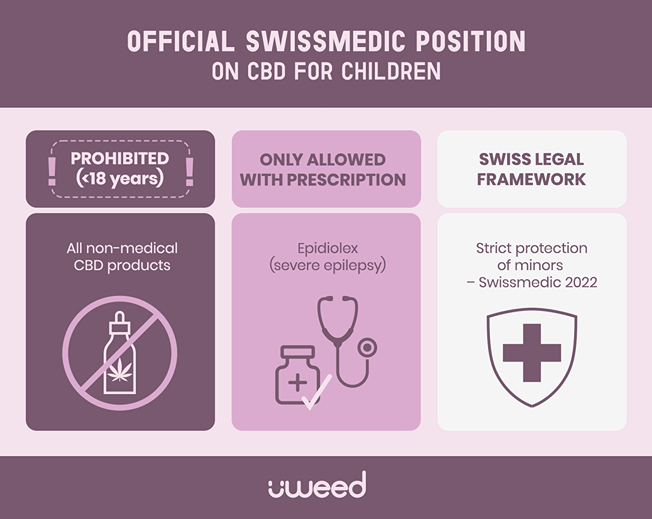
What is the official Swiss position on pediatric CBD?
Swissmedic maintains a strict and protective position concerning CBD use in minors, prioritizing child protection against documented risks. The Swiss regulatory framework represents one of the most comprehensive approaches to pediatric cannabinoid safety in Europe.
According to its cannabinoid evaluation report published in 2022, this Swiss regulation rests on two pillars of pediatric safety. The legal prohibition of all CBD products for children without mandatory medical prescription is based on the precautionary principle.
Swiss authorities emphasize insufficient safety data and established neurological risks, justifying this strict prohibition. The list of products banned for minors exhaustively covers all commercial CBD products – oils, gummies, cosmetics, flowers – specifically targeting those attractive to children that present amplified accidental exposure risks.
This protective regulation aligns with international recommendations that prioritize absolute safety of children against dangerous cannabinoids.
Why is CBD use prohibited for minors without prescription?
Swissmedic’s strict position concerning pediatric CBD use follows a comprehensive protection approach that we detail in our regulatory guide. This legal prohibition constitutes not only a legal framework, but a precautionary principle based on insufficient pediatric safety data and documented developmental risks.
The principle of “primum non nocere” (first, do no harm) guides this regulation. In the absence of solid efficacy evidence and facing established risks, Swiss authorities prioritize protection rather than experimentation on a vulnerable population.
Insufficient pediatric studies constitute a central argument. The variability of products available on the market makes any reliable risk assessment impossible. Legal sanctions for non-compliance include administrative fines and criminal prosecution for endangering others.
What CBD products are banned for minors in Switzerland?
All commercial CBD products are explicitly prohibited for minors according to Swiss regulatory framework, without exception. This total prohibition represents one of the most comprehensive approaches to protecting children from cannabinoid exposure in Europe.
The extensive regulations outlined in the complete Swiss CBD regulation framework exhaustively cover all products banned for minors available on the market.
The complete list includes commercial CBD oils and tinctures, edible products (gummies, candies, chocolates), vaping products (e-liquids, vape pens, CBD cartridges), cosmetics and balms containing CBD, as well as CBD flowers and resins.
Edible products and vaping products present particular danger due to their deliberate attractiveness to children – the former by their resemblance to ordinary confectionery, the latter by their appealing flavors and similarity to classic electronic cigarettes. These forms are strictly prohibited by Swissmedic and subject to reinforced surveillance due to their potential for massive accidental exposure.
This strict prohibition aims to absolutely protect developing brains against dangerous cannabinoids, without any possible commercial exception.
What should Swiss parents know about CBD and children?
As a responsible parent, you must master four pillars of protection against CBD-related risks. Understanding these fundamental safety principles ensures comprehensive protection for your child’s developing brain and overall wellbeing.
The complexity of CBD safety in children requires parents to be informed about multiple risk factors simultaneously. Each protective pillar addresses specific dangers while building a comprehensive safety framework.
Identify dangerous products: recognize THC-contaminated products and warning signs to avoid any accidental exposure. Monitor CBD gummies: these products banned for minors present mortal danger due to their resemblance to confectionery.
Consult your pediatrician: ask crucial questions before any mandatory medical prescription. Apply emergency protocols: know domestic protection measures and rapid intervention procedures.
This absolute pediatric safety protects your child’s brain development against dangerous cannabinoids and neurological risks documented by Swiss authorities.
How to identify dangerous CBD products for children?
While adults can evaluate CBD product quality through established criteria (third-party testing, analysis certificates, origin), children’s particular vulnerability requires absolute vigilance. The most dangerous products for minors often deliberately target families through appealing marketing and child-friendly presentations.
Products attractive to minors – colorful gummies, candies, sweet drinks – present amplified risks due to their deliberately appealing presentation and often unpredictable dosages. Absence of laboratory analyses constitutes the primary alarm signal.
Deficient labeling and marketing targeted toward families constitute flagrant violations of regulation. Vigilance is particularly important during online purchases where authenticity verification proves complex.
Why are CBD gummies dangerous for children?
CBD gummies and candies constitute a mortal danger specific to children due to their perfect resemblance to ordinary confectionery. This visual confusion can lead to massive accidental ingestion with dramatic consequences.
The deliberate attractiveness completely masks the psychoactive nature of the content. Uncontrollable dosage and delayed effects (30-120 minutes) create a dangerous window where the child can continue consuming.
Documented intoxication cases include emergency hospitalizations and pediatric comas. The delayed onset of effects means children may consume multiple units before any symptoms appear, leading to severe overdose situations.
What questions should I ask my pediatrician about CBD?
Pediatric consultation remains absolutely indispensable before any CBD consideration. Healthcare professionals possess the specialized knowledge necessary to evaluate risks specific to your child’s age, development, and health status.
Essential diagnostic questions: “What conventional treatments are available?” “Have we exhausted all proven options?” Risk questions: “What are the specific dangers for my child’s age?” “How could CBD interact with current treatments?”
Legal questions: “Is CBD legally prescriptible for this indication?” These fundamental questions ensure comprehensive evaluation of all safer alternatives before considering any cannabinoid intervention.
How to protect your child from accidental CBD exposure?
Emergency protocols that we detail are based on responsible usage principles that we advocate throughout our CBD guides. Preventing accidental exposure constitutes the logical extension of safety practices that any adult CBD user should adopt in a household with children.
Home security requires systematic storage in locked cabinets placed high and out of reach. Education of family members and extended family about CBD risks is crucial, as is vigilance during outings and social gatherings.
Emergency numbers must be easily available: 144 for Swiss emergencies, 145 for the Swiss Poison Control Center (Tox Info Suisse). Have your child’s weight, age, and any consumed product information readily available for emergency responders.
What are safe alternatives to CBD for common childhood problems?
Faced with documented CBD risks in children, established therapeutic alternatives offer proven and safe solutions. These medically validated options benefit from decades of specialized pediatric research and present robust safety profiles adapted to developing brains.
Unlike non-approved cannabinoids, these conventional therapies have in-depth safety studies, precise dosing protocols, and standardized medical surveillance. They represent the first-line treatments recommended by Swiss medical authorities for common pediatric conditions.
Comparative Table of Pediatric Therapeutic Alternatives
| Condition | Established Treatment | Proven Efficacy | Safety Profile | Application Age |
|---|---|---|---|---|
| Childhood anxiety | Cognitive-behavioral therapy (CBT) | 70-80% improvement | No side effects | 4+ years |
| Family therapy | 60-70% efficacy | Absolute safety | All ages | |
| Pediatric SSRIs (if necessary) | 50-60% response | Medical supervision required | 6+ years | |
| Sleep disorders | Sleep hygiene | 60% improvement | Total safety | All ages |
| Behavioral therapy | 75% efficacy | No risk | 3+ years | |
| Melatonin (if prescribed) | 80% improvement | Very good profile | 6+ years | |
| ADHD | Behavioral therapy | 65% improvement | Complete safety | 4+ years |
| Pediatric stimulants | 70-80% efficacy | Medical supervision | 6+ years | |
| Neurofeedback | 60% improvement | No adverse effects | 6+ years |
What proven treatments exist for childhood anxiety?
Childhood anxiety benefits from validated therapeutic approaches adapted to developing brains. The gold standard treatment combines evidence-based interventions specifically designed for pediatric populations.
Cognitive-behavioral therapy (CBT) constitutes the first-line treatment, with 70% efficacy through playful techniques adapted to age. This approach teaches children concrete coping strategies while respecting their developmental stage.
Relaxation techniques and family therapy develop lasting strategies without developmental risk. While we document CBD for anxiety and panic attacks in adults, children require approaches specially designed for their neurological vulnerability.
If necessary, pediatric SSRIs offer a medicinal alternative with specialized supervision and established safety profile.
How to treat childhood sleep problems without CBD?
Pediatric sleep disorders are effectively treated through behavioral approaches respectful of development. These evidence-based interventions address underlying causes while supporting natural sleep maturation processes.
Sleep hygiene – regular schedules, optimal environment, screen limitation – resolves 60% of mild disorders. Structured routines and gradual techniques develop natural nocturnal autonomy by leveraging children’s positive neuroplasticity.
While adults may find CBD for better sleep helpful, pediatric sleep mechanisms in maturation require non-invasive approaches. Prescribed melatonin presents an established safety profile with appropriate medical monitoring.
What non-drug therapies work for ADHD in children?
Pediatric ADHD responds well to multimodal approaches combining behavioral interventions and environmental accommodations. These comprehensive strategies address core symptoms while building long-term coping skills.
Behavioral therapy teaches concrete strategies with 65% demonstrated efficacy. Regular physical activity significantly improves attention by naturally stimulating neurotransmitters.
Neurofeedback shows promising efficacy while respecting natural neuroplasticity. Although some research explores CBD and ADHD in adults, pediatric interventions prioritize approaches developing lasting skills without risking normal neurological maturation.
Why are proven treatments better than unapproved CBD?
Our extensive CBD expertise allows us to emphasize the importance of established therapeutic alternatives for pediatric conditions. Unlike adult CBD applications that we document extensively, childhood disorders benefit from therapeutic arsenals validated by decades of specialized pediatric research.
The established safety of these approaches rests on thousands of studies. Proven efficacy is supported by randomized clinical trials specifically designed for pediatric populations.
Accessibility and health insurance reimbursement make these treatments available to all families. The comprehensive support systems surrounding these therapies ensure optimal outcomes for children and families.
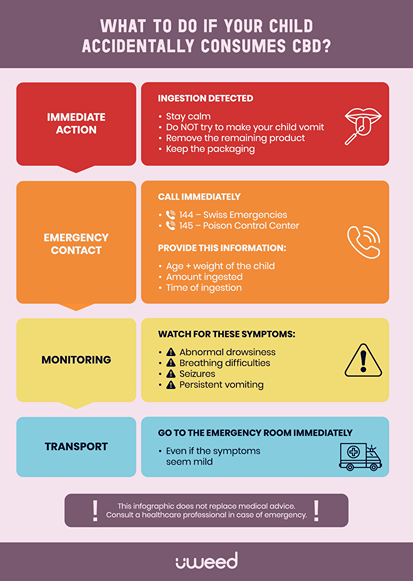
What to do if your child accidentally consumed CBD?
Accidental CBD ingestion constitutes a medical emergency requiring immediate intervention. The speed of action and quality of information transmitted to emergency services largely determine the prognosis.
- First steps: Stay calm and immediately assess your child’s condition. Do not induce vomiting. Remove any residual product and preserve packaging.
- Emergency contact: Immediately call 144 (Swiss emergencies) or the Swiss Poison Control Center (Tox Info Suisse). Communicate precisely: child’s age and weight, estimated quantity ingested, time of ingestion.
- Symptom surveillance: Abnormal somnolence, breathing difficulties, convulsions, persistent vomiting.
- Emergency transport: Take your child to pediatric emergency services even if symptoms seem benign.