
CBD (cannabidiol) is a non-intoxicating cannabinoid of the hemp plant and, next to THC, its best-known compound. If you are looking up CBD benefits or CBD effects, you will mostly be reading about CBD oil, also sold as CBD drops: both names mean the same product. The only honest way to talk about what cannabidiol does is by evidence level – cell culture, animal study, human study – and that is how we grade everything on this page. You will find what CBD is, how it is studied in the body, and what research shows by product form and by condition. In Switzerland, CBD products with under 1% THC are legal and sold as cosmetic or aromatic products, not as medicines. uWeed sells CBD oils as cosmetics or aromatic oils, and this page describes research, not product effects.
This article summarises what research says about the effects and side effects of CBD. It is not a recommendation to use CBD and not a statement that CBD has an effect on health. CBD products are not medicines and are not intended to diagnose, treat or cure any disease. The information does not replace medical advice: speak to your doctor before using CBD, especially if you take medication. Several of the studies cited used CBD in forms and amounts that are not intended for products sold freely in Switzerland, for example for ingestion. The CBD oils sold by uWeed are not intended for ingestion: read the instructions on the pack and follow the warnings.
What is CBD (cannabidiol)?
CBD (cannabidiol) is a cannabinoid – a compound of the hemp plant, Cannabis sativa – that, unlike tetrahydrocannabinol (THC), does not intoxicate. Cannabidiol, CBD for short, is extracted from the flowers and leaves of industrial hemp and is one of many cannabinoids in the plant. The abbreviation names a single substance, not a product.
Asked what CBD stands for, the answer is cannabidiol – and the CBD abbreviation is the same in English, German and French, which is why “CBD meaning” and “what is cannabidiol” searches all land on the same compound. Compared with THC, the difference that matters is this: both come from the same plant, but THC is the intoxicating compound of cannabis, while CBD produces no high and does not change perception. How the two molecules differ beyond that is set out in our article on the difference between CBD and THC.
Chemically, cannabidiol has the molecular formula C21H30O2 – the same as THC, arranged differently. Pure CBD is a crystalline solid at room temperature; in the shop you will mostly meet it dissolved in oil. In the fresh plant it is present mainly as cannabidiolic acid (CBDA), which only becomes CBD when heated. That step, decarboxylation, is why people speak of CBD being “activated”.
The legal position in Switzerland is clear: hemp and hemp products with a total THC content under 1% are not treated as narcotics [1]. CBD itself is not on the list of narcotics. That ordinance says nothing about effects; it regulates what may be made from hemp and sold. As for “CBD drugs”: the only CBD medicine is a prescription drug, which the research section below covers.
How does CBD work in the body?
CBD does not activate the body’s main cannabinoid receptor directly, as THC does – that is how laboratory research describes what CBD does at the endocannabinoid system, a signalling system of the body with receptors in nerve and immune cells.
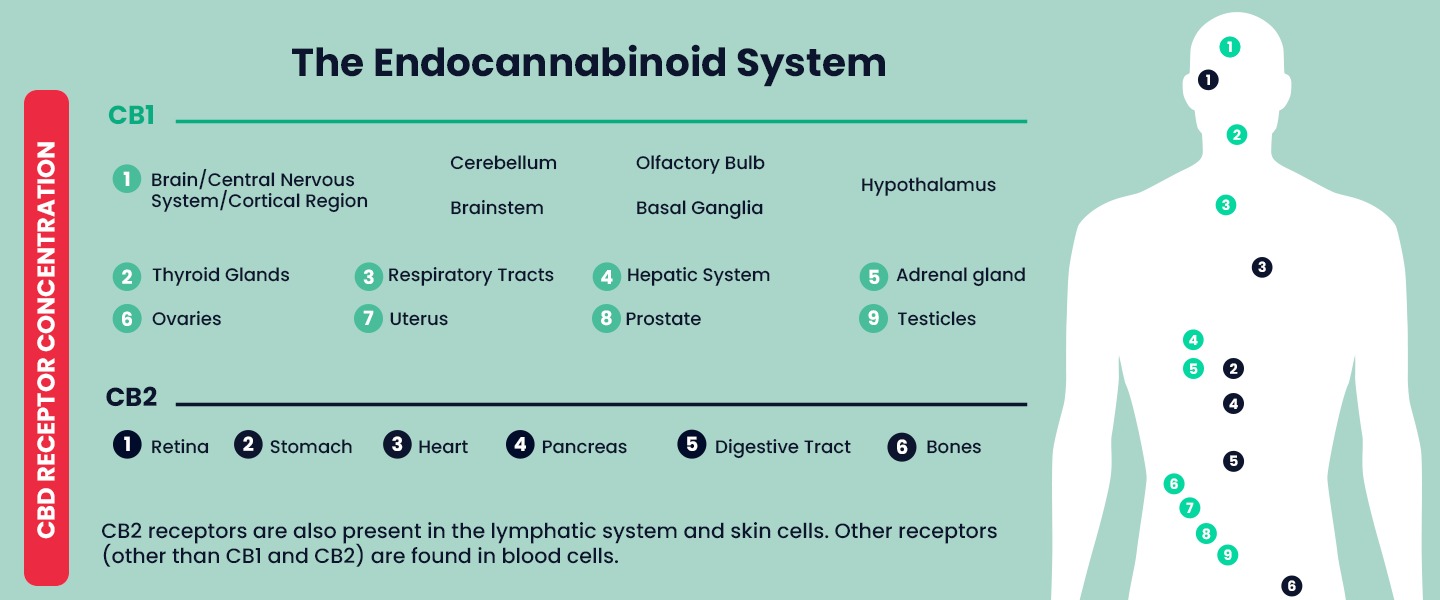
Pertwee, writing in a review in the British Journal of Pharmacology in 2008, summarised the central finding: cannabidiol shows only low affinity for the two cannabinoid receptors CB1 and CB2 and, in the laboratory, is active at other targets, such as the serotonin receptor 5-HT1A and the ion channel TRPV1 [2]. These results come from pharmacological lab research, meaning cell culture and animal studies.
So how does CBD work in the body, and what does CBD do there? Put plainly, the lab findings explain why cannabidiol is being researched, but they do not show an effect in people, and the mechanism is not fully understood. When you read about CBD effects on the body, the brain or the nervous system, it usually means a finding from cell or animal studies. We grade the human evidence step by step further down.
The endocannabinoid system: receptors and messengers
The endocannabinoid system is the body’s own cannabinoid system, built from three components: receptors, messengers and enzymes. Each plays a different role in the signal – receiving it, sending it, breaking it down.
| Component | Example | Where it is found |
|---|---|---|
| Receptors | CB1, CB2 | CB1 mainly in the nervous system, CB2 mainly in immune cells |
| Messengers (endocannabinoids) | anandamide, 2-AG | made by the body when needed |
| Enzymes | FAAH, MAGL | break the messengers down again |
The receptors in the nervous and immune systems receive the body’s own messengers anandamide and 2-arachidonoylglycerol (2-AG); enzymes then break these down. Physiology describes the system as part of homeostasis, the body’s internal balance. Where the two hemp compounds part ways is at the CB1 receptor: THC activates it directly, which explains the high. According to Pertwee’s lab findings, CBD does not [2] – the reason CBD does not intoxicate. CBD is only one of many compounds that interact with this system; how the body itself processes CBD is a separate question, covered under individual differences below.
CBD oil benefits: what studies on oral CBD have measured
What is known about CBD oil benefits comes from studies with oral CBD solutions and medicinal preparations, not from products on a cosmetic or aromatic-oil shelf – and that is the most important distinction on this page. CBD oil, also called CBD drops, is a CBD extract in a carrier oil such as MCT oil (from coconut) or hemp seed oil. Whether you search for cannabidiol oil, CBD drops or hemp extract, the same product is meant.
Millar and colleagues, in a 2018 systematic review in Frontiers in Pharmacology, assessed the human studies on the pharmacokinetics of cannabidiol – how CBD is absorbed, distributed and broken down [3]. Their finding on oral use is sobering: the absolute bioavailability of oral CBD has not yet been determined in humans, and the only measured value concerns smoking, at 31% [3]. How much CBD from an oil actually reaches the blood is therefore less well documented than much marketing copy suggests.
Besides their strength, CBD oils differ in the composition of the extract, and the axis is how much besides CBD stays in it. Full spectrum contains further cannabinoids and terpenes as well as THC under 1%; broad spectrum keeps the accompanying compounds without THC; an isolate contains pure CBD only. That is a question of composition, not a ranking of quality – you will find more on the aroma compounds in our article on terpenes in the cannabis plant.
Personal accounts of what CBD oil does are not studies either: they record what someone expected and experienced, not what a product causes. The research areas in which CBD oil appears are set out further down by evidence level, and the studies describe study preparations, not a recommendation for use. The CBD oils at uWeed are classified as cosmetics or aromatic oils.
CBD oil, hemp seed oil and cannabis oil: three different products
Three oils with similar names are three different products, and only one of them is CBD oil. They differ in which part of the plant is used and whether cannabinoids and THC are in the oil – which is why searches mixing “hemp oil”, “cannabis oil” and “CBD oil” often land on a different product than intended.
| Criterion | Hemp seed oil | CBD oil | Cannabis oil with THC |
|---|---|---|---|
| Source material | seeds, usually cold-pressed | flowers and leaves of industrial hemp, e.g. by CO2 extraction | flowers of THC-rich cannabis |
| Cannabinoids | practically none | CBD, plus others depending on the spectrum | THC, often also CBD |
| THC | practically none | under 1% | 1% and more possible |
| Classification in Switzerland | culinary oil | cosmetic or aromatic oil, not a narcotic [1] | narcotic; as medical cannabis only on prescription |
Hemp seed oil contains almost no cannabinoids and is a culinary oil, whereas cannabis oil in the narrow sense can contain THC. The question of what cannabis oil does can therefore only be answered product by product. A CBD oil with under 1% THC is permitted in Switzerland, while a cannabis oil with a higher THC content falls under narcotics law – our overview of whether CBD is legal in Switzerland explains the details.
CBD flowers, hemp capsules, hemp tea and skincare: what changes with the product form
The product form first decides the legal class and the route by which CBD enters the body, while research on effects by form is thin. Five forms are common, and they differ on two axes: their product class in Switzerland and their route. Questions about CBD flower benefits are therefore answered by the legal position first.
| Product form | Product class in Switzerland | Route | State of research |
|---|---|---|---|
| CBD oil | cosmetic or aromatic oil | studies: oral solutions; as a cosmetic: on the skin | human pharmacokinetic studies with oral preparations [3] |
| CBD flowers | tobacco substitute product | inhalation (smoking, vaporising) | pharmacokinetics measured for smoking [3] |
| Hemp capsules | foodstuff | oral | hardly any studies on the product form itself |
| Hemp tea | foodstuff | oral, as an infusion | hardly any studies on the product form itself |
| CBD skincare | cosmetic | on the skin (topical) | mainly animal data on skin application |
CBD flowers are smoked or vaporised and are classified in Switzerland as tobacco substitute products. Smoking is still smoking: combustion produces harmful substances as with tobacco, whatever the CBD content. Accordingly, the CBD flowers grown in Switzerland at uWeed are sold as tobacco substitute products.
Hemp capsules and hemp tea, by contrast, are consumed orally and are foodstuffs. There are hardly any studies on hemp capsules or hemp tea as product forms; the measurements for the oral and the inhaled route come from the review by Millar and colleagues [3] and are no basis for a time in minutes for any product. In Switzerland, hemp tea is likewise classified as a foodstuff and falls under food law.
CBD skincare – creams and balms – is a cosmetic for the skin. Searches such as “CBD cream for arthritis” or “CBD topical oil for pain” ask about an outcome, and research on the skin route is mainly animal data. What can be said is the class: CBD skincare is sold as a cosmetic product. So tell the forms apart by legal class and use – smoking, infusion, skincare – not by a hoped-for effect.
When does CBD take effect, and how long does it last?
When CBD takes effect is not established; how long it stays measurable in the blood is. Millar and colleagues (2018) report peak blood levels mostly within 0 to 4 hours and a half-life of 1.4 to 10.9 hours up to 2 to 5 days, depending on the route [3]. These are blood measurements, not the onset of an effect.
| Route in studies | Half-life |
|---|---|
| Oromucosal spray, single dose | 1.4–10.9 hours |
| Oral, repeated use | 2–5 days |
| Intravenous | about 24 hours |
| Smoking | about 31 hours |
In the studies reviewed, the time to peak blood level (Tmax) lay mostly between 0 and 4 hours and was delayed by food [3]. The half-life of CBD tells you how quickly the blood level falls again.
How long does CBD take to work? That cannot be answered with these data: a blood level does not say whether or when someone notices anything, and robust studies on that are missing. That is why we give no times in minutes here, including for how long an effect might last in everyday life. Little is known about regular use over months; what studies show on tolerability is covered further down in the safety section.
Metabolism, product and expectation: why CBD varies between people
Three factors explain why experiences with CBD vary so much from person to person: metabolism, the product and the expectation. The first is measured: Millar and colleagues report clear differences in blood levels between and within study participants, and in one study, levels with food were several times higher [3].
With the product, what counts is whether the contents match the label. Check the lab report for the batch: the certificate of analysis states the actual CBD and THC content and shows whether the label is right. How percentages convert into milligrams, and what that means for a bottle, is explained in our article on how CBD strength and concentration are labelled.
That leaves expectation: placebo and nocebo effects matter in CBD studies, which is why meaningful studies always compare against a placebo. When CBD seemingly “doesn’t work”, the reason often lies in the product and the expectation, not in a recipe you followed wrongly.
What does research show about CBD for specific conditions?
Research is studying CBD in many conditions, but for almost all of them there are only lab or animal findings and few robust human studies. To place them, an evidence ladder with three steps helps: cell culture, animal study, human study.
Within human studies, a randomised controlled trial carries more weight than an observation, and a review or meta-analysis more than a single study. So questions like “what is CBD oil good for?” are not answered by any single CBD study, only by the sum of the evidence. Each area below follows the same pattern: the research frame, the evidence level, one selected study.
The only approved use concerns a prescription CBD medicine for rare, severe forms of epilepsy. That preparation cannot be compared with CBD products sold freely: it is a tested medicine that doctors prescribe and monitor. Research is at an early stage almost everywhere else.
CBD and epilepsy
Epilepsy is the one area with high-quality human trials on CBD. Devinsky and colleagues, writing in the New England Journal of Medicine in 2017, studied a CBD medicine in a randomised, placebo-controlled trial with 120 children and young adults with Dravet syndrome, a rare and severe form of epilepsy [4]. Evidence level: human study (RCT). The median number of convulsive seizures per month fell from 12.4 to 5.9 in the CBD group and from 14.9 to 14.1 in the placebo group; at the same time, side effects such as diarrhoea, drowsiness and abnormal liver values were more frequent with the preparation [4].
The medicine is also being studied in Lennox-Gastaut syndrome. Such results cannot be transferred to oils, flowers or hemp capsules: the preparation is prescription-only and used under medical supervision. CBD sold freely is not a medicine; medical questions belong with a doctor.
CBD and pain
Pain is the most searched topic, and the one where most human studies did not test CBD on its own but together with THC. Boyaji and colleagues, in a 2020 review in Current Pain and Headache Reports, assessed the evidence on CBD in chronic pain management [5]. Evidence level: review of mostly preclinical data and few human studies. Their conclusion: because CBD was almost always combined with THC in the trials, an effect can hardly be attributed to CBD alone, and a recommendation for CBD in chronic pain is difficult on this basis [5].
So whether you search for CBD oil for pain, CBD for chronic pain, cannabidiol for chronic pain or CBD for back pain, the evidence is mixed. Back pain, muscle pain and inflammation are areas being studied, but robust results in people are missing for them too. Research on applying CBD to the skin exists mainly in animals, as the arthritis section shows. Searches like “how to use CBD oil for pain” ask for an instruction research cannot give. CBD sold freely is not a medicine; medical questions belong with a doctor.
CBD and arthritis
The most cited work on CBD and arthritis is an animal study – a reason for research, not a result for people with arthritis. Hammell and colleagues, in the European Journal of Pain in 2016, studied a CBD gel applied to the skin in a rat model of arthritis; joint swelling and pain-related behaviour decreased in the animals [6]. Evidence level: animal study, and the results cannot be transferred to humans.
Controlled human studies on CBD for arthritis – osteoarthritis or rheumatoid arthritis – are so far few, so “is CBD good for arthritis?” has no answer from human data. Questions about CBD dosage for arthritis cannot be answered either: no dose of CBD is established for any condition, and that is a question for a doctor. CBD cream for arthritis is, in Switzerland, a cosmetic, which describes its class, not an outcome. CBD sold freely is not a medicine; medical questions belong with a doctor.
CBD and anxiety
Anxiety is where CBD research looks most consistent in the lab, and still thinnest in long-term human trials. Blessing and colleagues, in a 2015 review in Neurotherapeutics, assessed preclinical and human evidence on cannabidiol and anxiety disorders [7]. Evidence level: review of mostly preclinical studies and a few acute human experiments. They found consistent findings in animal models, limited human data from single-dose experiments, and called for studies of longer use in people with anxiety disorders [7].
Searches like “CBD for anxiety”, “does CBD calm anxiety immediately” or “CBD relaxation” expect a promise the research does not make: a single-dose test in a lab, such as a simulated public-speaking task, is not everyday use. The question of how to use CBD oil for anxiety is not answered by these studies either, and CBD is not a substitute for treatment. CBD sold freely is not a medicine; medical questions belong with a doctor.
CBD and sleep
What is said about CBD and sleep mostly comes from research on cannabis and cannabinoids in general; CBD on its own is barely studied for sleep. Babson and colleagues, in a 2017 review in Current Psychiatry Reports, assessed the literature on cannabis, cannabinoids and sleep [8]. Evidence level: review of mixed, mostly small studies. For CBD they describe the research as preliminary and call for controlled, longer-term studies [8].
Many of the findings in the review concern THC-containing cannabis, not CBD alone, so “does CBD help with sleep?” cannot be answered from it, and research on CBD for sleep, or CBD oil for sleep in particular, is limited. CBD sold freely is not a medicine; medical questions belong with a doctor.
CBD and depression
On CBD and depression there are only a few small studies, and the best available analysis finds hardly any robust evidence. Black and colleagues, in a 2019 systematic review and meta-analysis in The Lancet Psychiatry, assessed 83 studies on cannabinoids in mental disorders, including depression and ADHD [9]. Evidence level: meta-analysis of human studies. Their result: there is very low-quality evidence that cannabinoids improve depressive disorders, and only a few of the studies examined CBD at all [9].
To “can CBD treat depression?” or searches for CBD oil for depression, research therefore gives no supporting answer, and CBD does not replace treatment. If you take medication, also read the section on interactions further down. CBD sold freely is not a medicine; medical questions belong with a doctor.
CBD and ADHD
ADHD is among the least studied areas: the meta-analysis by Black and colleagues (2019) also covered ADHD and found too few studies to conclude that cannabinoids improve it [9]. Evidence level: meta-analysis of human studies, with very little data on ADHD. Questions like “CBD for ADHD” or “does CBD help ADHD?” therefore have no answer from research.
For children and young people, one point is clear: the only CBD medicine for children is a prescription drug for rare forms of epilepsy, and freely sold CBD products are not a children’s topic. CBD sold freely is not a medicine; medical questions belong with a doctor.
CBD and Parkinson’s disease
On CBD and Parkinson’s disease there is one small exploratory human study, and its design shows why no recommendation follows from it. Chagas and colleagues, in the Journal of Psychopharmacology in 2014, studied 21 people with Parkinson’s disease in a double-blind trial; they received placebo or CBD in one of two dose groups [10]. Evidence level: small human study. The researchers found no significant difference in motor scores; only a quality-of-life questionnaire differed in the higher-dose group from placebo, and the authors call for larger studies [10].
Multiple sclerosis and restless legs syndrome – searched as “CBD restless leg syndrome” – are also areas being studied, but robust results in people are missing there as well as for CBD oil for Parkinson’s. CBD sold freely is not a medicine; medical questions belong with a doctor.
CBD and weight loss
The hope for CBD and weight loss and the question “does CBD make you hungry?” have the same answer: the findings come from animals, and robust human data are missing. Ignatowska-Jankowska and colleagues, in Neuroscience Letters in 2011, observed lower weight gain in rats given CBD and suggested CB2 receptors were involved [11]. Evidence level: animal study.
The difference from THC lies in its reputation: THC is known for stimulating appetite, CBD is not. Searches like “CBD for weight loss”, “how do I use CBD to lose weight” or “can CBD help weight loss” therefore find no answer from human research. CBD sold freely is not a medicine; medical questions belong with a doctor.
CBD and sex
On CBD and sex, research is so thin that any claim of an effect goes too far. What is reported about cannabis and sex comes mostly from surveys on THC-containing cannabis, not on CBD alone. There are hardly any studies on CBD alone and libido or arousal. So for “CBD and sex”, the honest answer is: there is no robust state of research. CBD sold freely is not a medicine; medical questions belong with a doctor.
CBD and sport
Questions about CBD in sport come mainly from athletes thinking of recovery; the research is early, and the practical issue is THC traces, not CBD. McCartney and colleagues, in a 2020 narrative review in Sports Medicine – Open, assessed the evidence relevant to CBD and sports performance [12]. Evidence level: narrative review of mostly preclinical and indirect data; the authors call for studies with athletes [12].
On anti-doping, they note that the World Anti-Doping Agency removed CBD from its prohibited list in 2018, while THC remains prohibited [12]. Full-spectrum products can contain THC traces, which is where the risk for athletes lies. CBD sold freely is not a medicine; medical questions belong with a doctor.
Other areas of CBD research
The list of areas in which CBD is studied is long – its length is not evidence; it shows how early the research still is. In four further areas, mainly lab and animal data or small pilot studies exist:
- Heart and blood pressure: the question “can CBD lower blood pressure?” has been looked at in early studies with few participants.
- Skin: CBD on the skin is studied mainly in the lab and in small observations.
- Metabolism: questions around blood sugar and metabolism are at an early stage of research.
- Addiction research: CBD is explored in pilot studies and animal models on smoking and alcohol.
None of these areas allows a statement about an effect in people today. CBD sold freely is not a medicine; medical questions belong with a doctor.
Is CBD safe?
In studies, CBD is considered generally well tolerated, but not without consequences: side effects and interactions with medication are documented. Iffland and Grotenhermen, in a 2017 review in Cannabis and Cannabinoid Research, summarise clinical and animal safety data and confirm an overall favourable safety profile [13]. Evidence level: review of human and animal studies. Large long-term studies are missing, though, and the authors call for larger and longer investigations [13]. The two questions that matter most are side effects and interactions, and groups that need particular protection.
Side effects and interactions with medication
The most frequent side effects are mild; the more important question is interactions with medication. In the studies reviewed by Iffland and Grotenhermen, tiredness, diarrhoea and changes in appetite and weight were among the most frequent side effects [13]. Which further effects are reported is summarised in our article on the side effects of CBD.
CBD is broken down by liver enzymes of the cytochrome P450 group that also process many medicines, so interactions are possible, and the authors call for more research on exactly these [13]. If you take other medication, check with your doctor or pharmacist.
Children, pregnancy and breastfeeding
For children, pregnant and breastfeeding women, safety data are missing, so caution applies instead of weighing up. Authorities advise against CBD products during pregnancy and breastfeeding because robust data are missing.
For children the position is just as clear. The approved medicine for rare forms of epilepsy is prescribed and monitored by a doctor; freely sold CBD products are not a children’s topic.
Common misconceptions about CBD’s effects
Short claims circulate about CBD’s effects, and each is only half true. We hear three of them particularly often, and each can be set straight with what is above.
“CBD doesn’t get you high” – but not every product is THC-free
CBD itself does not get you high, because it does not activate the CB1 receptor the way THC does [2]. The true core of the misconception lies with the product: under 1% THC is permitted in Switzerland, but under 1% THC is not zero THC [1]. Full-spectrum products can therefore contain THC traces, which the lab report for the batch shows and which can matter in a drug test. We answer whether CBD can make you high in more detail in a separate article.
“Natural” does not mean harmless
A plant origin says nothing about tolerability: plant-based is not risk-free, and amount, quality and interactions decide. What studies show on safety is set out in the section “Is CBD safe?” above. For quality, the lab report for the batch is the test, because it confirms the CBD and THC content of a natural product. Interactions with medication apply to a plant extract just as they do to any other substance.
A study is not proof that CBD works
The fact that CBD is being researched does not turn freely sold products into medicines. The evidence ladder from above applies here too: a finding in cell culture or in an animal study is a reason for further studies; only placebo-controlled human studies and a drug approval are proof. Medical CBD is therefore available only on medical prescription – in Switzerland, doctors can prescribe CBD medicines.
Frequently asked questions about CBD’s effects
What does CBD feel like?
CBD does not feel like a high: it produces no intoxication and does not change perception the way THC does. How individuals perceive CBD subjectively is not consistently described by science. Personal reports are not study results, and expectation shapes them strongly. Anyone describing what CBD feels like can therefore rely on only one established point: no high.
Is CBD addictive?
No signs of a potential for dependence or abuse have been found for pure CBD so far, unlike THC-containing cannabis. This is linked to the difference at the CB1 receptor: CBD produces no high that would encourage repeated use. The assessment applies to CBD as a substance, not to products containing THC. For questions about dependence and addiction treatment, a specialist service or a doctor is the right contact.
Can CBD make you fail a drug test?
Yes, a drug test can come back positive after CBD products, though not because of CBD: tests look for THC, not CBD. Standard urine tests look for THC breakdown products such as THC-COOH. Full-spectrum products contain THC under 1%, and these traces can add up with regular use. We explain how long THC stays detectable in a drug test separately.
Can you drive after using CBD?
Yes, in principle you may drive after using CBD, because on the road what counts legally is THC in the blood, not CBD. CBD itself has no legal limit, but THC traces from a product can. Switzerland sets a legal limit for THC in the blood. Anyone who feels unsure or impaired does not drive. The rules in detail are in our article on driving after using CBD in Switzerland.
How do the effects of CBD and CBG differ?
A comparison of the effects of CBD and CBG can hardly be supported today, because cannabigerol (CBG) is even less researched than CBD. CBG is a cannabinoid in its own right and is considered the precursor from which the plant forms other cannabinoids. The state of research is correspondingly thin and rests mainly on lab findings. What is known so far is in our article on what CBG is and how it is studied.
The bottom line: what is known about CBD benefits
Less is established about CBD benefits and CBD effects than much marketing copy implies: well researched is little, studied is a lot. What is established is what cannabidiol is, that it does not intoxicate, and how long it stays measurable in the blood by route [3]. The only approval concerns a medicine for rare forms of epilepsy [4]. For CBD oil in specific conditions, mostly lab and animal data or small studies are available, so medical questions belong with a doctor. You will find more about CBD at uWeed, the Swiss CBD shop.
Sources on CBD benefits
- Verordnung des EDI über die Verzeichnisse der Betäubungsmittel, psychotropen Stoffe, Vorläuferstoffe und Hilfschemikalien (BetmVV-EDI), SR 812.121.11 (no official English version), Annex 1, list d, consulted on 04.11.2026.
- Pertwee RG (2008): The diverse CB1 and CB2 receptor pharmacology of three plant cannabinoids: Δ9-tetrahydrocannabinol, cannabidiol and Δ9-tetrahydrocannabivarin. British Journal of Pharmacology 153(2): 199–215.
- Millar SA, Stone NL, Yates AS, O’Sullivan SE (2018): A Systematic Review on the Pharmacokinetics of Cannabidiol in Humans. Frontiers in Pharmacology 9: 1365.
- Devinsky O, Cross JH, Laux L, Marsh E, Miller I, Nabbout R, et al. (2017): Trial of Cannabidiol for Drug-Resistant Seizures in the Dravet Syndrome. New England Journal of Medicine 376(21): 2011–2020.
- Boyaji S, Merkow J, Elman RNM, Kaye AD, Yong RJ, Urman RD (2020): The Role of Cannabidiol (CBD) in Chronic Pain Management: An Assessment of Current Evidence. Current Pain and Headache Reports 24(2): 4.
- Hammell DC, Zhang LP, Ma F, Abshire SM, McIlwrath SL, Stinchcomb AL, et al. (2016): Transdermal cannabidiol reduces inflammation and pain-related behaviours in a rat model of arthritis. European Journal of Pain 20(6): 936–948.
- Blessing EM, Steenkamp MM, Manzanares J, Marmar CR (2015): Cannabidiol as a Potential Treatment for Anxiety Disorders. Neurotherapeutics 12(4): 825–836.
- Babson KA, Sottile J, Morabito D (2017): Cannabis, Cannabinoids, and Sleep: a Review of the Literature. Current Psychiatry Reports 19(4): 23.
- Black N, Stockings E, Campbell G, Tran LT, Zagic D, Hall WD, et al. (2019): Cannabinoids for the treatment of mental disorders and symptoms of mental disorders: a systematic review and meta-analysis. The Lancet Psychiatry 6(12): 995–1010.
- Chagas MHN, Zuardi AW, Tumas V, Pena-Pereira MA, Sobreira ET, Bergamaschi MM, et al. (2014): Effects of cannabidiol in the treatment of patients with Parkinson’s disease: An exploratory double-blind trial. Journal of Psychopharmacology 28(11): 1088–1098.
- Ignatowska-Jankowska B, Jankowski MM, Swiergiel AH (2011): Cannabidiol decreases body weight gain in rats: Involvement of CB2 receptors. Neuroscience Letters 490(1): 82–84.
- McCartney D, Benson MJ, Desbrow B, Irwin C, Suraev A, McGregor IS (2020): Cannabidiol and Sports Performance: a Narrative Review of Relevant Evidence and Recommendations for Future Research. Sports Medicine – Open 6: 27.
- Iffland K, Grotenhermen F (2017): An Update on Safety and Side Effects of Cannabidiol: A Review of Clinical Data and Relevant Animal Studies. Cannabis and Cannabinoid Research 2(1): 139–154.