

Cannabinol (CBN) is a cannabinoid of the hemp plant that forms mainly as THC breaks down. Pure CBN is now controlled as a narcotic in Switzerland [1]. We explain what CBN is and where it comes from, how it differs from CBD and THC, what Swiss law says, which CBN products are sold abroad and what research actually shows.
What Does CBN Stand For? Cannabinol Defined
CBN stands for cannabinol, a cannabinoid of the hemp plant that the plant does not make directly: it forms mostly as THC breaks down over time. That is why CBN is barely present in fresh plants, turns up more often in aged hemp and usually stays at low levels.
So what’s CBN, and what does CBN mean when you see it on a cannabis label? The CBN meaning is the same in weed and in hemp, and the definition sits in the name: a phytocannabinoid, in other words a cannabinoid that comes from the Cannabis sativa plant, defined by its origin rather than by anything the plant builds on purpose.
If you have seen CBN on a label and wondered what it is, you are looking at a close relative of cannabidiol (CBD), tetrahydrocannabinol (THC) and cannabigerol (CBG). Cannabinol was one of the first cannabinoids to be isolated, long before CBD and THC were described in detail. Of this family, CBD is by far the best studied today, and we summarise what research says about CBD in a separate article.
What makes CBN interesting is less its amount than its origin: as a breakdown product of THC, it is a sign that a plant has aged.
Where Does CBN Come From?
CBN forms as THC oxidises over time, and light, heat and oxygen speed this breakdown up. The longer cannabis is exposed to all three, the more of its THC turns into cannabinol.
The chain has two steps: THCA → THC → CBN. First, heat turns the acid form THCA into THC; that step is decarboxylation. Only the second step, the oxidation of THC, produces CBN, so it is oxidation and not decarboxylation that creates cannabinol. That is also the answer to what CBN is in weed: its level rises in old or poorly stored flowers, while fresh plants contain almost none. A high CBN value in a lab analysis therefore tells you mainly about the age and storage of a flower.
Products with a meaningful CBN content used CBN that was isolated or made synthetically or semi-synthetically, for example as an isolate. It is precisely these pure forms that are now controlled; we explain what that means below.
CBN vs CBD vs THC: The Differences
CBN vs CBD comes down to two things: how each one forms and how Swiss law classifies it. Together with THC and CBG, these are four cannabinoids from the same plant: the plant makes CBD and CBG itself from a shared precursor, CBGA, while CBN only appears later, from THC.
| Cannabinoid | How it forms | Found in fresh hemp | Legal status in Switzerland |
|---|---|---|---|
| CBD (cannabidiol) | made by the plant from the precursor CBGA (as CBDA) | the main cannabinoid in CBD hemp | marketable in hemp and CBD products under the total-THC limit, depending on product class |
| CBG (cannabigerol) | from the precursor CBGA, the starting point for the other cannabinoids | usually in small amounts | as for CBD, depending on product class |
| THC (tetrahydrocannabinol) | made by the plant from CBGA (as THCA) | low in CBD hemp, high in THC-rich cannabis | controlled above the total-THC limit |
| CBN (cannabinol) | through oxidation of THC | barely present | pure CBN controlled [1] |
The difference between CBN and CBD is therefore one of origin and legal status: CBD is a plant compound that may be sold under the limit, CBN a breakdown product that is controlled as a pure substance. Is CBN the same as CBD? No, it is a different cannabinoid, and the data available do not support ranking CBD and CBN as “better” or “stronger”, so we do not.
The same logic runs across THC vs CBD vs CBN: origin explains how much of each the plant contains, and the law decides what may be sold. For THC that classification hangs on the total-THC limit, for CBN on its listing as a pure substance. Our article on CBD and THC compared covers the two best-known cannabinoids in detail.
Is CBN Psychoactive?
CBN does not produce a high like THC, but it is not considered fully inactive either. In a human study published in Pharmacology in 1975, Karniol and colleagues found that CBN on its own did not produce the “drugged” feeling caused by THC, while combined with THC it slightly strengthened some of THC’s effects [2].
That was a small, old study with five volunteers, so it settles little. Lab data suggest that cannabinol binds CB1 receptors much more weakly than THC. And is CBN THC? No: it forms from THC but is a different molecule.
“Not intoxicating like THC” does not mean “permitted”, though: pure CBN is controlled in Switzerland whatever its weak psychoactivity [1]. For comparison with a cannabinoid considered non-intoxicating, read our article on cannabigerol (CBG).
Is CBN Legal in Switzerland?
No, pure CBN is no longer freely sold in Switzerland: according to Swissmedic, the Swiss agency for therapeutic products that also issues narcotics permits, it falls under the derivatives of number 303 (cannabinoids) in Annex 6 of the FDHA Narcotics List Ordinance (BetmVV-EDI) and is therefore controlled [1, 3]. The earlier statement that CBN is not a controlled substance in Switzerland no longer holds.
Only industrial and scientific use are exempt from this control; private use is not [1]. For you as a private person, that means the question “is CBN legal?” now has a clear answer in Switzerland: CBN products that used to be sold freely now fall under the Swiss Narcotics Act. It does not matter what a product is called or what form it takes, only whether it contains pure or added CBN; the detail follows in the next section.
That is why uWeed no longer carries CBN products. The legal status of CBD is unaffected, because CBD is not controlled as a narcotic, and the Swissmedic clarification concerns CBN only [1]. What applies to CBD products and where the THC limit lies is explained in our overview of whether CBD is legal in Switzerland.
Pure CBN, Natural Content and Exceptions
The control covers pure and enriched CBN, not the hemp plant with its natural CBN content [1]. What matters is whether CBN was added or enriched as a substance, or simply occurs in the plant. Four points draw the line:
- Covered: CBN as a pure substance, such as cannabinol isolate sold as “CBN crystals” [1].
- Covered: CBN products to which CBN was added or in which it is enriched, such as CBN oils, tinctures and drops, tablets, hemp capsules with added CBN or “CBN flowers” with an enriched content [1].
- Not covered: CBN at its natural concentration in the hemp plant. Cannabis is not controlled because of the cannabinoids it contains naturally; what counts is the total THC content measured against the legal limit set in the BetmVV-EDI [1, 3].
- Exception with conditions: industrial use must be plausibly demonstrated, and the end product must comply with the relevant law, for example food or therapeutic-products law. Purely commercial trade without a compliant product is not industrial use [1].
So a product’s form does not decide how it is classified; only whether CBN was added to it as a substance does.
CBN Good Night and Other Former CBN Products
“CBN Good Night” is the name of a product with added CBN that people in Switzerland still search for. Products like it are no longer sold here, and the reason is legal: since pure and added CBN fall under the derivatives of number 303, selling them for private use is no longer permitted [1]. That applies to every former CBN product, whatever the brand. We therefore do not reproduce reviews of individual products: if you search for “CBN Good Night”, this page gives you the legal position, not a rating.
CBN Oil, Gummies and Other Forms Sold Abroad
The CBN products described here are sold in some other countries; in Switzerland, pure and added CBN is controlled, so none of them may be sold for private use [1]. The table explains what each form is and how it is generally used where it is sold, because that is how most readers first meet CBN.
What is CBN oil, then? It is the most common of these forms abroad: a carrier oil with CBN added. What is CBN in gummies and edibles? The same compound, added to a food product instead. Many such products combine CBN with CBD or other cannabinoids. In Switzerland, CBD products in these forms are a separate legal matter, and the CBD oils uWeed sells are cosmetic or aromatic products, not intended for ingestion.
| Form | What it is | How it is used abroad | Status in Switzerland |
|---|---|---|---|
| Oils, tinctures and drops | CBN dissolved in a carrier oil, sold in dropper bottles | taken by mouth | not for private use [1] |
| Gummies and other edibles | CBN added to a food product such as a gummy | swallowed | not for private use [1] |
| Capsules and tablets | CBN in a pre-measured capsule or tablet | swallowed | not for private use [1] |
| Vape products | CBN in a liquid or cartridge | inhaled | not for private use [1] |
| Isolate | CBN as a crystalline powder | used to make other products | not for private use [1] |
CBN Effects: What the Research Shows
What is CBN good for? There is no proven benefit in humans: most findings on CBN effects come from cell and animal studies, and very few from studies in people. A great deal is promised about cannabinol, and little has been shown.
Maioli and colleagues reviewed the field in 2022 in the journal Plants: cannabinol remains little studied, no human data on how the body processes it exist, and most results come from animal or cell models [4]. The table shows which evidence level each research question has reached. How CBN might act alongside other cannabinoids and terpenes is discussed under the name entourage effect.
| Research question | Evidence level | What it can show |
|---|---|---|
| Sleep (“does CBN make you sleepy?”) | one very small human study, in combination with THC; animal results not replicated | not established in humans |
| Pain | animal studies in rats | preliminary, barely studied in humans |
| Appetite | animal studies in rats | preliminary, not shown in humans |
| Nerve cells | cell culture | preliminary, basic research |
None of these observations is a proven benefit. Research suggests effects in some areas, but preliminary lab data do not carry over to people, and the review itself concludes that sleep-inducing properties of CBN are unsubstantiated from a clinical perspective [4]. That also means none of the products in the previous section is backed by proven effects of cannabinol.
How Does CBN Work?
How does CBN work? What is known is mostly receptor-binding data, which show where CBN may act rather than what it does to your body. The endocannabinoid system is the body’s own signalling network, with two main receptors, CB1 and CB2.
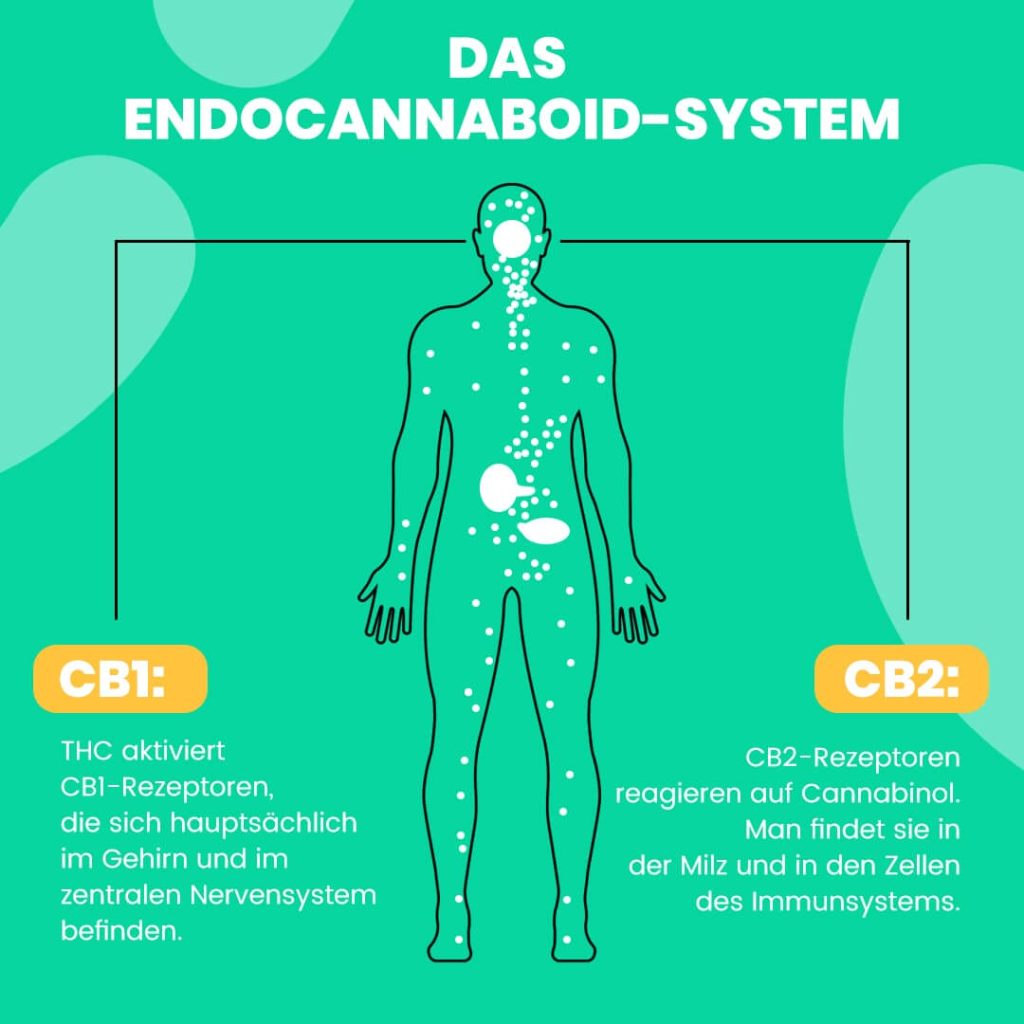
Lab data suggest that CBN may bind both CB1 and CB2 receptors, and that it binds CB1 more weakly than THC. These are laboratory measurements, not observations in people. Binding data like these do not show an effect in humans; for what has actually been studied, see the evidence table above.
CBN Side Effects: Is CBN Safe?
There are hardly any reliable data on CBN side effects, because cannabinol has barely been studied in people. In the few small human studies, drowsiness was among the reactions reported; how often it occurs cannot be derived from these data.
Whether CBN can cause headaches, whether CBN is addictive and how it interacts with medicines have barely been studied either. Its relative CBD is far better documented, and you can read what is known in our article on the side effects of CBD. Products sold abroad, such as gummies, often combine CBN with other cannabinoids, so a reaction reported after taking them cannot be put down to CBN alone.
Because pure CBN is controlled in Switzerland [1], the question of whether CBN is safe is now largely a historical one for consumers here.
Common Misconceptions About CBN
Four common assumptions about CBN do not hold up, mostly because the marketing is older than the current legal position. Here is how they compare with the facts:
- “CBN is a sleeping aid.” CBN is not an authorised medicine in Switzerland, and pure CBN is a controlled substance [1].
- “CBN is a terpene.” There are no CBN terpenes: CBN is a cannabinoid. Terpenes are aroma compounds such as myrcene or limonene that also occur in hemp; you can read more about them in our article on terpenes.
- “CBN is legal like CBD.” That used to be true, but not any more: pure CBN is controlled, CBD is not [1].
- “CBN strains are a variety of their own.” CBN content rises through ageing and the oxidation of THC, not through breeding. US articles list “CBN strains”, but there is no CBN variety with its own genetics, and high-THC cannabis is not legal in Switzerland in any case.
All four rest on the same mix-up: CBN was marketed like a new CBD, yet chemically it is a breakdown product and legally a controlled substance.
The Bottom Line on CBN
CBN is a cannabinoid that forms differently from CBD: not in the growing plant, but as THC breaks down under light, heat and oxygen. Cannabinol is chemically interesting but scientifically little proven, and research on its effects rests mostly on lab and animal studies. Legally the position is clear: pure CBN is controlled in Switzerland, so the oils, gummies and capsules sold abroad cannot be sold for private use here, while the status of CBD is unchanged. Reading about CBN today means reading about a substance caught between research and prohibition.
Sources and Legal Basis for CBN
- “Clarification concerning CBN that falls under derivatives of number 303 cannabinoids”, Swissmedic, as of July 2026, BetmVV-EDI Annex 6, number 303, accessed 29.10.2026.
- Karniol IG, Shirakawa I, Takahashi RN, Knobel E, Musty RE (1975): Effects of Δ9-Tetrahydrocannabinol and Cannabinol in Man. Pharmacology 13(6): 502–512.
- Verordnung des EDI über die Verzeichnisse der Betäubungsmittel, psychotropen Stoffe, Vorläuferstoffe und Hilfschemikalien (BetmVV-EDI), SR 812.121.11 (FDHA Ordinance on the Lists of Narcotics, Psychotropic Substances, Precursors and Auxiliary Chemicals; German version), Annex 6, number 303, accessed 29.10.2026.
- Maioli C, Mattoteia D, Amin HIM, Minassi A, Caprioglio D (2022): Cannabinol: History, Syntheses, and Biological Profile of the Greatest “Minor” Cannabinoid. Plants 11(21): 2896.