
Terpenes are the aroma compounds of the hemp plant, and the same terpenes give CBD products such as flowers, hash and oil their smell. So what is a terpene? It is a volatile molecule that decides whether a strain smells of lemon, pepper or pine, and it is not a cannabinoid: cannabidiol (CBD) is one, and Swiss hemp products must by law contain under 1% THC. Cannabis terpenes appear on the certificate of analysis as a terpene profile of their own. We cover how they smell, where they occur, their boiling points and how to read that profile, but not what they do in the human body.
What are terpenes?
A terpene is a volatile organic compound: a hydrocarbon that plants build from five-carbon isoprene units. Terpenes are secondary plant compounds found in hemp as well as in citrus peel, lavender and conifers. Because they evaporate at room temperature, you smell them straight away, and because they are so volatile, heat drives them off first.
Ask a chemist what a terpene is and the answer starts with those isoprene units. Monoterpenes such as myrcene, limonene and pinene are built from two units with ten carbon atoms (C10); sesquiterpenes such as beta-caryophyllene from three (C15). The bigger the molecule, the higher its boiling point tends to be. When a terpene also carries oxygen, as linalool does, chemists call it a terpenoid, but on a certificate of analysis both are listed under “terpenes”. The definition holds for the whole plant kingdom, not only hemp. Cannabis resin contains hundreds of terpene and cannabinoid compounds, many of them not yet fully identified, as Booth and Bohlmann summarise in a 2019 review of the plant’s biology in the journal Plant Science [1].
Terpenes vs cannabinoids and flavonoids: the difference
The hemp plant makes three groups of compounds that labels often name in one breath, and cannabinoids vs terpenes is the pair most readers mix up; flavonoids are the third. What separates all three is their chemical class, which decides where each one appears on the certificate of analysis. Only one of the three is regulated by law.
| Compound class | Examples | Listed on the certificate as |
|---|---|---|
| Cannabinoids | CBD, CBG, THC | cannabinoid profile, content in % |
| Terpenes | myrcene, limonene, linalool | terpene profile, in % or mg/g |
| Flavonoids | quercetin, cannflavin A | usually not listed |
Terpenes and cannabinoids are easy to confuse, yet cannabinoids such as cannabidiol (CBD) and tetrahydrocannabinol (THC) form a compound class of their own, and in Switzerland hemp products must contain under 1% total THC. Cannabis terpenes are not cannabinoids but aroma compounds, while flavonoids act as the plant’s colour and flavour compounds. What sets the two cannabinoids apart chemically and legally is explained in our article on the difference between CBD and THC. For the smell of a flower, the terpene profile is the part that counts.
Where the cannabis plant makes its terpenes: trichomes and ripening
Cannabis terpenes are made in the trichomes, the tiny resin glands that frost the female flower. Under a magnifying glass they look like miniature mushrooms with a glossy head, and that head is where the resin collects. Terpenes and cannabinoids form side by side in the same sticky resin, which is why a flower dense with trichomes usually smells intense too. How much of each sits in the resin changes over the flowering period, and the harvest date fixes the profile the plant is cut with.
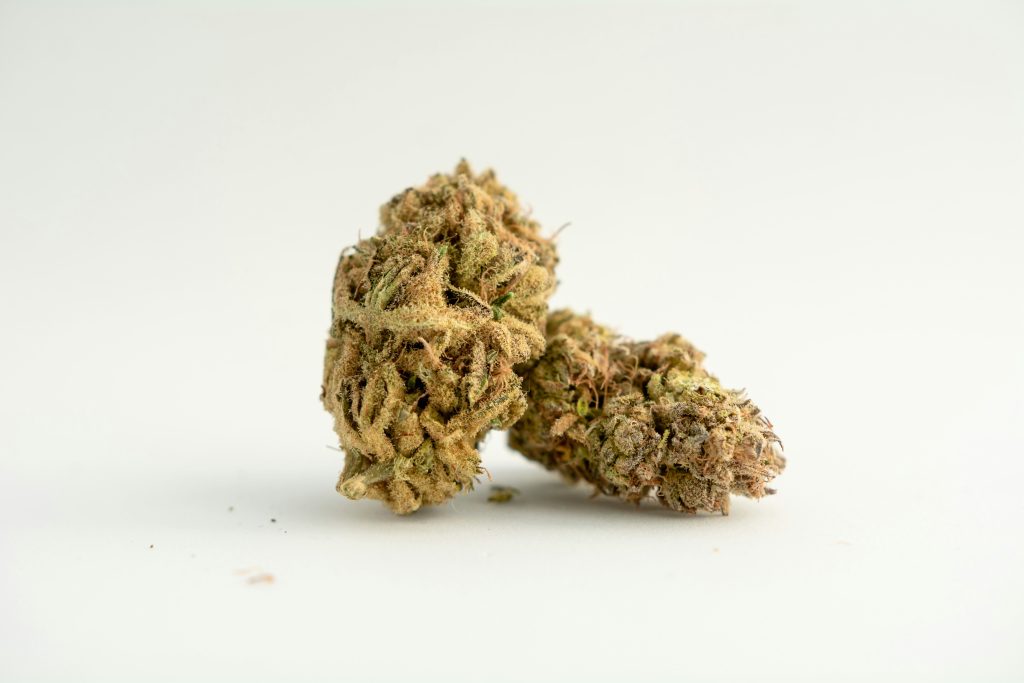
After harvest, drying and curing decide how many of those terpenes in hemp reach the jar. Slow drying at a moderate temperature keeps the volatile monoterpenes in the resin, while too much heat or airflow lets them escape early. A gentle cure over several weeks gives the aroma time to round out. That is why the same strain from two growers rarely smells identical: terpenes in weed are a product of genetics and craft.
The main cannabis terpenes and their aromas
About a dozen terpenes shape almost every cannabis aroma, even though the resin holds hundreds of terpene and cannabinoid compounds (Booth and Bohlmann, 2019) [1]. Myrcene, limonene, linalool, beta-caryophyllene and pinene are the main terpenes in weed and hemp alike, usually at a few tenths of a percent to a few percent of the dried flower. Each strain has its own mix, printed on the certificate of analysis of Swiss CBD flowers whenever the lab measured terpenes. Recognise the five below by smell, from earthy through citrus, floral and spicy to resinous, and you can read almost any terpenes list on a lab report.
Myrcene: earthy, musky, fruity
Myrcene smells earthy and musky, with a note of ripe mango, and in many strains it is the most common terpene in cannabis, hence its nickname “the mother of all terpenes”. Outside hemp, the monoterpene β-myrcene is known from hops, thyme and lemongrass, which is why a myrcene-heavy jar can recall a herb garden or freshly brewed beer. On a terpene profile it appears as “myrcene” or “β-myrcene” with its share in % or mg/g, and when it tops the list it sets the strain’s base note. With a boiling point of about 167 °C, myrcene is one of the more volatile terpenes.
Myrcene at a glance:
- Aroma : earthy, musky, ripe mango
- Also found in : hops, thyme, lemongrass
- Boiling point : ≈ 167 °C
Limonene: fresh and citrusy
Limonene smells fresh, of lemon, orange and grapefruit, because it is the same molecule that carries the scent of citrus peel. D-limonene is a monoterpene and also occurs in juniper; in perfume, cleaning products and food flavourings it is one of the most widely used aroma compounds. On a terpene profile it appears as “limonene” or “D-limonene”, and when it sits high next to myrcene, an earthy flower gains a bright citrus edge. Paired with pinene, the result is often a fresh, almost zesty bouquet. Its boiling point is about 176 °C.
Limonene at a glance:
- Aroma : lemon, orange, grapefruit
- Also found in : citrus peel, juniper
- Boiling point : ≈ 176 °C
Linalool: floral like lavender
Linalool smells floral like lavender, with a slightly spicy edge. It is a monoterpene alcohol, meaning a terpene with an extra hydroxyl group, and it gives lavender, coriander and bergamot their scent; perfumers and cosmetics makers work with the very same molecule. In cannabis, linalool usually occurs in smaller shares than myrcene or limonene, so it tends to sit further down the terpene profile and still tints the aroma floral. Crush a lavender flower between your fingers and linalool is mostly what you smell. With a boiling point of about 198 °C, it lingers longer than the lighter monoterpenes.
Linalool at a glance:
- Aroma : floral, lavender, slightly spicy
- Also found in : lavender, coriander, bergamot
- Boiling point : ≈ 198 °C
Beta-caryophyllene: peppery and spicy
Beta-caryophyllene smells peppery and spicy, of black pepper, clove and a little wood. Unlike the other four main terpenes it is a sesquiterpene: built from three isoprene units (C15), it is the largest molecule on this list. A strain rich in beta-caryophyllene smells like a freshly turned pepper mill when you open the jar. Its size shows in the boiling point too, which at about 256 °C sits well above the monoterpenes. On a terpene profile it appears as “β-caryophyllene” or simply “caryophyllene”, sometimes alongside caryophyllene oxide, which forms from it on contact with air.
Beta-caryophyllene at a glance:
- Aroma : black pepper, clove, woody
- Also found in : black pepper, clove
- Boiling point : ≈ 256 °C
Pinene: resinous like a pine forest
Pinene smells resinous like a pine forest, of needles, resin and fresh green. It is the most widespread terpene in the plant kingdom and comes in two forms, alpha-pinene and beta-pinene, which a terpene profile usually lists separately. Outside hemp it sits in conifers and rosemary: rub a sprig of rosemary between your fingers and you have a fair idea of it. With a boiling point of about 155 °C for alpha-pinene, it is the most volatile of the five main terpenes, which is why a flower often loses its green pine note first.
Pinene at a glance:
- Aroma: pine, resin, green
- Also found in: conifers, rosemary
- Boiling point: ≈ 155 °C (alpha-pinene)
Other terpenes: humulene, ocimene and terpinolene
Beyond the five main terpenes, minor terpenes add small shares to the aroma, and they make the difference between two strains with the same main terpene: two myrcene-led flowers smell different depending on what sits below it. These six minor terpenes in the terpene profile turn up most often:
- Humulene: hoppy, earthy, woody
- Ocimene: sweet, fruity, slightly herbal
- Terpinolene: pine and citrus with a floral note
- Nerolidol: woody, reminiscent of tree bark
- Bisabolol: mild and floral, reminiscent of chamomile
- Geraniol: rosy and floral
Small shares, big influence: the minor terpenes are what make a strain recognisable.
Terpene chart: aroma, sources and boiling point
This terpene chart sums up eight cannabis terpenes for reading a certificate of analysis: aroma for the nose, sources for recognition and boiling point for handling. It carries no effects column, only measurable data.
| Terpene | Main aroma | Also found in | Boiling point (°C) |
|---|---|---|---|
| Myrcene | earthy, mango | hops, thyme | ≈ 167 |
| Limonene | citrus | citrus peel, juniper | ≈ 176 |
| Linalool | lavender, floral | lavender, coriander | ≈ 198 |
| Beta-caryophyllene | pepper, clove | black pepper, clove | ≈ 256 |
| Pinene | pine, resin | conifers, rosemary | ≈ 155 |
| Humulene | hoppy, woody | hops | — |
| Ocimene | sweet, fruity | basil, mango | ≈ 175 |
| Terpinolene | pine, citrus | tea tree, nutmeg | ≈ 185 |
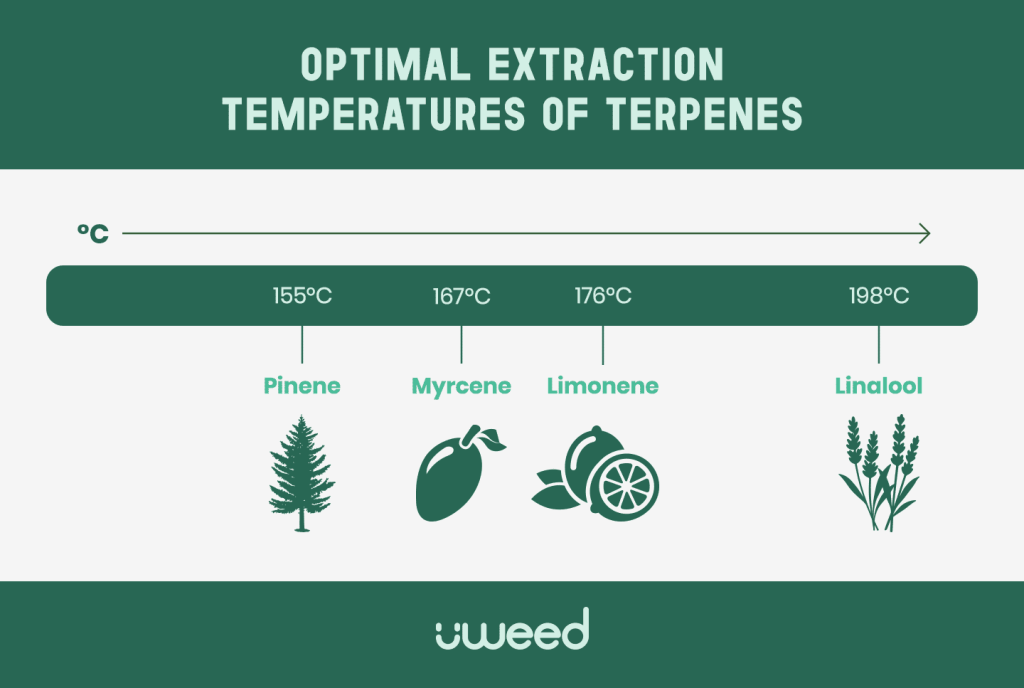
The boiling points of the terpenes apply at normal air pressure and are rounded; no reliable value at normal pressure is available for humulene. Read as a terpene boiling point chart, the range from about 155 to 256 °C explains why heat and light drive the lighter terpenes out of a flower first.
What do terpenes do in the cannabis plant?
In the plant, terpenes work as scent and defence compounds: their smell keeps grazing animals and pests away, and in many plants it also draws in pollinators. That is the established answer to what terpenes do, for the plant. Many plants release more terpenes when a leaf is damaged, sending a scent signal into their surroundings. For us, the terpenes in hemp and in CBD products are first of all aroma and flavour, which is why perfumery, food flavourings and cosmetics use the very same molecules, such as limonene from orange peel or linalool from lavender.
What terpenes do in the human body is a different question, and the evidence there is not settled, so this article sticks to aroma, sources and analysis. Anyone searching for CBD terpenes soon meets the entourage effect: the hypothesis that terpenes and cannabinoids might act differently together than alone. It remains a hypothesis, not a result. For choosing a flower, what counts is what you can smell and measure. What research has examined so far, and what is still open, we cover in our article on the entourage effect.
Reading a terpene profile: what the certificate of analysis shows
You read a terpene profile in four steps: find the section, check the unit, identify the dominant terpene and check the date of analysis. It is the only objective clue to how a strain smells, and it sits on the certificate of analysis (CoA), the lab report for that batch, in its own section headed “Terpene profile” or “Terpenes”.
Labs measure cannabis terpenes by gas chromatography, usually GC-MS or GC-FID, and report them in percent or in milligrams per gram (mg/g), where 1% equals 10 mg/g. Not every certificate includes them, because many labs test only the cannabinoids as standard. An example: if limonene shows 0.6% ahead of myrcene at 0.4%, the flower will smell more of citrus than of earth. Here is how to read it:
- Find the “Terpene profile” section; if it is missing, terpenes were not measured.
- Check the unit, percent or mg/g, so you can compare two strains directly.
- Read off the dominant terpene: the highest value sits at the top and sets the main aroma, while the total terpenes line shows how intense the smell is.
- Check the date of analysis, because terpenes break down over time, especially under light and heat.
A hemp terpene profile tells you how a flower smells and how fresh the measurement is; it says nothing about an effect.
Flowers, hash and oil: where does the terpene profile survive?
The less a product is processed, the more of its terpene profile survives, from flower through resin and full-spectrum oil to isolate, which keeps none. CBD terpenes travel with the plant material, so the degree of processing decides how much aroma is left.
| Product type | Processing | Terpene profile |
|---|---|---|
| CBD flowers | dried and cured | complete, as long as stored well |
| CBD hash | trichomes mostly separated mechanically and pressed | concentrated, intense aroma |
| Full-spectrum CBD oil | extraction, for example with CO2 | partly retained, depending on the method |
| Distillate and isolate | distilled or purified | largely or completely removed |
Hash is made by separating the trichomes from the flower and pressing them, so it smells more concentrated than the flower it came from. Mechanical methods such as sieving and pressing use no solvents and leave the terpenes in the resin. You can see how different those profiles turn out across our CBD hash from Switzerland.
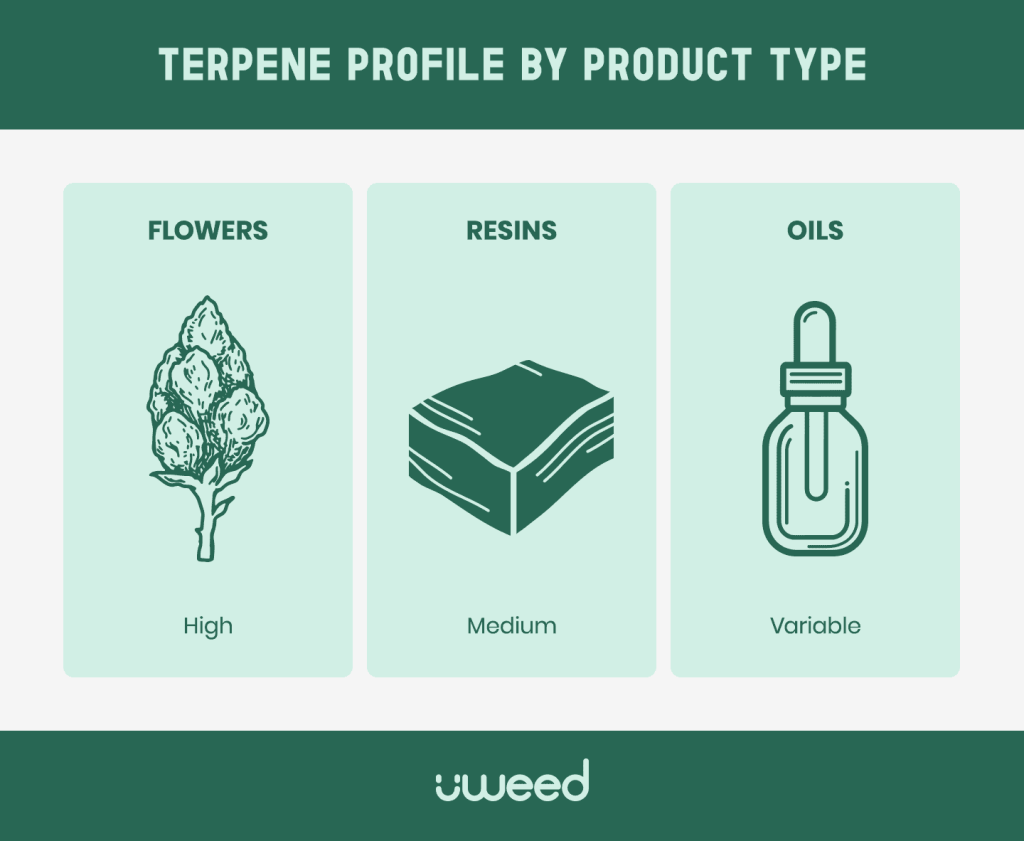
With oil, the extraction method decides. CO2 extraction at a low temperature can retain part of the terpenes, while distillation and isolation remove most of them. How the processes differ is covered in our guide to CBD extraction methods.
Choosing CBD flowers by terpenes: what to look for
Choosing CBD flowers by aroma comes down to a few checks before the basket, centred on the dominant terpene, the certificate of analysis and the packaging. Whether you search for CBD terpenes or for terpenes in CBD flowers, you end up buying by aroma: at uWeed, terpenes come as part of flowers, hash or oil, not as an isolated product. Check these:
- Aroma: read whether the product description names citrus, pepper or pine, and match it to the dominant terpene.
- Certificate of analysis: make sure it includes a terpene section, and note the date of analysis.
- Freshness: choose packaging that seals airtight and lets no light through.
- Minor terpenes: compare two flowers with the same main terpene by what sits below it on the profile.
With these checks you choose a flower by the aroma you actually want to smell.
Keeping terpenes intact: boiling point, light and storage
You keep terpenes intact by storing flowers dark, cool and airtight, because heat, light and air take their aroma first. As the terpene boiling point chart above shows, terpenes boil at about 155 °C (pinene) to 256 °C (beta-caryophyllene), yet evaporate slowly far below that and oxidise in air and light. Four steps keep the terpene profile in the jar:
- Store flowers in the dark, because light speeds up the breakdown of terpenes.
- Keep them cool, at room temperature or below, away from radiators and sun.
- Use an airtight glass jar rather than plastic.
- Keep relative humidity stable, as a guide roughly between 55 and 62%.
The same steps apply to hash; oil stays dark and cool in its original bottle. What else matters for shelf life is covered in our guide on how to store CBD flowers.
- ✅Do: open the jar briefly, smell, close it tightly again.
- ❌Don’t: leave flowers open in a warm room or in the sun.
The same physics applies to heat. Combustion runs far above every terpene boiling point, so terpenes break down faster than with controlled heating. Devices with temperature control are listed in our CBD vape category.
Natural vs synthetic terpenes: the difference
On a label, natural terpenes usually means “taken from a plant”, and whether that plant was hemp or something else, only the declaration tells you. Origin is the axis that separates three forms: cannabis-derived, botanical and synthetic. The molecule can be identical in all three, because limonene is limonene whether it comes from hemp or from orange peel.
| Origin | Obtained from | Typically on the label |
|---|---|---|
| Cannabis-derived | hemp | "natural cannabis terpenes", "hemp-derived" |
| Botanical | other plants, such as citrus or pine | "botanical terpenes", "natural terpenes" |
| Synthetic | synthesis in a lab | "flavouring", "terpene blend" |
You recognise the origin from the declaration and, for flowers and hash, from the certificate of analysis. A CBD flower carries its own terpenes; added terpene blends are more likely in liquids and flavoured products, whose ingredient list names them.
Frequently asked questions about terpenes
Are terpenes legal in Switzerland?
Yes, terpenes are legal in Switzerland, because they are aroma compounds and not controlled substances. What the law regulates in hemp products is not the terpene content but the THC content: under the Swiss Narcotics Act (BetmG) and its ordinances, hemp with a total THC content under 1% does not count as a narcotic. The same terpenes are used in food flavourings and perfumes. Whether CBD is legal in Switzerland, and on what terms, is covered in its own article.
Do terpenes get you high?
No, terpenes do not get you high: the high from cannabis comes from tetrahydrocannabinol (THC), not from its aroma compounds. Terpenes are not intoxicating, so the answer to “can terpenes get you stoned?” is no. Whether a strain smells of citrus or of earth says nothing about its THC content, which appears as a separate value in the cannabinoid profile. Whether CBD makes you high is a separate question with its own article.
What is a high terpene percentage?
A total terpene content of about 2% or more counts as high for dried CBD flowers, and 4% is unusually rich: most certificates of analysis show totals between a few tenths of a percent and a few percent. The total terpenes line measures aroma intensity and nothing else, so a higher figure means a louder smell, not a stronger product. Freshness matters just as much, so check the date of analysis too.
The bottom line: recognising terpenes and choosing by aroma
Terpenes are the vocabulary of aroma: compounds from the trichomes of the hemp plant that decide whether a strain smells earthy, citrus, floral, peppery or resinous. You recognise the five main cannabis terpenes, myrcene, limonene, linalool, beta-caryophyllene and pinene, by nose and on the terpene profile of the certificate of analysis. Once you can read them, you choose CBD flowers by the aroma you are after, check the date of analysis and store the flowers dark, cool and airtight. That way the terpenes in cannabis stay in the jar, not just on the certificate.
Sources on terpenes
- Booth JK, Bohlmann J (2019): Terpenes in Cannabis sativa – From plant genome to humans. Plant Science 284: 67–72.