Full-Spectrum CBD Oils
Full-spectrum CBD oil carries cannabigerol (CBG), cannabichromene (CBC), cannabinol (CBN), terpenes and flavonoids alongside cannabidiol (CBD). That complete cannabinoid profile brings a trace of THC with it: in Switzerland, under 1% THC. Every oil in our CBD shop comes from a Swiss producer, and every batch is lab-tested.
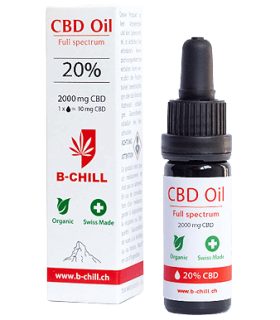
B-Chill CBD Oil 20% Full Spectrum Hemp Drops — 10 ml
CBD 2000 mgTHC 0.2%
With the CBD Oil 20%, B-Chill offers a full-spectrum CBD extract produced in Switzerland. Content sits at 20% CBD (2000 mg), with less than 1% THC. Supercritical CO₂ extraction without solvents retains CBG and CBC alongside CBD. The CBD drops are based on MCT coconut oil. This Swiss oil is lab tested, free from fungicides, herbicides, pesticides and solvent residues, additive-free, GMO-free and compliant on heavy metals.
Alpsbee Punch Day CBD Oil 22% Full Spectrum Hemp Drops — 10 ml
CBD 2200 mgTHC 0.2%
With Punch Day CBD Oil 22%, Alpsbee offers a full-spectrum CBD extract produced in Switzerland. Content sits at 22% CBD (2200 mg), with less than 1% THC. Ultrasonic extraction retains CBG alongside CBD. The CBD drops are based on MCT coconut oil. This Swiss oil is lab tested, free from fungicides, herbicides, pesticides and solvent residues, additive-free, GMO-free and compliant on heavy metals.
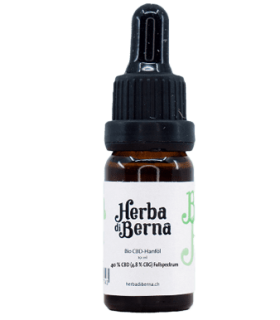
Herba di Berna CBD Oil 40% Full Spectrum Hemp Drops — 10 ml
CBD 4000 mgTHC 1.0%
The CBD Oil 40% by Herba di Berna is a full-spectrum CBD extract produced in Switzerland. At 40% CBD (4000 mg), it is an ultra-concentrated formula, with less than 1% THC. Extraction uses supercritical CO₂ without solvents, which preserves CBG, CBN and CBC alongside CBD. The extract is then blended into MCT coconut oil. The hemp extract is lab tested, free from fungicides, herbicides, pesticides and solvent residues, additive-free and GMO-free.
Herba di Berna CBD Oil 24% Full Spectrum Hemp Drops — 10 ml
CBD 2400 mgTHC 0.4%
With the CBD Oil 24%, Herba di Berna offers a full-spectrum CBD extract produced in Switzerland. Content sits at 24% CBD (2400 mg), with less than 1% THC. Supercritical CO₂ extraction without solvents retains CBG and CBC alongside CBD. The CBD drops are based on sunflower oil. This Swiss oil is lab tested, free from fungicides, herbicides, pesticides and solvent residues, additive-free, GMO-free and compliant on heavy metals.
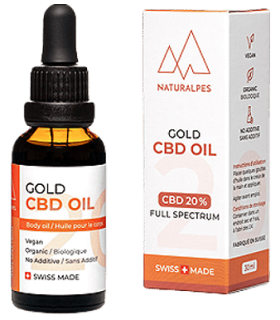
Naturalpes Gold CBD Oil 20% Full Spectrum Hemp Drops — 10 ml
CBD 2000 mgTHC 0.8%
With Gold CBD Oil 20%, Naturalpes offers a full-spectrum CBD extract produced in Switzerland. Content sits at 20% CBD (2000 mg), with less than 1% THC. Supercritical CO₂ extraction without solvents retains CBG, CBN and CBC alongside CBD. The CBD drops are based on hemp seed oil. This Swiss oil is made to ISO 9001, lab tested, free from fungicides, herbicides, pesticides and solvent residues, additive-free, GMO-free and compliant on heavy metals.
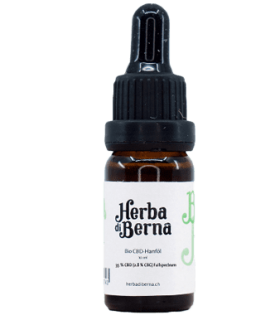
Herba di Berna CBD Oil 35% Full Spectrum Hemp Drops — 10 ml
CBD 3500 mgTHC 1.0%
With the CBD Oil 35%, Herba di Berna offers a full-spectrum CBD extract produced in Switzerland. Content sits at 35% CBD (3500 mg), with less than 1% THC. Supercritical CO₂ extraction without solvents retains CBG, CBN and CBC alongside CBD. The CBD drops are based on MCT coconut oil. This Swiss oil is lab tested, free from fungicides, herbicides, pesticides and solvent residues, additive-free, GMO-free and compliant on heavy metals.
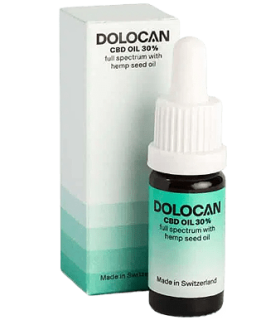
Dolocan CBD Oil 30% Full Spectrum Hemp Drops — 10 ml
CBD 3000 mgTHC 0.8%
The CBD Oil 30% by Dolocan is a full-spectrum CBD extract made in Switzerland. As a high-concentration formula, it delivers 30% CBD (3000 mg), with less than 1% THC. The extract is drawn with supercritical CO₂ without solvents, keeping CBG and CBC alongside CBD. The carrier oil is hemp seed oil. The CBD drops are lab tested, free from fungicides, herbicides, pesticides and solvent residues, additive-free, GMO-free and compliant on heavy metals.
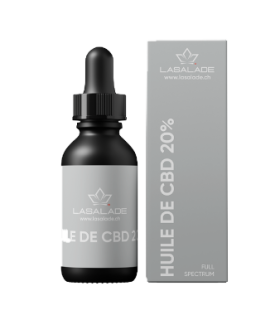
La Salade Natural CBD Oil 20% Full Spectrum Hemp Drops — 10 ml
CBD 2000 mgTHC 0.3%
With Natural CBD Oil 20%, La Salade offers a full-spectrum CBD extract produced in Switzerland. Content sits at 20% CBD (2000 mg), with less than 1% THC. Supercritical CO₂ extraction without solvents retains CBG, CBN and CBC alongside CBD. The CBD drops are based on MCT coconut oil. This Swiss oil is lab tested, free from fungicides, herbicides, pesticides and solvent residues, additive-free, GMO-free and compliant on heavy metals.
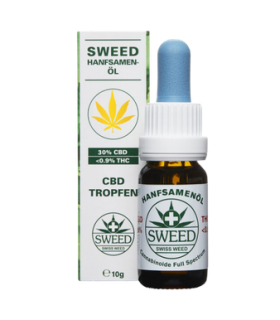
Sweed CBD Oil 30% Full Spectrum with Hemp Seed Oil — 10 ml
CBD 3000 mgTHC 0.9%
The CBD Oil 30% by Sweed is a full-spectrum CBD extract made in Switzerland. As a high-concentration formula, it delivers 30% CBD (3000 mg), with less than 1% THC. The extract is drawn with supercritical CO₂ without solvents, keeping CBG, CBN and CBC alongside CBD. The carrier oil is hemp seed oil. The CBD drops are lab tested, free from fungicides, herbicides, pesticides and solvent residues, additive-free and GMO-free.
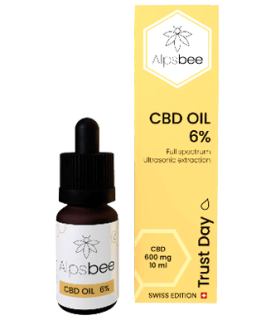
Alpsbee Trust CBD Oil 6% Full Spectrum Hemp Drops — 10 ml
CBD 600 mgTHC 0.1%
Trust CBD Oil 6% by Alpsbee is a full-spectrum CBD extract produced in Switzerland. At 6% CBD (600 mg), it is an entry-level formula, with less than 1% THC. Extraction uses ultrasound, which preserves CBN alongside CBD. The extract is then blended into MCT coconut oil. The hemp extract is lab tested, free from fungicides, herbicides, pesticides and solvent residues, additive-free, GMO-free and compliant on heavy metals.
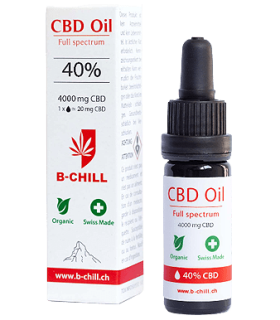
B-Chill CBD Oil 40% Full Spectrum Hemp Drops — 10 ml
CBD 4000 mgTHC 0.4%
The CBD Oil 40% by B-Chill is a full-spectrum CBD extract made in Switzerland. As an ultra-concentrated formula, it delivers 40% CBD (4000 mg), with less than 1% THC. The extract is drawn with supercritical CO₂ without solvents, keeping CBG and CBC alongside CBD. The carrier oil is MCT coconut oil. The CBD drops are lab tested, free from fungicides, herbicides, pesticides and solvent residues, additive-free and GMO-free.
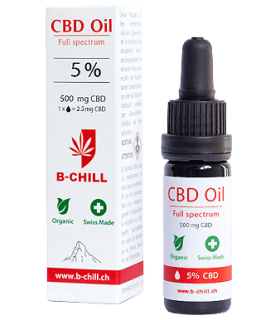
B-Chill CBD Oil 5% Full Spectrum Hemp Drops — 10 ml
CBD 500 mgTHC 0.1%
The CBD Oil 5% by B-Chill is a full-spectrum CBD extract made in Switzerland. As an entry-level formula, it delivers 5% CBD (500 mg), with less than 1% THC. The extract is drawn with supercritical CO₂ without solvents, keeping CBG and CBN alongside CBD. The carrier oil is MCT coconut oil. The CBD drops are lab tested, free from fungicides, herbicides, pesticides and solvent residues, additive-free, GMO-free and compliant on heavy metals.
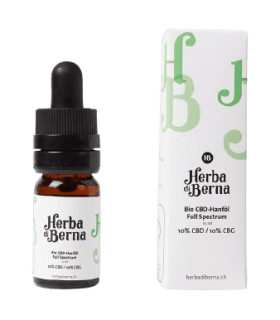
Herba di Berna Hemp Oil with 10% CBG + 10% CBD Full Spectrum Drops — 10 ml
CBG 1000 mgCBD 1000 mg
The Hemp Oil with 10% CBG + 10% by Herba di Berna is a full-spectrum CBG extract produced in Switzerland. At 10% CBG and 10% CBD, it is a balanced formula, with less than 1% THC. Extraction uses supercritical CO₂ without solvents, which preserves CBD and CBN alongside CBG. The extract is then blended into MCT coconut oil. The hemp extract is lab tested, free from fungicides, herbicides and pesticides, additive-free and GMO-free.
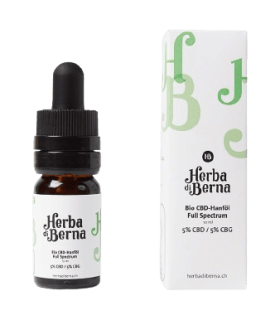
Herba di Berna Hemp Oil with 5% CBG + 5% CBD Full Spectrum Drops — 10 ml
CBG 500 mgCBD 500 mg
The Hemp Oil with 5% CBG + 5% by Herba di Berna is a full-spectrum CBG extract made in Switzerland. As an entry-level formula, it delivers 6% CBG and 5% CBD (500 mg CBD), with less than 1% THC. The extract is drawn with supercritical CO₂ without solvents, keeping CBD, CBN and CBC alongside CBG. The carrier oil is MCT coconut oil. The CBG drops are lab tested, free from fungicides, herbicides and pesticides, additive-free and GMO-free.
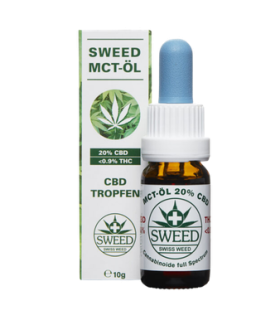
Sweed CBD Oil 20% Full Spectrum with MCT Oil — 10 ml
CBD 2000 mgTHC 0.7%
The CBD Oil 20% by Sweed is a full-spectrum CBD extract produced in Switzerland. At 20% CBD (2000 mg), it is a concentrated formula, with less than 1% THC. Extraction uses supercritical CO₂ without solvents, which preserves CBG, CBN and CBC alongside CBD. The extract is then blended into MCT coconut oil. The hemp extract is lab tested, free from fungicides, herbicides, pesticides and solvent residues, additive-free and GMO-free.
Alpsbee Nice Day CBD Oil 12% Full Spectrum Hemp Drops — 10 ml
CBD 1200 mgTHC 0.1%
Nice Day CBD Oil 12% by Alpsbee is a full-spectrum CBD extract made in Switzerland. As a balanced formula, it delivers 12% CBD (1200 mg), with less than 1% THC. The extract is drawn with ultrasound, keeping CBN and CBC alongside CBD. The carrier oil is MCT coconut oil. The CBD drops are lab tested, free from fungicides, herbicides, pesticides and solvent residues, additive-free, GMO-free and compliant on heavy metals.
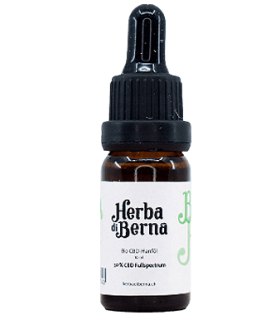
Herba di Berna CBD Oil 30% Full Spectrum Hemp Drops — 10 ml
CBD 3000 mgTHC 0.9%
The CBD Oil 30% by Herba di Berna is a full-spectrum CBD extract made in Switzerland. As a high-concentration formula, it delivers 30% CBD (3000 mg), with less than 1% THC. The extract is drawn with supercritical CO₂ without solvents, keeping CBG and CBC alongside CBD. The carrier oil is MCT coconut oil. The CBD drops are lab tested, free from fungicides, herbicides, pesticides and solvent residues, additive-free and GMO-free.
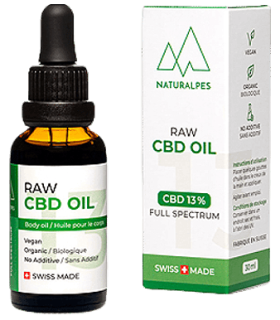
Naturalpes Raw CBD Oil 13% Full Spectrum Hemp Drops — 10 ml
CBD 1300 mgTHC 0.6%
Raw CBD Oil 13% by Naturalpes is a full-spectrum CBD extract produced in Switzerland. At 13% CBD (1300 mg), it is a balanced formula, with less than 1% THC. Extraction uses supercritical CO₂ without solvents, which preserves CBG and CBC alongside CBD. The extract is then blended into hemp seed oil. The hemp extract is lab tested, free from fungicides, herbicides, pesticides and solvent residues, additive-free and GMO-free.
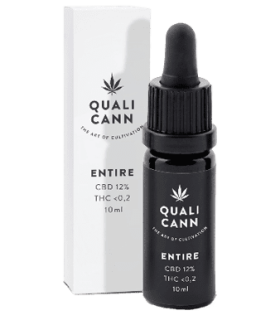
Qualicann Entire CBD Oil 12% Full Spectrum Hemp Drops — 10 ml
CBD 1200 mgTHC 0.1%
Entire CBD Oil 12% by Qualicann is a full-spectrum CBD extract produced in Switzerland. At 12% CBD (1200 mg), it is a balanced formula, with less than 1% THC. Extraction uses ethanol, which preserves CBG and CBC alongside CBD. The extract is then blended into hemp seed oil. The hemp extract is lab tested, free from fungicides, herbicides, pesticides and solvent residues and compliant on heavy metals.
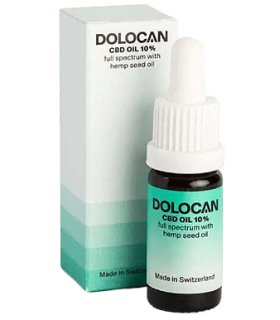
Dolocan CBD Oil 10% Full Spectrum Hemp Drops — 10 ml
CBD 1000 mgTHC 0.5%
With the CBD Oil 10%, Dolocan offers a full-spectrum CBD extract produced in Switzerland. Content sits at 10% CBD (1000 mg), with less than 1% THC. Supercritical CO₂ extraction without solvents retains CBG and CBC alongside CBD. The CBD drops are based on hemp seed oil. This Swiss oil is lab tested, free from fungicides, herbicides, pesticides and solvent residues, additive-free, GMO-free and compliant on heavy metals.
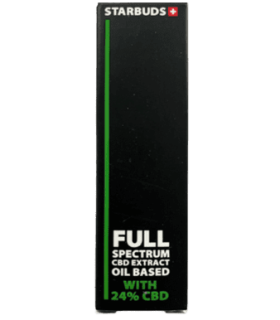
Starbuds CBD Oil 24% Full Spectrum Hemp Drops — 10 ml
CBD 2400 mgTHC 0.9%
The CBD Oil 24% by Starbuds is a full-spectrum CBD extract made in Switzerland. As a concentrated formula, it delivers 24% CBD (2400 mg), with less than 1% THC. The extract is drawn with supercritical CO₂ without solvents, keeping CBG, CBN and CBC alongside CBD. The carrier oil is sunflower oil. The CBD drops are lab tested, free from fungicides, herbicides, pesticides and solvent residues, additive-free, GMO-free and compliant on heavy metals.
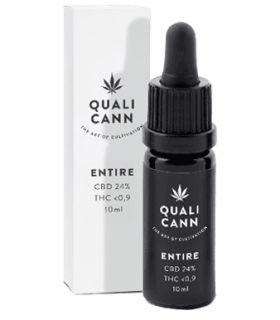
Qualicann Entire CBD Oil 24% Full Spectrum Hemp Drops — 10 ml
CBD 2400 mgTHC 0.6%
Entire CBD Oil 24% by Qualicann is a full-spectrum CBD extract made in Switzerland. As a concentrated formula, it delivers 24% CBD (2400 mg), with less than 1% THC. The extract is drawn with ethanol, keeping CBG, CBN and CBC alongside CBD. The carrier oil is hemp seed oil. The CBD drops are lab tested, free from fungicides, herbicides, pesticides and solvent residues and compliant on heavy metals.
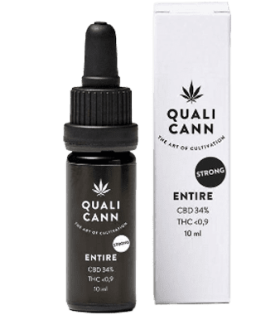
Qualicann Entire CBD Oil 34% Full Spectrum Hemp Drops — 10 ml
CBD 3400 mgTHC 0.6%
With Entire CBD Oil 34%, Qualicann offers a full-spectrum CBD extract produced in Switzerland. Content sits at 34% CBD (3400 mg), with less than 1% THC. Ethanol extraction retains CBG and CBC alongside CBD. The CBD drops are based on hemp seed oil. This Swiss oil is lab tested, free from fungicides, herbicides, pesticides and solvent residues and compliant on heavy metals.
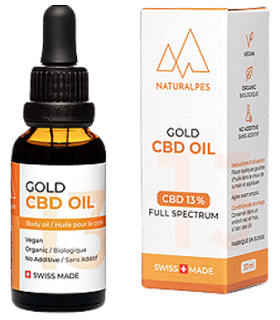
Naturalpes Gold CBD Oil 13% Full Spectrum Hemp Drops — 10 ml
CBD 1300 mgTHC 1.0%
Gold CBD Oil 13% by Naturalpes is a full-spectrum CBD extract made in Switzerland. As a balanced formula, it delivers 13% CBD (1300 mg), with less than 1% THC. The extract is drawn with supercritical CO₂ without solvents, keeping CBG, CBN and CBC alongside CBD. The carrier oil is hemp seed oil. The CBD drops are lab tested, free from fungicides, herbicides, pesticides and solvent residues, additive-free and GMO-free.
Products 1-24 of 42
What is full-spectrum CBD oil?
Full-spectrum CBD oil is a hemp extract in a carrier oil such as coconut (MCT) or hemp seed oil, where the extraction takes the plant's whole cannabinoid and terpene profile instead of isolating one component. That is exactly why it also holds a residue of tetrahydrocannabinol (THC): in Switzerland, under 1% THC.
Whole-plant extract and whole plant CBD oil name the same thing. An oil like this is placed on the market as a cosmetic or aroma product, not as a food and not as a food supplement. It shares only the plant with hemp seed oil, which is pressed from the seeds and holds no cannabidiol.
Broad spectrum is that same extract with the THC stripped out afterwards. Isolate is pure cannabidiol, with no other cannabinoids and no terpenes.
Which cannabinoids are in a full-spectrum extract?
A full-spectrum extract holds cannabidiol (CBD) as its main cannabinoid, with cannabigerol (CBG), cannabichromene (CBC), cannabinol (CBN), traces of tetrahydrocannabinol (THC), terpenes and flavonoids alongside it. The proportions in a given bottle sit on its batch certificate of analysis.
- Cannabidiol (CBD) — the main cannabinoid, shown on the lab report as a percentage and in milligrams.
- Cannabigerol (CBG) — a precursor cannabinoid, present in small amounts in the finished extract.
- Cannabichromene (CBC) — a trace cannabinoid, staying below the one percent mark.
- Cannabinol (CBN) — forms chemically as THC degrades in the extract: a process in the bottle, not in the body.
- Tetrahydrocannabinol (THC) — in Switzerland, under 1% THC, shown as total THC.
- Terpenes and flavonoids — the plant compounds that carry smell and colour. Not every certificate breaks them out line by line.
An isolate oil looks almost identical on the label. Only a lab report listing several cannabinoids and matching the batch number proves a full-spectrum extract. Cannabis research has a term for how these compounds interact, and what the entourage effect means is set out separately.
How is full-spectrum CBD oil made?
Full-spectrum CBD oil is made by separating nothing after the extraction. CO2, ethanol and ultrasound serve all three spectra; what marks out full spectrum is what is missing — no THC removal, no isolation.
- Swiss hemp below the legal THC threshold is harvested and dried.
- Extraction releases cannabinoids, terpenes and flavonoids from the plant material; run too hot, it costs precisely those compounds.
- The degree of filtration decides the colour: raw and dark, decarboxylated and golden, distilled and clear.
A full-spectrum oil is therefore darker than an isolate oil — plant compounds, not impurity. What separates the methods is set out in CBD extraction with CO2.
Full-spectrum CBD oil with THC: the Swiss legal position
In Switzerland a full-spectrum oil showing under 1% THC is not a narcotic and is freely sold. What counts is the threshold in the finished product, not whether THC is present at all — in a full-spectrum extract it is present by definition.
| Swiss threshold | under 1% THC in the finished product |
|---|---|
| Product class | cosmetic or aroma product |
| Not classified as | food, food supplement, medicine |
| Batch proof | certificate of analysis showing total THC |
Taken literally, this is therefore a CBD oil with THC. Legally it is not a THC oil, because the threshold is met, and that residue is exactly what separates it from the broad spectrum. uWeed does not sell THC oil: above the threshold, the product is not freely saleable in Switzerland.
A full-spectrum oil is placed on the market as a cosmetic or aroma product. It is not a food, not a food supplement and not a medicine. Swiss origin means cultivation and finished product fall under the same regulation; thresholds differ abroad, and taking a product across a border is a separate question. What holds inside the country is summarised in is CBD legal in Switzerland?
Buying full-spectrum CBD oil in Switzerland: what to check
Check four figures before you buy a full-spectrum CBD oil: the carrier oil, the concentration, the price per milligram and the lab report. All four sit on the label or the certificate, and the filters above map onto these axes.
- Carrier oil — coconut (MCT) is thin and neutral in taste, hemp seed oil thicker and more vegetal, sunflower oil between the two. The base changes nothing about the cannabinoid content.
- Concentration — the percentage says how much cannabidiol sits in each millilitre; with the bottle size it gives the total CBD in milligrams.
- Price per milligram — bottle price divided by total CBD, the only figure that compares bottles of different size and strength.
- Lab report — it tells you whether the label is accurate, and on a full-spectrum oil lists several cannabinoids rather than CBD alone.
None of the four can be read from colour or smell. They are written down, and that is where to compare them. On concentration, how to read CBD oil strength covers how the steps work.
Frequently asked questions about full-spectrum CBD oils
Does full-spectrum CBD oil contain THC?
Yes, a full-spectrum CBD oil contains THC in trace amounts: in Switzerland, under 1% THC, which is the legal ceiling. Cannabidiol (CBD) and tetrahydrocannabinol (THC) are two different cannabinoids, and their presence together in one bottle does not make the product a THC oil. The figure for your batch sits on the certificate of analysis. To exclude THC entirely, broad spectrum is the option — CBD and THC compared sets out what separates them.
Will full-spectrum CBD oil make you high?
No, full-spectrum CBD oil will not make you high. The THC content stays under 1% THC and therefore below the legal threshold, and cannabidiol itself is not psychoactive. The figure is established batch by batch on the certificate of analysis, so it is verifiable. That is why the product is freely sold in Switzerland and does not fall under the Narcotics Act. The background is covered in does CBD make you high?
Will full-spectrum CBD oil show up on a drug test?
Yes, a positive result cannot be ruled out. Common tests look for tetrahydrocannabinol (THC) and its breakdown products rather than for cannabidiol, and a full-spectrum oil holds precisely the substance being tested for, even at under 1% THC.
Whether a saliva or urine test reacts depends on the method, the amount and the timing. If you are tested regularly, broad spectrum or an isolate removes the question, since neither holds THC. For how long THC stays detectable, the guide has the figures.
Can I drive after using a full-spectrum CBD oil?
A full-spectrum CBD oil contains THC, and Switzerland applies zero tolerance at the wheel: legally, the combination is not safe. From 1.5 micrograms of THC per litre of whole blood, unfitness to drive is deemed established, whether or not the person feels affected. That a product with under 1% THC is legally sold changes nothing: sales law and traffic law are separate.
The rule applies to every vehicle, bicycles and e-scooters included. If in doubt, do not drive. What that means in practice is in CBD and driving in Switzerland.
Is full-spectrum oil the same as CBD isolate?
No, full-spectrum oil and CBD isolate are opposite positions rather than two variants of one thing. An isolate consists of cannabidiol alone, with no other cannabinoids, no terpenes and no THC. A full-spectrum oil keeps the plant’s whole profile including trace THC, which shows on the lab report as several cannabinoid lines instead of one. The uWeed range carries no isolate oil, but you can buy CBD isolate as crystals.