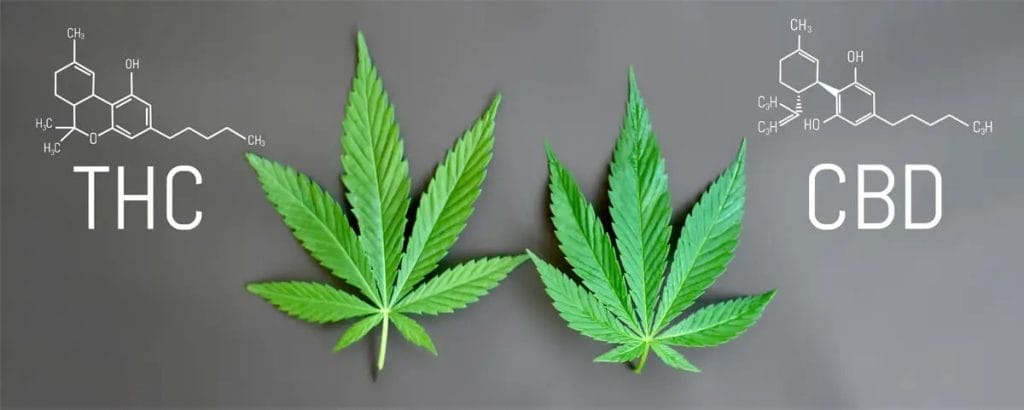
THC is short for tetrahydrocannabinol, one of more than a hundred cannabinoids made by the hemp plant, Cannabis sativa L. Of all of them, tetrahydrocannabinol is the main psychoactive one: it is the compound that makes cannabis intoxicating. You will come across it on the label of a CBD product, in the news and in Swiss law.
That is exactly why it marks the line Swiss law draws between hemp and a controlled substance. Hemp with 1% total THC or more is a narcotic under the Swiss Narcotics Act; hemp with under 1% total THC is not. Below, we explain how THC is built, how it works in the body, what it is prescribed for, what risks it carries and where the legal line sits.
This article is for information only and does not replace medical advice. uWeed’s products are not medicines.
THC Definition: What Tetrahydrocannabinol Is and Where It Comes From
THC (tetrahydrocannabinol) is a cannabinoid that the hemp plant makes mainly in the resin of the trichomes on its female flowers. As a phytocannabinoid, it is the main psychoactive cannabinoid in cannabis, because it binds to the CB1 receptor in the brain. CBD from the same plant is not intoxicating.
That is the short answer to what THC is, and the full tetrahydrocannabinol definition adds one point: the fresh plant contains very little THC as such. Most of it is stored as the acid THCA. How much a plant makes varies widely between strains – industrial hemp and CBD hemp stay under 1% THC, while drug-type cannabis sits far above. What decides how a plant is treated is not its species, but its measured THC content.
What Does THC Stand For?
THC stands for tetrahydrocannabinol – in full, delta-9-tetrahydrocannabinol, or Δ9-THC for short. The tetrahydrocannabinol meaning lies in how the molecule is built. “Cannabinol” is the basic structure, which also gives the related cannabinoid cannabinol (CBN) its name, and “tetrahydro” means that THC carries four more hydrogen atoms than CBN. “Delta-9” marks where one particular double bond sits. In everyday use, THC almost always means delta-9-THC. The same molecule goes by other names, too: as a medicine it is called dronabinol, while slang words such as “weed” or “pot” name the cannabis plant, not the molecule. So the THC meaning is precise: one single, well-described compound.
The Chemistry of THC: Molecule, Delta-9 and THCA
Chemically, “THC” covers three things: the THC molecule itself, its isomers and its acid precursor, THCA. We go from the molecule to the form in which it actually occurs in the plant – and that form decides which THC content a lab report shows.
THC Chemical Formula and Structure
The THC chemical formula describes a small, fat-soluble molecule, and those two properties explain much of what you will read about THC later. Its molecular formula is C21H30O2.
| Attribute | Value | Note |
|---|---|---|
| Molecular formula | C21H30O2 | 21 carbon, 30 hydrogen and 2 oxygen atoms |
| Molar mass | about 314 g/mol | for delta-9-THC |
| Class | terpenophenol | like most cannabinoids |
| Solubility | lipophilic, barely water-soluble | dissolves in fat and alcohol |
Because THC is fat-soluble, not water-soluble, the body stores it in fatty tissue – which is why it can be detected there for longer than in the blood.
Delta-9 THC and Other THC Variants
Delta-9-THC is the form the hemp plant makes and the form meant whenever people talk about THC. The other variants are isomers: they share the same molecular formula but differ in the position of one double bond in the ring. That position is the axis on which the three best-known forms line up.
| Variant | Occurrence in the plant | Origin |
|---|---|---|
| Delta-9-THC | dominant | made by the plant |
| Delta-8-THC | traces only | mostly made semi-synthetically from CBD |
| Delta-10-THC | traces only | mostly made semi-synthetically |
In chemistry, then, delta-9 THC is the standard case and the other two are largely laboratory variants. Which forms count legally is set by Swiss narcotics law – what that means for the measured total THC is covered in the legal section below.
What Is THCA?
THCA, or tetrahydrocannabinolic acid, is the acid form of THC and the form in which the living plant mostly stores it. It is built from cannabigerolic acid (CBGA), the shared precursor from which the plant also makes the acid forms of other cannabinoids – CBDA, the precursor of CBD, for example. Which cannabinoid forms depends on the enzymes of each strain. THCA itself is not psychoactive.
So is THCA the same as THC? Chemically, no: in the THCA vs THC comparison, the difference is a single carboxyl group. When heated, THCA loses it and becomes THC – a reaction chemists call decarboxylation.
Because heat turns THCA into THC, lab reports state total THC: THC plus THCA × 0.877. The factor is a mass ratio – THC is lighter than THCA by the carboxyl group it has lost. This total is the value that counts for the 1% line. You can read more about the shared precursor in our article on cannabigerol (CBG), the precursor of the cannabinoids.
How Does THC Work in the Body?
THC works because it binds to a receptor the body already has. The body has an endocannabinoid system, a network of messengers such as anandamide and the receptors they dock onto. The two best known are the CB1 receptor, found mainly in the brain and the wider nervous system, and the CB2 receptor, found mainly on cells of the immune system.
THC binds to the CB1 receptor as a partial agonist: it activates the receptor, but not fully. The psychoactive action of tetrahydrocannabinol rests on this binding – THC is psychoactive because it reaches this receptor. Matsuda and colleagues described the receptor itself in 1990 in the journal Nature, after cloning it from rat brain in a laboratory study [1]. Since then it has been clear that THC acts at one specific site in the nervous system.
What does THC do to the brain, and what does tetrahydrocannabinol do to the body as a whole? In a given person, the THC effects on the body depend on amount and form of use, so there is no single answer – and this action at the CB1 receptor is the reason the law regulates THC and not CBD. How the body breaks THC down afterwards, and how long THC stays in your system, we explain in a separate article.
Does THC Get You High?
Yes, THC gets you high: it is psychoactive and the main cause of the cannabis high. How strong that high is depends on the amount and the form in which THC is taken. So the question of whether has a clear answer; the question of how strongly does not.
CBD comes from the same plant but is non-intoxicating. THC is psychoactive, CBD is not – and that is exactly the line Swiss law draws. The idea that CBD simply cancels out THC is a common simplification that does not hold. What separates the two cannabinoids chemically and legally is set out in our article on the difference between CBD and THC.
What Is THC Used for in Medicine?
In Switzerland, THC is used as a prescription-only active substance. Since 1 August 2022, doctors may prescribe THC-containing cannabis medicines without an exemption from the Federal Office of Public Health (FOPH). Pharmacies usually make them up as magistral preparations, that is, to a doctor’s prescription [2].
The FOPH names three areas in which cannabis medicines are mainly prescribed [2]:
- chronic pain
- spasticity and cramps in multiple sclerosis or other neurological conditions
- nausea and loss of appetite during chemotherapy
The decision always lies with a doctor; none of this is about treating yourself.
How strong the evidence is was reviewed in 2017 by the National Academies of Sciences, Engineering, and Medicine in a review report. It found substantial or conclusive evidence for cannabinoids in chronic pain in adults, in chemotherapy-induced nausea (oral cannabinoids) and in patient-reported spasticity in multiple sclerosis; for many other uses, such evidence is lacking [3]. The FOPH considers the evidence insufficient for general cover by basic health insurance, so costs are covered only case by case [2]. uWeed’s CBD products are not medicines and are not intended for these medical uses.
What Are the Risks and Side Effects of THC?
THC risks depend mainly on how often, how strong and at what age someone uses it: the adverse effects of THC rise with frequency and THC content, which is why THC is regulated. The three sections below go from the short-term effects, through dependence, to the risks for mental health.
Short-Term Side Effects of THC
THC can reduce attention, concentration and the ability to learn – that is how the FOPH describes its main short-term side effect [4]. What makes up the high also impairs performance in everyday life. Three short-term consequences are worth knowing, from performance through health to the road:
- Performance: continuous heavy use can also hold back performance at school or at work [4].
- Smoking cannabis, usually mixed with tobacco, adds a risk of respiratory and cardiovascular disease [4].
- Anyone under the influence of THC must not drive; the rule on the road is covered in the legal section.
How strong these negative effects of THC are, and how they show in the body, depends on composition and amount – it cannot be predicted in the individual case.
Is THC Addictive?
Yes, THC can be addictive: according to the FOPH, long-term use of THC-containing cannabis carries the risk of psychological dependence [4]. The risk of cannabis dependence is higher than many people assume, and it rises the more often someone uses cannabis and the younger they start.
Leung and colleagues estimated in 2020, in a systematic review and meta-analysis in the journal Addictive Behaviors, that about one in five people who use cannabis (22%) have a cannabis use disorder. For young people who use cannabis weekly or daily, the cohort studies in the review put the risk of dependence at about one in three (33%) [5]. Among the long-term effects of THC, the FOPH also names serious developmental disorders after heavy, long-term use at a young age [4].
If you want to talk about your own use, SafeZone.ch, a service of the FOPH, offers free, anonymous online counselling in German, French and Italian.
THC, Psychosis and Young People
Frequent use of high-THC cannabis is associated with a higher risk of psychosis. Di Forti and colleagues examined this in 2019 in The Lancet Psychiatry, in a multicentre case-control study in humans at eleven sites in Europe and Brazil. People who used cannabis daily had about three times the odds of a first psychotic episode compared with people who had never used it; for daily use of cannabis with 10% THC or more, the odds were nearly five times higher [6].
A case-control study shows an association, not proof of cause. What it does show is that, for the long-term effects of THC on mental health, THC content and frequency together make the difference. Young people are particularly at risk, because their brain is still developing, and according to the FOPH heavy, long-term use at a young age can disrupt that development [4]. CBD products under 1% THC are not what these findings are about.
Is THC a Drug? THC Laws in Switzerland
Yes, in Swiss law THC counts as a drug: cannabis with 1% THC or more is a narcotic under the Swiss Narcotics Act (Federal Act on Narcotics and Psychotropic Substances) [7]. What counts is the total THC content, as set out in directory d of the FDHA Narcotics Directory Ordinance [8]. Hemp with less than 1% THC is not covered by the Narcotics Act [9].
| Area | Limit | Legal basis | Note |
|---|---|---|---|
| Cannabis as a narcotic | 1% total THC or more | Narcotics Act [7], Narcotics Directory Ordinance, directory d [8] | a controlled substance under the Narcotics Act |
| Hemp and CBD hemp | under 1% total THC | Narcotics Act [7], FOPH [9] | not a narcotic |
| Cannabis medicines | 1% total THC or more | doctor's prescription [2] | see the medicine section |
| Road traffic | zero tolerance | road traffic law | separate THC limit in the blood |
So in Switzerland, total THC content determines whether hemp falls under the Narcotics Act: hemp with under 1% total THC is not classified as a narcotic. Product legality still depends on the applicable product category and rules. If you know the rules from another country, do not assume they apply here: the Swiss 1% line differs from the limits used in many other countries. Which product classes exist and what applies to each is covered in our overview of whether CBD is legal in Switzerland.
The medical exception is described above. On the road, a separate rule applies regardless of narcotics law: zero tolerance for THC. Where the THC limit for driving in Switzerland lies, and what it means for CBD, we explain in a separate article.
THC and CBD: Two Cannabinoids from the Same Plant
THC is one cannabinoid among many, and once you understand THC, you also understand what the others do not do. CBD, or cannabidiol, and THC share the precursor CBGA but act differently at the receptor: THC activates the CB1 receptor, CBD does not. Same precursor, different action at the receptor – that is why the law regulates THC and not CBD. A third cannabinoid forms from THC itself, because THC ages into CBN: when plant material is stored for a long time, part of the THC oxidises into cannabinol (CBN), which forms as THC ages.
A plant’s cannabinoid profile is made up of these and other compounds, plus the terpenes that shape its aroma. The idea that cannabinoids and terpenes influence each other is a research hypothesis, not an established finding. What the studies show on this is summarised in our article on the entourage effect.
Who Discovered THC?
THC was discovered in 1964 by the Israeli chemists Yechiel Gaoni and Raphael Mechoulam at the Weizmann Institute: they first isolated it from hashish as a pure compound and worked out its structure. For a plant people have used for thousands of years, that is surprisingly late. Only once the pure, chemically described compound existed could researchers ask where in the body THC acts – a question answered in 1990 with the description of the CB1 receptor [1]. That is why Mechoulam is regarded as a pioneer of cannabinoid research.
Frequently Asked Questions About THC
Which Cannabinoids Get You High?
THC is the main intoxicating cannabinoid in the hemp plant and the one that causes the cannabis high. CBD, CBG and CBN are not considered intoxicating in the amounts in which they occur in hemp. They come from the same plant but do not bind to the CB1 receptor the way THC does. The most common follow-up question – does CBD make you high – we answer in a separate article.
Do CBD Products Contain THC?
Yes, CBD products made from hemp can contain traces of THC, but in Switzerland they must stay under 1% total THC. What counts is total THC, meaning THC and THCA together. The value for a given product is shown on its lab report or certificate of analysis. Traces are still traces, but they are not zero: a drug test looks for THC breakdown products, not for the figure on the label.
The Bottom Line: THC at a Glance
THC, short for tetrahydrocannabinol, can be placed in five points:
- THC is the main psychoactive cannabinoid in the hemp plant.
- It acts because it binds to the CB1 receptor in the nervous system.
- Medically, it is used only on prescription, for a few clearly defined areas.
- Its risks, above all dependence and harm to mental health, rise with frequency and THC content.
- In Switzerland, cannabis with 1% total THC or more is a narcotic.
Know these five points and you also know why legal CBD products stop at the 1% line – and why THC and CBD, despite coming from the same plant, are two different compounds.
Sources on Tetrahydrocannabinol (THC)
- Matsuda LA, Lolait SJ, Brownstein MJ, Young AC, Bonner TI (1990): Structure of a cannabinoid receptor and functional expression of the cloned cDNA. Nature 346(6284): 561–564.
- “Medizinische Anwendung von Cannabis” (Medical use of cannabis), Federal Office of Public Health (FOPH), information page, in German, consulted on 29 October 2026.
- National Academies of Sciences, Engineering, and Medicine (2017): The Health Effects of Cannabis and Cannabinoids: The Current State of Evidence and Recommendations for Research. National Academies Press, Washington DC.
- “Addiction and health: Cannabis”, Federal Office of Public Health (FOPH), information page, consulted on 29 October 2026.
- Leung J, Chan GCK, Hides L, Hall WD (2020): What is the prevalence and risk of cannabis use disorders among people who use cannabis? A systematic review and meta-analysis. Addictive Behaviors 109: 106479.
- Di Forti M, Quattrone D, Freeman TP, Tripoli G, Gayer-Anderson C, Quigley H et al. (2019): The contribution of cannabis use to variation in the incidence of psychotic disorder across Europe (EU-GEI): a multicentre case-control study. The Lancet Psychiatry 6(5): 427–436.
- Federal Act on Narcotics and Psychotropic Substances (Narcotics Act, NarcA), SR 812.121, official German text, consulted on 29 October 2026.
- FDHA Ordinance on the Directories of Narcotics, Psychotropic Substances, Precursors and Auxiliary Chemicals (Narcotics Directory Ordinance, BetmVV-EDI), SR 812.121.11, Annex 5, directory d, official German text, consulted on 29 October 2026.
- “Gesetzgebung Hanf- und Cannabisprodukte” (Legislation on hemp and cannabis products), Federal Office of Public Health (FOPH), information page, in German, consulted on 29 October 2026.