Optimal preservation of your CBD cannabis products relies on a methodical approach that effectively protects their freshness and properties. Inadequate storage can cause up to 40% potency loss in six months, while optimal conditions maintain quality for 12 to 18 months.
This cannabis storage expertise revolves around five fundamental pillars. First, understanding how four natural enemies – UV light, oxygen, high temperatures, and poorly controlled humidity – progressively degrade your precious cannabinoids and terpenes. Next, mastering proven storage techniques: airtight glass jars, specialized containers, humidity control packs, and vacuum sealing according to your needs.
The third pillar involves avoiding classic mistakes that ruin even the best products: plastic bags, inappropriate refrigeration, or proximity to heat sources. Monitoring shelf life constitutes the fourth crucial aspect – knowing how to recognize signs of deterioration before it’s too late.
Finally, each CBD product requires a personalized approach: flowers demand strict humidity control, oils fear heat, resins pose adhesion challenges, and seeds dread excess moisture. This adaptation ensures that each form of CBD retains its optimal therapeutic potential.
Whether you’re starting with a few grams or managing an extensive collection, these scientifically-based principles will transform your storage habits and durably preserve your investments in quality CBD products.
⚠️ Warning: CBD products are not medications and in no way replace medical treatment. The information detailed in this article does not constitute medical advice and cannot be used to diagnose, treat, or cure any illness. Always consult your doctor or healthcare professional before using CBD, particularly if you take other medications. Furthermore, CBD products (including oils) sold by uWeed in Switzerland are not made to be ingested: take time to read the instructions on the packaging and respect the warnings provided.
Table of contents on How to Store Weed the Right Way
- What Makes Weed Go Bad? The 4 Key Factors
- What’s the Best Thing to Store Weed In? A Quick Comparison
- What Are the Most Common Cannabis Storage Mistakes?
- How Long Does Weed Last and How to Tell If It’s Expired?
- How to Store Different Types of CBD Products?
- Frequently Asked Questions About Storing Legal Cannabis
What Makes Weed Go Bad? The 4 Key Factors
Cannabis quality degradation results from four main enemies you absolutely must know:

UV Light – Directly destroys active compounds (cannabinoids, terpenes, and flavonoids), causing up to 50% loss after 100 hours of exposure.

Oxygen in Air – Causes continuous oxidation of terpenes and cannabinoids, altering aromas and potency.
High Temperatures – Above 21°C (70°F) accelerate the decomposition of active molecules (cannabinoids, terpenes, and flavonoids).

Poorly Controlled Humidity – Promotes mold above 65% or dries out aromatic compounds below 58%.
These factors amplify each other: each unfavorable condition worsens the impact of others. Understanding these mechanisms guides you toward appropriate solutions: dark storage, airtight containers, stable temperature, and controlled humidity between 58-62%.
UV Light: Why Storing in a Dark Place Is Crucial for Potency
Ultraviolet light causes degradation that directly decomposes cannabinoids and evaporates aromatic terpenes. A study by Ross et al. titled “Light-induced degradation of cannabinoids in cannabis preparations” (2000) published in the Journal of Pharmacy and Pharmacology demonstrates a 50% CBD loss after only 100 hours of light exposure.
Whether natural or artificial light, these rays transform active CBD into less effective CBN. Terpenes responsible for distinctive aromas – like limonene and myrcene – rapidly evaporate under UV exposure.
💡 The solution: maintain storage in total darkness with opaque containers or spaces without direct lighting. This light protection preserves the integrity of your Swiss products.
Oxygen: Why You Need an Airtight Container for Your Weed
Oxygen present in ambient air acts as a natural oxidant that progressively attacks the molecular structure of your CBD flowers. This continuous oxidation transforms active cannabinoids (CBD, CBG, CBN) into less effective compounds, significantly reducing the potency of your products.
This oxidation process particularly deteriorates trichomes and damages the aromatic profile of terpenes. These precious resinous glands, visible to the naked eye as small sparkling crystals, contain the majority of your plant’s active compounds. Once exposed to oxygen, they lose their characteristic shine and become dull and brittle.
Terpenes, responsible for each variety’s distinctive aromas, are particularly vulnerable to this degradation. Understanding the aromatic profile of terpenes helps you appreciate why myrcene, limonene, and pinene – these compounds that give unique notes to your flowers – evaporate and chemically transform with prolonged air contact.
This is why airtight storage becomes indispensable: limiting oxygen exposure preserves not only your cannabinoids’ potency but also maintains the aromatic richness that makes all the difference in your experience.
Temperature: What’s the Best Temperature to Store Weed?
Cannabinoid stability depends directly on temperature control. Above 21°C (70°F), accelerated decomposition irreversibly alters your products’ properties.
Excessive heat evaporates delicate terpenes, depriving your flowers of their unique aromatic profile. Additionally, temperature variations create cycles that weaken trichomes.
Storage in cool, stable conditions – ideally between 15-21°C (59-70°F) – preserves your cannabinoids’ quality. This controlled temperature maintains an optimal balance and significantly extends storage duration.
Humidity: How to Keep Weed from Drying Out or Getting Moldy
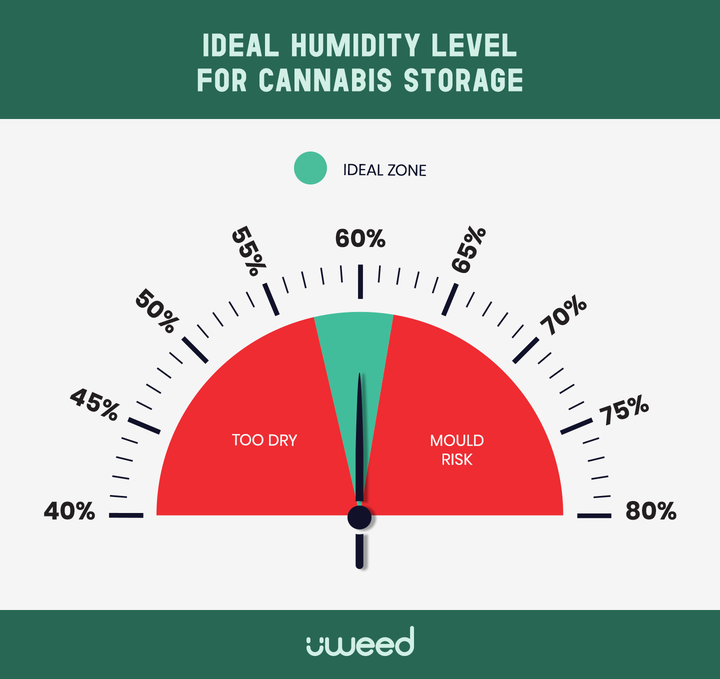
The perfect balance sits between 58-62% relative humidity, a critical zone for preserving your CBD flowers’ texture and properties. Below this, your products become brittle and lose their terpenes through evaporation.
Excessive humidity beyond 65% creates favorable conditions for mold, definitively compromising your supply’s safety. Spores develop rapidly in these humid environments.
💡 The solution: use bidirectional humidity packs like Boveda or Integra, which automatically maintain humidity in the optimal zone. These regulators absorb excess moisture or release water vapor as needed. A digital hygrometer monitors these parameters in real-time and alerts you to deviations requiring correction.
What’s the Best Thing to Store Weed In? A Quick Comparison
Four approaches have proven effective for maintaining your CBD products’ freshness:
- Airtight glass jars – The classic solution: reliable, accessible, and effective against air and light
- Specialized containers – Offer precise environmental control for those seeking perfection
- Humidity regulation packs – Automatically stabilize conditions in any airtight container
- Vacuum sealing – Eliminates oxygen for long-term storage
Each method addresses different needs, from daily to long-term storage.
Mason Jars: Why an Airtight Glass Jar Is the Gold Standard
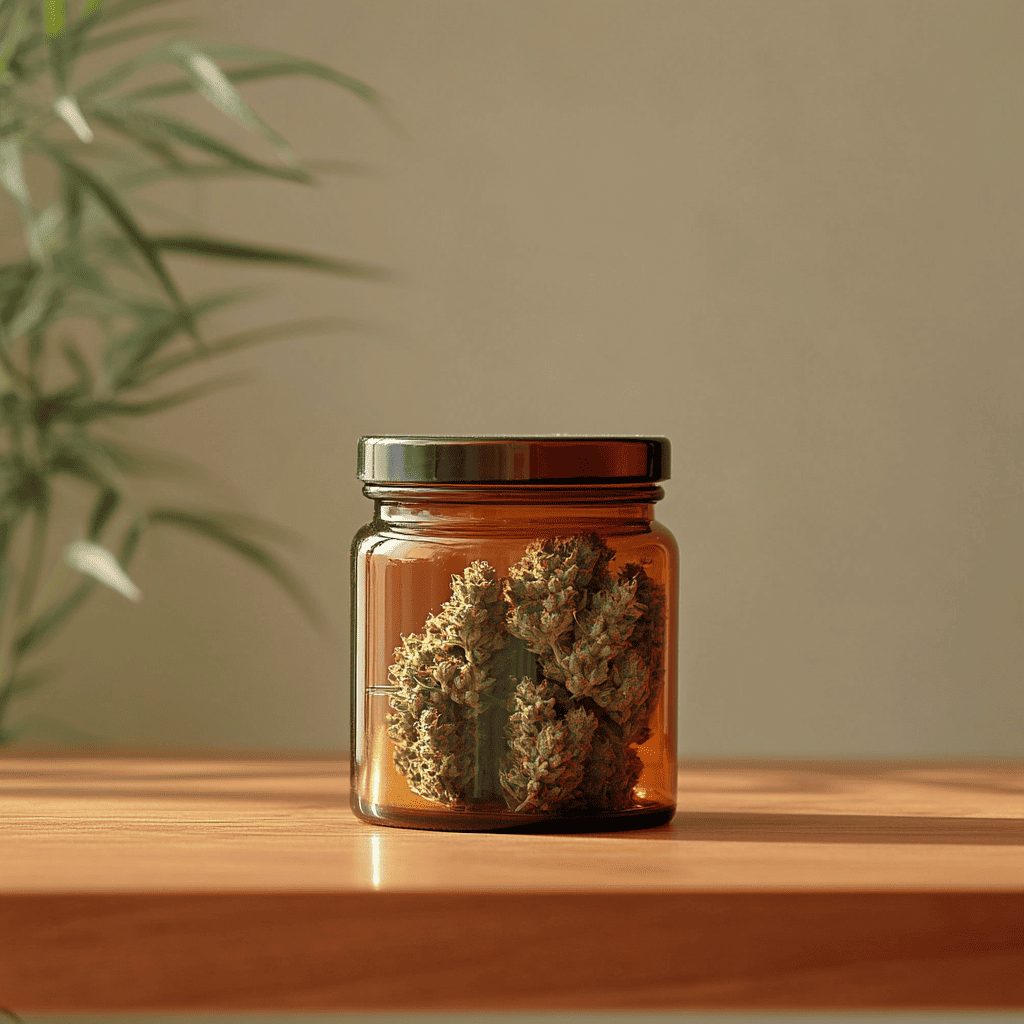
Glass stands out thanks to its perfect chemical neutrality: unlike plastic, it never alters your flowers’ terpenes or cannabinoids. It’s an airtight seal that limits internal oxygen, drastically slowing the oxidation of active compounds.
Amber or opaque glass adds essential UV protection against potency degradation. This triple action – neutrality, airtightness, and light protection – explains why professionals systematically favor this solution.
To get started with this proven method, you can find our selection of storage jars suitable for preservation in our shop. A modest investment that durably preserves your CBD products’ quality and aromas.
Weed Containers & Humidors: Are They Worth It?
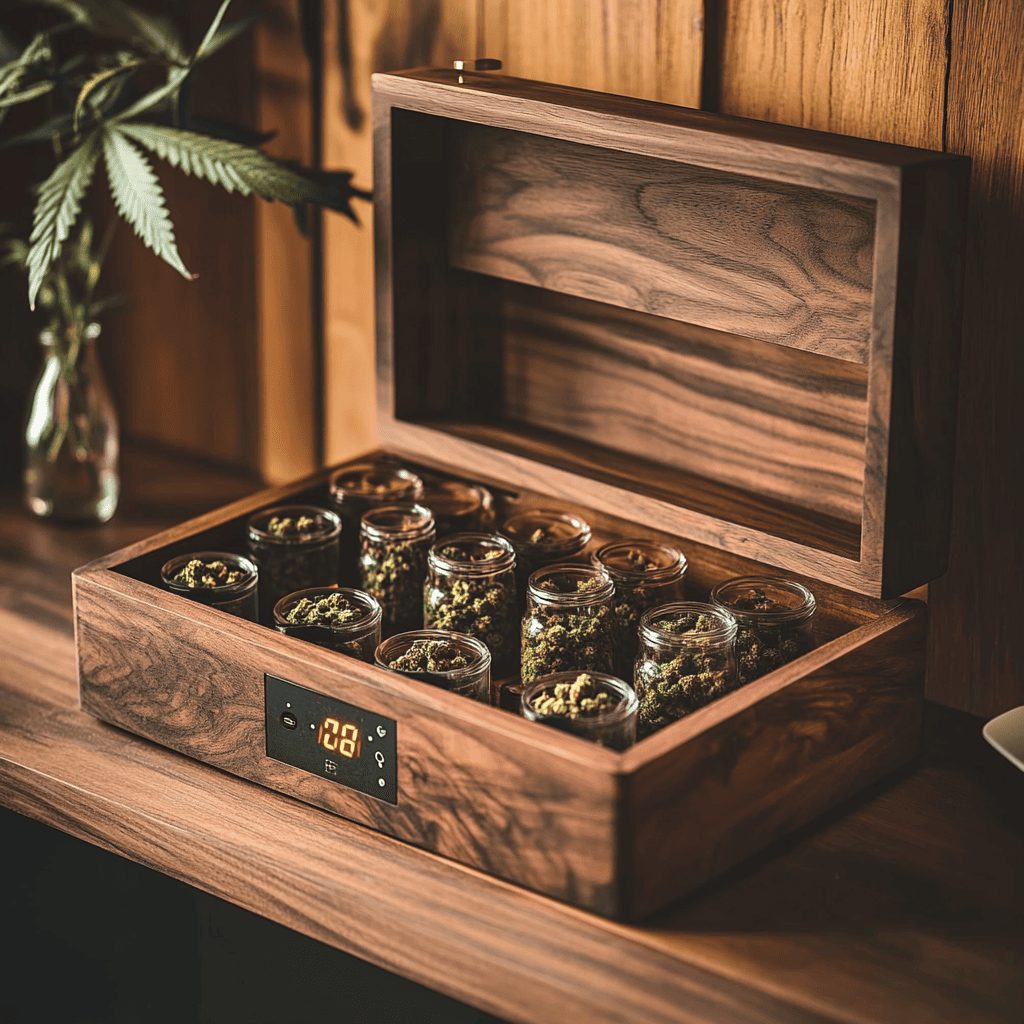
Specialized cannabis humidors integrate automatic control systems and digital monitoring, offering unmatched precision for demanding collectors. These premium solutions maintain perfect conditions without manual intervention.
These advanced systems include calibrated sensors, circulation fans, and sometimes cooling elements. The significant investment justifies itself for extensive collections or exceptional products.
Integrated technology eliminates environmental variations and guarantees long-term stability. For occasional users, glass jars with humidity packs offer excellent value.
Humidity Packs (Boveda): How Do They Work?
Bidirectional humidity packs use salts that absorb or release water vapor according to conditions, automatically maintaining the optimal 58-62% rate. This passive technology requires no energy source.
Boveda and Integra brands offer different humidity percentages, with effectiveness durations of 2 to 6 months depending on treated volume. These regulators transform any airtight container into a professional storage system.
Simple installation in your glass jar instantly creates a controlled environment. These packs preserve ideal texture while preventing mold development.
Vacuum Sealing: Is It a Good Option for Long-Term Storage?
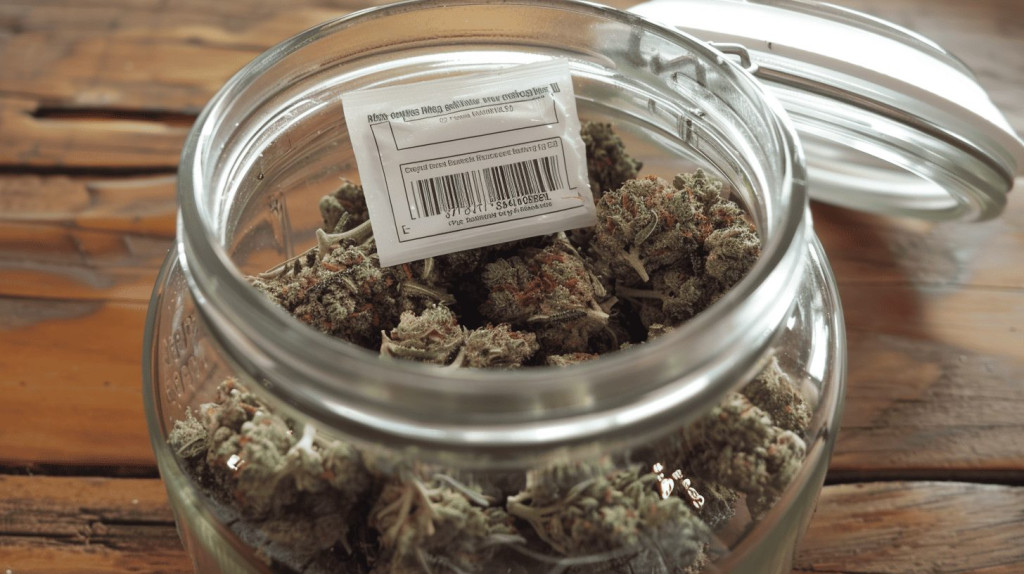
Vacuum storage eliminates oxygen, which is responsible for oxidation, considerably slowing cannabinoid and terpene degradation. This method particularly suits long-term storage of large quantities.
However, compression can damage delicate trichomes and alter your CBD flowers’ texture. Vacuum packaging adapts better to concentrates and less fragile resins than voluminous buds.
For optimal use, limit vacuum sealing to storage periods exceeding 6 months, with moderate suction levels. This technique preserves potency but modifies your products’ physical appearance.
What Are the Most Common Cannabis Storage Mistakes?
Even experienced enthusiasts sometimes make mistakes that damage their CBD products. Three major traps constantly recur: using plastic bags that trap moisture and release chemical compounds, putting cannabis in the fridge or freezer, thinking they’re helping, and storing near heat sources like radiators or electronic devices.
Some storage mistakes may seem logical at first, but they quickly ruin quality – from aroma loss and reduced potency to mold growth or complete drying out. By knowing these common pitfalls, you can keep your entire selection of CBD flowers in top condition and avoid costly disappointments.
Here’s a quick summary of good and bad practices to help you navigate easily:
Good and bad ways to store cannabis
| To Do ✅ | Don't Do ❌ |
|---|---|
| Glass jar | Plastic bag |
| Darkness | Direct light |
| Stable temperature | Refrigerator/Freezer |
Plastic Baggies: Why They Are a Bad Idea for Your CBD Flowers
Porous plastic allows gas exchanges that accelerate your cannabinoids’ oxidation, compromising their stability. This permeability continuously exposes your products to external humidity and atmospheric variations.
Static electricity generated by plastic tears away precious trichomes during handling, depriving your flowers of their active compound concentration. This mechanical loss adds to chemical degradation.
Plastic compounds progressively migrate into your products, altering their purity and aromatic profile. This contamination compromises the authenticity of the terpenes’ characteristics.
Plastic containers absorb and release surrounding odors, masking natural aromas and destroying the desired sensory experience.
Should You Store Weed in the Fridge or Freezer?
Refrigeration creates harmful conditions through condensation formation during opening and closing cycles. This excessive moisture promotes mold development and compromises safety.
Constant temperature variations destabilize your cannabinoids’ balance, accelerating their degradation. Kitchen odors contaminate your delicate flowers, masking their authentic terpenes with parasitic aromas.
Freezing makes trichomes brittle as glass, pulverizing them at the slightest contact. This extreme fragility destroys the resinous glands’ structure, containing your active compounds.
Cold preservation methods ignore cannabinoid products’ specific needs. Controlled room temperature solutions better preserve quality.
Should You Keep Cannabis Near Electronics or Heat Sources?
Heat sources like radiators, computers, or electronic devices create unstable thermal zones that rapidly degrade cannabinoids. This exposure evaporates terpenes and decomposes active molecules.
Localized variations generate thermal gradients in your containers, creating hot spots that selectively accelerate degradation. This instability compromises your storage’s homogeneity.
Environmental stability requires placement isolated from thermal and electrical disturbances, guaranteeing ideal conditions for your premium products.
How Long Does Weed Last and How to Tell If It’s Expired?
Your CBD flowers can be preserved between 6 months and 2 years, depending on your storage conditions. Well-preserved in an airtight jar away from light, they maintain quality up to 18 months. Poorly stored in a drawer or plastic bag, they degrade in just a few months.
Spotting expired cannabis means observing four warning signals: color becoming dull, aromas fading or becoming unpleasant, appearance of suspicious spots or filaments (mold), and texture becoming powdery or too dry. Even under perfect conditions, your cannabinoids naturally lose 5 to 10% of their potency each year.
Knowing how to recognize these signs helps you optimize your purchases and avoid unpleasant surprises.
What Is the Average Shelf Life of Cannabis?
Properly stored cannabis maintains optimal properties for 12 to 18 months under ideal conditions: darkness, stable temperature of 15-21°C (59-70°F), humidity of 58-62%, and airtight containers. This duration assumes premium initial quality.
Degradation factors add up: each unfavorable condition proportionally reduces storage duration. Fluctuating temperature storage halves this optimal period.
Cannabinoid potency gradually diminishes even under perfect conditions, with a natural loss of 5-10% annually. This slow degradation remains acceptable compared to dramatic losses from poor storage.
How to Tell If Your Weed Has Gone Bad (Smell & Visual Signs)
Visual inspection reveals flowers’ progressive discoloration, losing their green color to turn brown or yellow. This alteration indicates natural pigment degradation.
Missing or vitrified trichomes signal significant cannabinoid loss. These usually milky or amber resinous glands become transparent or easily detach.
Olfactory inspection detects characteristic aroma loss replaced by musty, dry hay, or ammonia odors. These changes often precede visible degradation.
What Does Moldy Weed Look Like?
Mold appears as white, gray, or green cottony filaments on surfaces, distinguished from natural trichomes by their stringy appearance. This growth compromises product safety.
The characteristic musty smell, reminiscent of a humid basement or wet laundry, signals the presence of spores before visibility. This early detection allows rapid isolation of contaminated products.
Dark or discolored zones, particularly in dense bud parts, often hide infection beginnings. Thorough examination with a magnifying glass reveals the first signs.
Does Weed Lose Its Potency Over Time?
Natural cannabinoid degradation follows inevitable evolution, even under optimal conditions. CBD slowly transforms into less active CBN, with a conversion rate of 2-5% annually according to studies.
Volatile terpenes gradually evaporate despite airtightness, reducing aromatic intensity and entourage effect. This gradual loss affects sensory experience more than absolute potency.
A study by Namdar et al. (2018) published in the European Journal of Medicinal Chemistry documents these temporal changes in correctly preserved samples.
How to Store Different Types of CBD Products?
Whether you’re attracted to complex aromas and CBD flower texture, or powerful resin concentration, each product has its secrets. Adapting your storage method guarantees that the sensory experience remains faithful to what the product offers best.
Flowers demand precise humidity control to preserve their sparkling trichomes. Oils dread heat that degrades their cannabinoids. Resins become sticky and difficult to handle without precautions. Seeds fear excessive humidity that compromises their viability.
This diversity is explained by the different ways to consume CBD: each form possesses a unique composition that reacts differently to environmental conditions. A lipid-rich oil doesn’t store like flowers containing natural water.
The table below guides you according to your products:
How to Store Each CBD Product Type
| Product Type | Best Container | Key Advice |
|---|---|---|
| Flowers | Glass jar | Humidity control |
| Oil | Original bottle | Keep upright away from heat |
| Resin | Parchment paper | Prevent sticking |
CBD Flower vs. Hash: What Are the Storage Differences?
CBD flowers and resins have opposite needs. Flowers, with their residual water (8-12%), demand strict humidity control: too dry, trichomes crumble; too humid, mold appears.
Resins pose a unique storage challenge: their high density and lack of moisture make them extremely temperature-sensitive. Heat causes them to stick permanently to containers, while cold makes them hard and brittle. That’s why our CBD hash, available online at uWeed, is first wrapped in non-stick parchment paper and then stored in an airtight jar at a cooler temperature (12–15 °C compared to 15–18 °C for flowers).
Despite these differences, both forms share the requirement for UV light and oxygen protection to preserve their therapeutic potential.
How to Properly Store CBD Oil After Opening?
CBD oils require absolute protection against UV light that rapidly degrades cannabinoids in solution. Original amber bottles or total darkness storage preserve molecular stability.
Constant temperature between 15-21°C (59-70°F) avoids phase separation and maintains formulation homogeneity. Thermal variations can alter viscosity and compromise effectiveness.
Our premium Swiss CBD oils can be stored for up to 24 months, provided their appearance and aroma are regularly checked to detect any early signs of change. 🧴
Are There Special Requirements for Storing CBD Edibles?
Edible CBD products combine the preservation challenges of cannabinoids with those of perishable foods, making a hybrid storage approach essential. The requirements vary by product type: our CBD and hemp teas benefit from dry packaging that preserves volatile terpenes, while capsules and candies call for different, product-specific precautions.
Residual moisture in food products can promote bacterial development, sometimes requiring selective refrigeration according to formulation. Strict expiration dates guide your consumption decisions and should never be ignored.
Stock rotation according to the FIFO (First In, First Out) principle optimizes your CBD edible products’ freshness and guarantees a consistent experience. This professional method prevents consuming expired products while maximizing the benefits of your purchases. 🍃
What Is the Best Way to Store Cannabis Seeds?
Cannabis seeds demand a particular approach: unlike flowers, they primarily fear humidity that compromises their viability. A rate above 50% triggers premature germination or promotes destructive fungus development.
The refrigerator becomes your ally here, unlike other CBD products. Preserved in an airtight container with a desiccant (silica gel), they maintain their germination potential for 2-5 years. Stable temperature between 2-8°C (36-46°F) slows their metabolism without damaging them.
To preserve our selection of CBD hemp seeds sold at uWeed, absolutely avoid temperature variations and direct light exposure. A cool, dark drawer works perfectly if you don’t have a dedicated refrigerator.
Labeling remains essential: purchase date and variety help you respect optimal storage durations and plan your future crops.
Frequently Asked Questions About Storing Legal Cannabis
Does Grinding Weed in Advance Affect How Long It Stays Fresh?
Yes, grinding your cannabis drastically reduces its storage duration by multiplying the oxygen-exposed surface by ten. This pulverization accelerates volatile terpene evaporation and cannabinoid oxidation, transforming your precious reserve into bland powder in a few weeks.
Grind only the quantity needed for immediate consumption. Ground cannabis stored in an airtight jar keeps its properties 2-3 weeks maximum, compared to several months for whole flowers.
How Can I Rehydrate Weed That's Too Dry?
Add a slice of fresh bread or orange peel in your jar for 2-4 hours maximum to rehumidify your desiccated flowers. This gentle method transfers natural moisture without risking mold, unlike more aggressive methods.
Monitor the process carefully: excessive humidity quickly transforms recovery into catastrophe. Remove the humidifying element as soon as your flowers regain flexibility.
Is It Normal for My Weed's Smell to Fade Over Time?
It’s perfectly normal, terpenes responsible for aromas naturally evaporate over time, even under optimal storage conditions. This olfactory degradation begins at harvest and accelerates with air, light, and heat exposure.
Well-preserved cannabis loses about 10-15% of its aromas the first year. If the smell completely disappears or becomes unpleasant, check for mold presence or reconsider your storage methods.