
A consumer study with IG Hemp Switzerland
In recent years, CBD has been gaining popularity across Europe and the rest of the world. Little known to the public until recently, cannabidiol now attracts more and more consumers. Products based on this hemp molecule are legal in most European countries as long as their THC content stays below a set threshold, under 1% in Switzerland.
As a result, the number of CBD enthusiasts continues to grow. uWeed, an online CBD marketplace with one of Switzerland’s largest CBD selections, wanted to find out more about them. In collaboration with IG Hemp Switzerland, we interviewed 1,170 CBD consumers in Switzerland to find out more about them. Including, which products they like the most, and what they’re looking for. A few months down the line, here’s what we found out!
Motives stated by respondents
The survey’s first question was why respondents use CBD. Relaxation came first (50%), ahead of sleep (46%). Other, health-related motives are set out in the full report. These are consumers’ answers: they describe their motives, not what CBD does.
There is currently no large-scale scientific data to assess how effective cannabidiol is for health.
CBD enthusiasts tend to have a high level of education
Our survey found that the average CBD consumer tends to have a high level of education. Indeed, almost half of Swiss respondents (41%) have a university or college degree (Bachelor’s, Master’s, or Ph.D.), well above the national average of 31%. However, this does not mean that CBD users are rolling in money: almost 40% have incomes below CHF 50,000 per year. A relatively small proportion (16%) earn a “high” salary, i.e. over CHF 100,000 per year.
This may be explained by the relatively young age of the participants in our survey: 56% are aged between 18 and 40 years old, while 22% are over 50. At the same time, just over half are currently in a relationship, and about a third have started a family.
CBD use tends to be gendered
Not only are more men using CBD than women, but the ways in which they use it differ. Two-thirds of our survey respondents were male. Moreover, more than a third of men have been using CBD for more than two years, compared to only one in five women. This makes men the early adopters of the cannabidiol market, along with seniors, almost a quarter of whom have been using CBD for more than three years. In contrast, almost half of women have been using CBD for less than six months. Could women be the future of the CBD market?
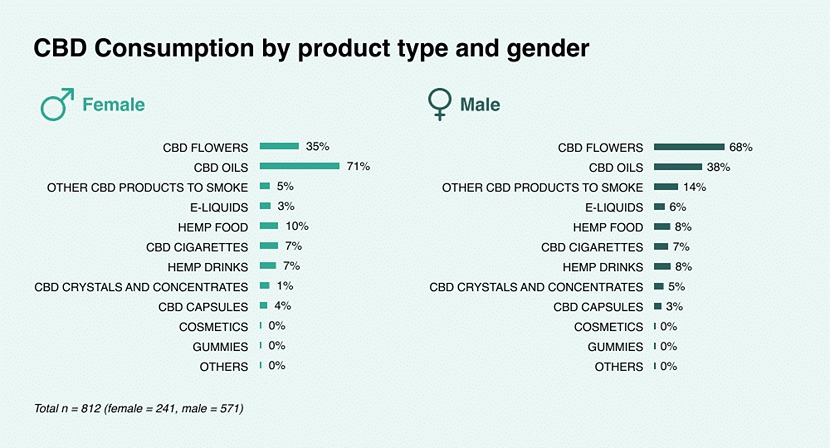
At the same time, women report being less familiar with CBD than men, estimating their level of knowledge at 3.3 out of 5, compared to 3.5 for men. Finally, men tend to favor CBD flowers, whereas women tend to opt for oil.
Consumers are buying and seeking information online
We also found differences between men and women in the way they seek out information about CBD. Women are more likely to ask their family, friends, or professional network for information, while men rely on online publications and social networks.
In general, CBD consumers look for information on current research and on the various products on the market. Their main sources are search engines, personal networks, CBD brand sites, and specialist blogs.
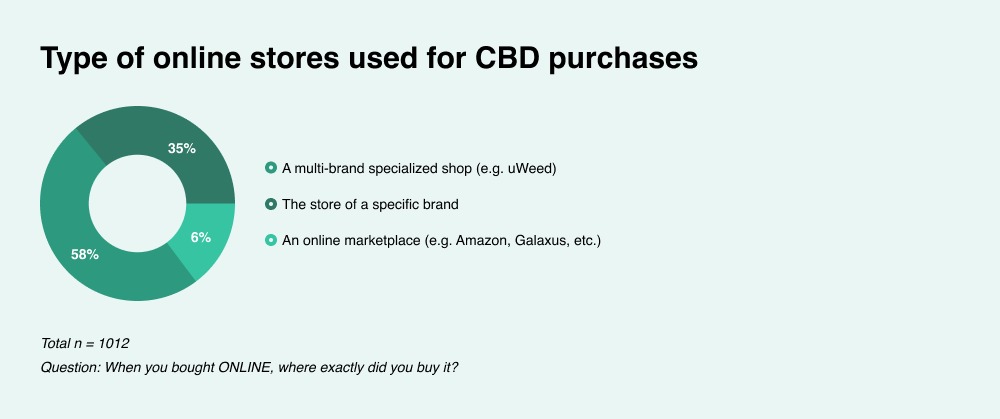
In terms of CBD purchasing habits, the majority (74%) of consumers favor e-commerce, which is not particularly surprising. Since the start of the health crisis, online retail sales have increased significantly. Of these, 58% opt for multi-brand platforms such as this one, 35% go directly to specific brands and 6% buy from marketplaces such as Amazon or Galaxus.
Consumption patterns vary depending on the product
Two products dominate CBD use in Switzerland: in the 30 days before the survey, nearly 60% of respondents had used CBD flowers and nearly 50% CBD oil.
As we have seen above, the consumption of these two products varies according to the gender of the respondent. But there are also differences in terms of the acquisition. People who prefer flowers tend to try several different products, whereas CBD oil consumers tend to stick to one brand once they have found the one they like. At the same time, CBD oil users tend to buy online rather than from a brick-and-mortar store, unlike flower users. This may be because it is easier to find CBD flowers in physical shops, such as kiosks and petrol stations, than oil.
Finally, for some people CBD is a social occasion: 40% of Swiss respondents consume dried flowers in the company of others, compared to 15% of those who prefer oil.
Respondents and other substances
We wanted to know what the relationship of CBD consumers was with illicit substances or those considered “drugs”. It should be remembered that CBD-based products are not considered narcotics as long as their THC content remains below a threshold defined by various European legislation.
It turns out that in Switzerland, more than half of CBD enthusiasts do not consume addictive or illicit substances. Among the others, the majority (74%) use tobacco, almost half use illegal cannabis and only one in 10 use other drugs.
We also asked THC users whether they would keep using CBD if THC were legalised: more than half said yes.
All the survey results, motives included, are in the full report, available in French and German.