Disclaimer
This article is for information only. It is not legal or medical advice, and the products described are not medicines. For any specific legal question, please consult a Swiss legal expert.
Yes, CBD is legal in Switzerland as long as the product stays below 1% total THC and was not made from hemp at 1% THC or more. Below 1% total THC, CBD is not a narcotic: hemp under that limit falls outside narcotics law, and cannabidiol itself is not on the list of controlled substances. Legal CBD does not mean that every product may be sold.
After that, the product class decides. Swiss law only allows a product on the market if it meets the rules for its intended use: not what it is called, but what it is for. CBD flowers, hash and pre-rolls are herbal smoking products, e-liquids fall under tobacco products law, and oils are sold as aroma oil or as a cosmetic. Food with added CBD is not authorised; hemp seeds and hemp seed oil are.
Growing, selling, crossing a border and driving have their own rules, set out further down. So what is allowed, restricted or banned for CBD in Switzerland comes down to two questions, in this order: how much THC does the product contain, and which product class applies?
What Decides Whether Cannabis Is Legal in Switzerland?
Whether cannabis is legal in Switzerland is decided not by the plant or the strain but by a measured value: total THC. Hemp and cannabis are botanically the same plant, and Swiss cannabis law, in the form of the Narcotics Act (BetmG) [1], draws the line at 1.0% total THC, meaning THC plus THCA.
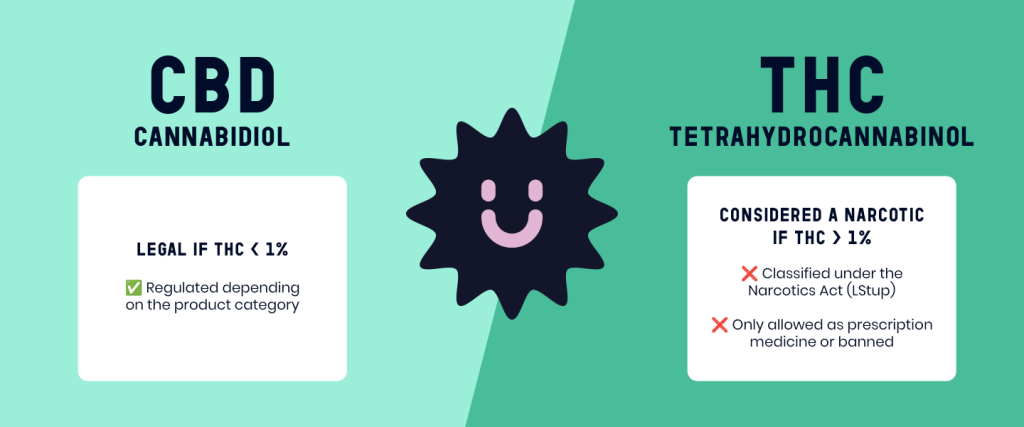
Cannabidiol is not on the list of controlled substances: a CBD product is regulated because of its THC content and its product class, not its CBD content. A high CBD content makes a product neither more nor less legal, because the limit measures THC, not CBD. Below the limit, the real question begins: which product class applies. Why the law treats the two substances so differently is explained in our article on the difference between CBD and THC.
Below 1% THC: Hemp Is Not a Narcotic
Below 1.0% total THC, hemp is not a narcotic in Switzerland: this is the normal case, not a tolerance. The three key values at a glance:
- Limit: below 1.0% total THC
- Measured as: THC plus THCA, in the plant and in the starting material
- Legal basis: the Narcotics Act (BetmG) and the FDHA Narcotics Schedules Ordinance (BetmVV-EDI) [2]
Hemp plants and hemp products with a total THC content below 1.0% fall outside the definition of cannabis in narcotics law, which is what Swiss law’s THC limit for hemp CBD products means in practice. A product must also not have been made from hemp at 1.0% or more: the starting material counts too, not only the finished product. Handling, trading and possessing such products therefore needs no authorisation under the Narcotics Act. That does not make every product freely saleable, because this is where product-class law takes over.
From 1% THC: Cannabis Falls Under the Narcotics Act
From 1.0% total THC, cannabis is a narcotic in Switzerland and is banned without authorisation, so THC cannabis is not legal, and a CBD product only becomes illegal through its THC content. For medical purposes, cannabis has not been banned since 1 August 2022: doctors may prescribe it without an exceptional authorisation from the FOPH, while Swissmedic supervises cultivation, manufacture and trade [1]. The authorised cannabis medicines are Sativex and Epidyolex; pharmacies also compound preparations on a doctor’s prescription. Other exceptions are FOPH exceptional authorisations, for example for research, and authorised pilot trials on the sale of cannabis, which are limited until 2031 and cover neither home growing nor tourists. Semi-synthetic cannabinoids follow their own rules, set out in the next section.
- Status: narcotic, banned without authorisation
- Route of access: doctor’s prescription, FOPH exceptional authorisation or an authorised pilot trial
- Where dispensed: pharmacy for medicines, or the dispensing point of the pilot trial concerned
Statutory regulation of the cannabis market is being worked on: as of October 2026, the consultation on parliamentary initiative 20.473 has closed, and in May 2026 the National Council’s health committee returned the bill to its subcommittee for revision. For CBD below 1% THC, this changes nothing about today’s framework.
HHC, THCA and Other Cannabinoids: What the Law Covers
The 1% limit is not a loophole for other cannabinoids: someone looking for HHC or THCA is, legally, not looking for CBD. Tetrahydrocannabinolic acid (THCA) counts towards total THC because heating turns it into THC, so a “THCA product” with little THC is not automatically below the limit, and THCA is not legal in Switzerland simply because the label says so.
Hexahydrocannabinol (HHC) has been controlled under narcotics law since 31 March 2023, and HHCP, THCP and H4CBD since 9 October 2023. Since 5 November 2024, the BetmVV-EDI [2] has also covered the whole group of synthetically derived THC derivatives. These substances are treated as narcotics regardless of their THC content, and Δ8-THC, as a THC isomer, is a narcotic in any case. Semi-synthetic cannabinoids are not CBD, and the name on the pack does not decide. uWeed carries none of these substances.
Which CBD Products Are Legal in Switzerland?
Switzerland’s stance on CBD below 1% THC is that the product class decides which CBD products are legal, not the product name: the same cannabidiol can sit in different product classes, and the law asks what a product is for. Each product is classified case by case by its composition, intended use and presentation, as the enforcement guide of the federal Expert Panel on Demarcation Questions sets out [3]. Whoever sells it must state the intended use; where in doubt, the authority assigns it. A product that does not meet the rules for its intended use may not be sold, and CBD crystals (isolate) are no exception: their legal status follows the intended use like any other CBD product.
Law and authority change with the class. Smoking products and e-cigarettes fall under the Tobacco Products Act and are notified to the FOPH, the FSVO is responsible for food, cosmetics and consumer goods, and Swissmedic for medicines. That is why, from here on, this page answers one question per product group.
| Product class | Typical products | Legal basis | Competent authority |
|---|---|---|---|
| Herbal smoking products | CBD flowers, hash, pre-rolls | Tobacco Products Act (TabPG) | Notification to the FOPH, enforcement by the cantons |
| E-cigarettes and e-liquids | CBD vapes, e-liquids, refill containers | TabPG and Tobacco Products Ordinance (TabPV) | Notification to the FOPH, enforcement by the cantons |
| Cosmetics | Creams, balms, skin oils | Food law, Cosmetics Ordinance (VKos) | FSVO, cantonal food control |
| Chemical or aroma oil | Aroma and fragrance oils, denatured | Chemicals law, denaturing duty | Notification Authority for Chemicals, cantonal offices |
| Consumer goods with mucous-membrane contact | For example tobacco-free snus substitutes | Food law | FSVO |
| Food | Added CBD not authorised; hemp seeds, hemp seed oil and tea from hemp leaves allowed | Food law (LGV) | FSVO |
| Animal feed | CBD extracts not authorised | Feed law | Agroscope |
| Medicines | Authorised products, pharmacy preparations | Therapeutic Products Act (HMG) | Swissmedic |
Are CBD Flowers, Hash and Pre-Rolls Legal in Switzerland?
Yes, CBD flowers are legal in Switzerland as long as they stay below 1% total THC, but they are not an unregulated item. In law, CBD flowers count as a herbal smoking product and therefore as a tobacco product under the Tobacco Products Act (TabPG) [4]. There is no ban on CBD flowers, but there are duties for everyone who makes, imports or offers them.
The same class covers hash, pollen, moonrocks, trim, pre-rolls and hemp cigarettes, so CBD cigarettes in Switzerland follow the same rules: the processing form does not change the legal class. CBD hash is legal when the resin stays below 1% total THC and meets the duties for smoking products. In substance, the pack of these products must carry:
- a product name marked as plant-based and tobacco-free
- a health warning that smoking the product damages health, plus a combined picture warning
- for hemp, a warning that the product may impair the ability to drive and that driving after use is not advised
- all warnings in German, French and Italian
There is no official English text of the TabPG, so the list above summarises the warnings rather than quoting them. Since 1 October 2025, only products labelled this way may be manufactured or imported; older stock may be sold off. Whoever manufactures or imports the product notifies the FOPH within one year of market launch, so the notification duty sits with the brand, while everyone offering it has a self-control duty.
Sale is allowed only to people aged 18 or over, and not only in specialist shops: kiosks, petrol stations and online shops are allowed too, and cantons may require additional permits. Advertising health benefits or healing effects is banned (Art. 5(2) TabPG) [4]. Strains with their lab reports are listed under legal CBD flowers from Swiss growers.
Is It Legal to Smoke CBD in Public in Switzerland?
Smoking CBD in public in Switzerland is legal outdoors under federal law, but since 1 October 2024 it has been banned in enclosed spaces open to the public and at workplaces, just like tobacco [5]. The same indoor ban applies to e-cigarettes, and cantons and municipalities may set further restrictions; house rules and place-based bans are covered in the answer to “Is CBD Banned Anywhere in Switzerland?” below. Smoking weed, meaning cannabis at 1% THC or more, is an offence wherever it happens, with a fixed-penalty fine for small amounts [1].
In a police check, CBD flowers look the same as THC cannabis. Rapid tests measure THC, and a lab analysis settles the content. The original packaging with its labelling can help classification, but it is not a guarantee.
Are CBD E-Liquids and Vapes Legal in Switzerland?
Yes, CBD in e-cigarettes and e-liquids is legal in Switzerland as long as the product stays below 1% total THC. E-liquids and vapes also fall under the Tobacco Products Act, but as a category of their own rather than as herbal smoking products, and nicotine-free e-cigarettes count as e-cigarettes in law. A THC vape is a different matter: at 1% THC or more, THC vapes are narcotics in Switzerland and cannot be sold, even though they are common abroad. Three rules apply to every CBD vape:
- Duties: a health warning in three national languages, a package leaflet and notification to the FOPH by the manufacturer or importer within one year of market launch, under the TabPG and the Tobacco Products Ordinance (TabPV) [6]. Refill containers also need chemicals-law labelling; the driving warning for hemp flowers does not apply here.
- Disposables: the tank volume is capped at 2 ml. Some cantons, such as Geneva and Valais, ban disposable e-cigarettes, and cantonal law decides whether nicotine-free devices are covered. Parliament has demanded a national ban by motion; it would only apply once the law is amended.
- Age: sale only to people aged 18 or over.
The volume and concentration limits in the law for tanks, refill bottles and nicotine content are written for nicotine products. They cannot simply be applied to CBD liquids. Nicotine-free options with cannabidiol are listed under CBD vapes and e-liquids.
Is CBD Oil Legal or Banned in Switzerland?
CBD oil below 1% total THC is legal in Switzerland, either as an aroma or fragrance oil under chemicals law [7] or as a cosmetic applied to the skin. It is banned as a food: CBD oil is not authorised for ingestion, as the next section explains. Oil is not a legal category, so whether a CBD oil is legal in Switzerland depends on its intended use.
Aroma oils sold to consumers have had to contain a denaturant that deters ingestion since 2022, under a general ruling of the Notification Authority for Chemicals [8]. CBD oils offered as an oral-care cosmetic do not meet the rules for cosmetics, and an oil offered with the intent of ingestion and an expected effect falls under therapeutic products law. What is on the pack follows the classification, not the quality: it says nothing about the CBD content. This is how the two legal classes differ:
| Classification | Legal basis | Required information | Form of use |
|---|---|---|---|
| Aroma oil | Chemicals Ordinance (ChemV), general ruling of the Notification Authority for Chemicals of 29 March 2022 | Denatured; chemicals-law labelling; hazard labelling, child-resistant closure and register number only if classified as hazardous | Fragrance and aroma oil, not intended for ingestion |
| Cosmetic | Food law (LGV), Cosmetics Ordinance (VKos) | Ingredient list, responsible person, batch, durability | Applied to the skin |
With one of these classifications and a correct declaration, a CBD oil is legal in Switzerland. Which of the two classes applies is stated on the pack. Both versions, each with its classification, are listed under CBD oil for aroma and skin use.
Are CBD Edibles and Drinks Legal in Switzerland?
No, edibles and drinks with added CBD may not be sold in Switzerland, while hemp itself is allowed as a food. CBD and CBD-containing hemp extracts are novel foods under the Foodstuffs and Utility Articles Ordinance (LGV) [9] and would need authorisation, and none has been granted in Switzerland or the EU, so cannabidiol is not authorised as a food ingredient. Hemp seeds, hemp seed oil, hemp seed flour and tea from hemp leaves as an infusion are allowed, and maximum THC levels apply to them. The FSVO currently sees safety concerns because of data gaps. This has consequences for three product groups:
- Oil: a CBD oil may not be intended for ingestion, which is why it is declared as not for consumption. Looking for a CBD oil to take orally leads to no freely sold product in Switzerland; oral CBD preparations exist only as medicines on prescription.
- Hemp tea: “contains CBD” is not allowed on food, and that is why the product is called hemp tea, not CBD tea. Tea from hemp leaves is allowed; for tea with flower parts, the seller must show that it was consumed to a significant degree before 1997.
- Edibles: gummies, chocolate, baked goods and drinks with added CBD cannot be sold as food.
The food route is therefore closed for cannabidiol. For hemp as a plant, it stays open. Infusions made from hemp are listed under hemp tea grown in Switzerland.
CBD Gummies in Switzerland: Why They Are Not Legal
CBD gummies and other edibles with added CBD may not be sold as food in Switzerland, because CBD is not authorised as a novel food. The same applies to chocolate, baked goods and drinks with added CBD. In the EU, too, CBD has not yet been authorised as a food, and the assessment there is still ongoing. On sale abroad therefore does not mean allowed in Switzerland: no CBD gummy has been authorised as food. THC gummies at 1% THC or more are narcotics. uWeed sells no CBD edibles.
Is CBD Skincare Legal in Switzerland?
Yes, CBD skincare is legal in Switzerland if it meets the rules for cosmetics, and among CBD products it is the clearest class. The plant part used does not matter; what counts is that no intermediate product in manufacturing exceeds 1.0% THC [3]. The FSVO is responsible at federal level, and the cantonal food authorities carry out controls. Three points make a CBD cosmetic compliant:
- Safety report: the manufacturer shows in the product information file that the CBD used is safe. If the CBD content is above the scientific guide value of 0.19%, the safety report must justify it [10].
- Label: INCI ingredient list, name and address of the responsible person, batch number, durability, function and warnings in at least one official language, as the Cosmetics Ordinance (VKos) requires [11].
- Claims: healing, soothing or preventive claims are banned on cosmetics. CBD oils for oral care are not compliant cosmetics; an oil is defensible only as a skin cosmetic.
Cosmetics for external use are described by their care function. A skin condition is never part of that description. Creams, balms and skin oils are listed under CBD skincare with cannabidiol.
Are CBD Seeds Legal in Switzerland?
Yes, CBD seeds are legal in Switzerland if they come from hemp strains that stay below 1% total THC: with seeds, the strain decides, not the seed. Seeds for plants at 1% total THC or more count as banned narcotics themselves, whatever the seed’s own THC content [2].
You can also grow hemp in Switzerland: growing hemp that stays below 1.0% total THC is outside the Narcotics Act and needs no FOPH authorisation. There is no federal limit on the number of plants, but some cantons require notification from a certain number, for example Graubünden and St. Gallen from 10 plants, and there is no private exception to the THC limit.
A special seed law for hemp has not existed since 2021; farm cultivation is subject to plant health and direct payment law, overseen by the FOAG. CBD seeds are for growing, not for eating, whereas edible hemp seeds are food with their own THC limits. Strains for growing are listed under CBD seeds from Switzerland.
Is CBD for Pets Legal in Switzerland?
No, CBD oils for feeding to animals may not be sold in Switzerland: CBD extracts are not authorised as a feed additive in Switzerland or the EU [12]. For animals, neither cosmetics nor food law applies; Agroscope is responsible for feed control and Swissmedic for veterinary medicines. Two rules separate what is allowed from what is not:
- Feed: hemp seeds, hemp seed oil, hemp cake, hemp flour and hemp fibre from varieties below 0.2% THC are allowed; leaves and flowers have been excluded since 2023.
- Veterinary medicines: a product offered with a healing or effect claim is a veterinary medicine and needs Swissmedic authorisation under the Therapeutic Products Act (HMG) [13].
Care products for external use on animals fall under chemicals law. uWeed no longer sells CBD products for animals.
Buying, Selling, Travelling and Driving: The Rules in Practice
Up to here, this page has dealt with the product on the shelf. From here on it deals with everything else someone wants to do with it, because it is not only buying that is regulated: where to buy, the minimum age, selling, crossing a border and driving each follow their own rules. Alongside federal law, cantonal rules play a part too, from the shop to the road.
Where Can You Buy Legal CBD in Switzerland?
You can buy legal CBD in Switzerland in specialist shops, kiosks, petrol stations and online: a product is legal, not a place of sale. Smoking products and e-liquids are sold only to people aged 18 or over, and whether a product is correctly declared is recognisable on the pack:
- the product class and directions, such as “not intended for ingestion” or “for application to the skin”
- the name and address of the manufacturer or importer
- the mandatory warnings on smoking products
- the ingredient list on cosmetics
- a current lab report showing the THC content
On uWeed, we publish the lab report on the product page where the brand supplies one. Where a brand supplies none, the product page says so. If you want to order legal CBD online in Switzerland, all categories are in the uWeed shop.
What Is the Minimum Age to Buy CBD in Switzerland?
The minimum age to buy CBD flowers, hash, pre-rolls, vapes and e-liquids in Switzerland is 18: since 1 October 2024, selling them to anyone younger has been banned nationwide, in every sales channel, including online [4]. The point of sale must display the sales ban, and vending machines are allowed only where minors have no access. The minimum age depends on the product class, and oils and cosmetics have no federal minimum age. Some cantons go further: in Ticino, the sale of hemp products to minors is banned outright.
Can You Sell CBD in Switzerland?
Yes, you can sell CBD in Switzerland, and selling needs no federal permit for products below 1% THC. Some cantons, such as Ticino and Vaud, do require a cantonal permit for the retail sale of hemp products. The duties follow the product class:
- Smoking products and e-liquids: labelling, warnings, notification to the FOPH by the manufacturer or importer, sale from 18 only, advertising limits
- Cosmetics: product information file with safety report, and labelling
- Aroma oils: denaturing and chemicals-law labelling
- Self-control: it lies with whoever places the product on the market, the retailer included, not only the brand
There is no general duty to produce a certificate of analysis for every single product, but self-control does require being able to demonstrate conformity. At uWeed, we collect, check and publish third-party lab reports; the testing is done by the labs, not by us.
Travelling with CBD: Import, Export and Border Rules
A CBD product that is legal in Switzerland is not automatically legal once it crosses a border: Swiss law ends at the border, and in the destination country that country’s law applies, not the Swiss 1% limit. Visitors to Switzerland follow the same rules as residents: CBD below 1% THC is legal, cannabis at 1% or more is not, and the pilot trials are not open to tourists. That is the short answer to whether weed is legal in Switzerland for tourists.
Anyone importing CBD products commercially into Switzerland must prove total THC below 1% with a batch-specific certificate of analysis from a laboratory accredited to ISO/IEC 17025 or working to GMP; Swissmedic issues no no-objection certificate for this [3]. The FOPH recommends that sellers point out the risk of prosecution abroad. Import and export are handled by the Federal Office for Customs and Border Security (FOCBS). The key values:
- Evidence for commercial imports: batch-specific certificate of analysis, total THC below 1%
- Competent authority: FOCBS, for import and export
- Date checked (country table): 20.08.2026
CBD Laws in Neighbouring Countries: Germany, France, Italy and Austria
No neighbouring country applies the Swiss 1% limit, so the Swiss limit does not travel with you. In Germany, CBD flowers count as cannabis unless they qualify as industrial hemp, which means at most 0.3% THC and exclusively commercial or scientific purposes. Under the Consumer Cannabis Act (KCanG) [14], in force since 1 April 2024, importing cannabis into Germany is banned even for adults and even in small amounts, and that covers Swiss CBD flowers, hash and pre-rolls. CBD as a substance is exempt; whether a full-spectrum oil with THC traces is caught has not been settled.
| Country | What the rule covers | Limit or status | Date checked |
|---|---|---|---|
| Germany | Definition of industrial hemp (plant and exclusively commercial or scientific purpose), not a ceiling for finished products; import of cannabis banned | 0.3% THC; KCanG § 1 no. 8 and 9, § 2(1) | 20.08.2026 |
| France | The variety and extracts, and the products containing them | 0.3% THC; Arrêté of 30 December 2021; the ban on flower sales was annulled by the Conseil d'État on 29.12.2022 (no. 444887) | 20.08.2026 |
| Italy | Cultivation; flower sales are governed separately | 0.2% in cultivation, 0.6% analytical tolerance (Legge 242/2016); the flower-sales ban under Legge 80/2025 has been suspended since the Consiglio di Stato ruling of 12.11.2025, and a referral to the CJEU is pending | 20.08.2026 |
| Austria | Cultivation of industrial hemp | 0.3% THC, the EU cultivation threshold; rules for finished CBD products to be confirmed | pending |
The FOPH recommends pointing out this risk of prosecution abroad. Limits change, and this table is not a substitute for guidance from the authorities in your destination country.
CBD and Driving: Zero Tolerance on Swiss Roads
Swiss roads apply zero tolerance for THC: anyone driving with THC in their blood is deemed unfit to drive, regardless of actual impairment. The threshold is 1.5 micrograms of THC per litre of whole blood (Art. 2(2)(a) VRV) [15], measured under the FEDRO ordinance VSKV-ASTRA (Art. 34) [16], a rule the Federal Supreme Court confirmed in 2021 [17]. The usual consequence is licence withdrawal for at least three months (Art. 16c SVG) [18]. Tests look for THC, not CBD, and full-spectrum products contain THC traces, which is why hemp smoking products carry the statutory driving warning described in the flowers section above. Our article on CBD and driving in Switzerland covers what this means in detail.
Drug Tests: They Look for THC, Not CBD
Drug tests look for THC, not CBD. Full-spectrum products contain THC traces below 1%, and those are exactly the traces a test can pick up; a positive result does not show whether the THC came from a legal CBD product. How informative a test is depends on the test method. A separate article explains how long THC shows up in a drug test, test type by test type.
Frequently Asked Questions About CBD in Switzerland
The main questions about CBD in Switzerland are answered in the sections above. These are three remaining legal questions that are often confused, and each answer can be read on its own.
Since When Has CBD Been Legal in Switzerland?
CBD has been legal in Switzerland for as long as it has been sold, because cannabidiol itself is not a narcotic and is not on the narcotics schedule, so it never had to be legalised. For hemp products, what counts is the limit of 1% total THC set in the FDHA Narcotics Schedules Ordinance [2]. Later changes mainly concerned product classes rather than the substance, for example the rules for smoking products and e-cigarettes that have applied since 1 October 2024.
Is CBD Banned Anywhere in Switzerland?
There is no general CBD ban in Switzerland; restrictions concern the place or the class, not the substance. Food with added CBD, THC vapes and, in some cantons, disposable vapes are not allowed, and CBD oil is banned only as a food. Smoking CBD flowers in enclosed spaces open to the public and at workplaces is banned like tobacco, and cantons may be stricter. Bars, restaurants, hotels, employers or landlords may prohibit use on their premises, even when the product is legal. Smoking bans on school grounds, playgrounds or at stops are set by cantons or municipalities in many places and vary.
Is CBD Approved as a Medicine in Switzerland?
Yes, as an ingredient of authorised cannabis medicines: Swissmedic has authorised Epidyolex and Sativex, and pharmacies also compound preparations on a doctor’s prescription. A CBD product offered for a medical purpose is a medicine and needs authorisation under the Therapeutic Products Act [13]. Freely sold CBD products are not medicines; the authorisation of cannabidiol is limited to these preparations.
Conclusion: Legal CBD in Switzerland at a Glance
Is CBD legal in Switzerland? Yes, when two questions are answered with yes, in this order. First the THC content: if the product stays below 1% total THC and was not made from hemp with more, it is not a narcotic. Then the class: it may be sold only if it meets the rules for its product class, so as a smoking product, e-liquid, aroma oil or cosmetic, yes, and as food or animal feed, no. For CBD in Switzerland, some cantons also add their own notification and permit duties for growing and selling.
Sources and Legal Basis for CBD in Switzerland
Every statement on this page can be checked against these sources, checked in October 2026.
- Federal Act on Narcotics and Psychotropic Substances (Narcotics Act, BetmG), SR 812.121. THC limit, medical cannabis, pilot trials, fixed-penalty fines; checked October 2026.
- FDHA Ordinance on the Lists of Narcotics, Psychotropic Substances, Precursors and Auxiliary Chemicals (BetmVV-EDI), SR 812.121.11. 1% total THC, HHC and THC derivatives, seeds and cuttings; checked October 2026.
- Expert Panel on Demarcation Questions (FOPH, FSVO, Swissmedic, cantons): Products containing cannabidiol (CBD) and other cannabinoids not subject to narcotics law, overview and enforcement guide, version 8.0, valid from 1 May 2025. Basis of the product-class sections; checked October 2026.
- Federal Act on Tobacco Products and Electronic Cigarettes (TabPG), SR 818.32, German text; no official English version exists. Labelling, warnings, notification, minimum age, advertising; checked October 2026.
- Federal Act on Protection against Passive Smoking, SR 818.31. Indoor smoking ban; checked October 2026.
- Ordinance on Tobacco Products and Electronic Cigarettes (TabPV), SR 818.321, German text; no official English version exists. E-cigarettes and refill containers; checked October 2026.
- Chemicals Ordinance (ChemV), SR 813.11. Aroma oils as chemical products; checked October 2026.
- General ruling of the Notification Authority for Chemicals of 29 March 2022, BBl 2022 736. Denaturing of aroma oils; checked October 2026.
- Foodstuffs and Utility Articles Ordinance (LGV), SR 817.02. Novel foods, cosmetics, consumer goods; checked October 2026.
- “Cannabidiol (CBD) in Kosmetika”, FSVO information page. 0.19% guide value; checked October 2026.
- FDHA Ordinance on Cosmetic Products (VKos), SR 817.023.31. Labelling of cosmetics; checked October 2026.
- Feed Ordinance (FMV), SR 916.307. CBD extracts and hemp products as feed; checked October 2026.
- Federal Act on Medicinal Products and Medical Devices (Therapeutic Products Act, HMG), SR 812.21. Medicines and veterinary medicines; checked October 2026.
- Consumer Cannabis Act of the Federal Republic of Germany (Konsumcannabisgesetz, KCanG). § 1 no. 8 and 9, § 2(1); checked October 2026.
- Traffic Rules Ordinance (VRV), SR 741.11, Art. 2(2)(a); checked October 2026.
- FEDRO Ordinance on the Road Traffic Control Ordinance (VSKV-ASTRA), SR 741.013.1, Art. 34; checked October 2026.
- BGE 147 IV 439, ruling 6B_282/2021 of the Federal Supreme Court of 23 June 2021; checked October 2026.
- Road Traffic Act (SVG), SR 741.01, Art. 16c; checked October 2026.